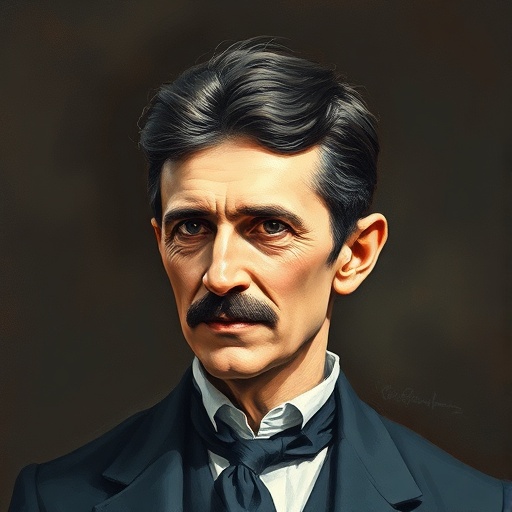
Nikola Tesla — "I have been so absorbed in my work that I have neglected my personal life."
I have been so absorbed in my work that I have neglected my personal life.
I have been so absorbed in my work that I have neglected my personal life.
Click any product to generate a realistic preview. Up to 3 at a time.
* Initial load can take up to 90 seconds — revising the preview in another color is nearly instant.
"Science is but a perversion of itself unless it has as its ultimate goal the betterment of humanity."
"My method is different. I do not rush into actual work. When I get an idea I start at once building it up in my imagination. I change the construction, make improvements, and operate the device entire…"
"Everyone should consider his body as a priceless gift from one whom he loves above all, a marvelous work of art, of indescribable beauty, and mystery beyond human conception, and so delicate that a wo…"
"I am unwilling to submit to any procedure for the determination of my mental condition."
"I have been called by some a visionary, by others a dreamer, but I am a practical man."
Serbian-American inventor and electrical engineer whose alternating-current designs powered the modern electrical grid; died poor and largely forgotten. Closely associated with George Westinghouse (his AC-power business partner) and Mihajlo Pupin (fellow Serbian-American physicist at Columbia). For an intellectual contrast, see Thomas Edison, American inventor and direct-current advocate — Edison's direct-current power-distribution scheme was displaced by Tesla-Westinghouse AC in the 1890s 'War of Currents'. Edison ran a public-relations campaign electrocuting animals to discredit AC — the most famous engineering-ethics rivalry in American history. Tesla's AC won and powers nearly every electrical grid on Earth.
Attributed, general sentiment about his dedication to science.
Date: Early 20th Century
WisdomFound in 1 providers: grok
1 source checked
When someone is so consumed by their work that personal relationships, health, and social life fall away, they're describing a life defined entirely by professional pursuit. This captures the cost of obsessive dedication — not as complaint but as observation. In modern terms, it's the experience of a workaholic who realizes their whole identity has collapsed into their career, leaving little room for love, friendship, or rest.
Tesla never married, remained celibate his entire life, and had almost no close personal relationships. He worked in isolation for long stretches, obsessing over AC power, wireless transmission, and the Tesla coil. His rivalry with Edison consumed him professionally. He died alone in Room 3327 of the Hotel New Yorker in 1943, nearly penniless. His journals reveal a man who found meaning only in discovery, treating human connection as a distraction from his mission.
The late 19th and early 20th centuries were defined by the Second Industrial Revolution — electricity, railroads, and factories remaking society at breathtaking speed. Inventors like Tesla operated in a winner-take-all environment where patents meant fortunes and rivals moved fast. The Protestant work ethic treated labor as a moral virtue, and scientific genius was increasingly romanticized. Personal sacrifice for professional greatness was seen not as a flaw but as the mark of a true pioneer.
AI-generated insights based on extensive research and information for context. Factual errors? Email [email protected].
Your cart is empty