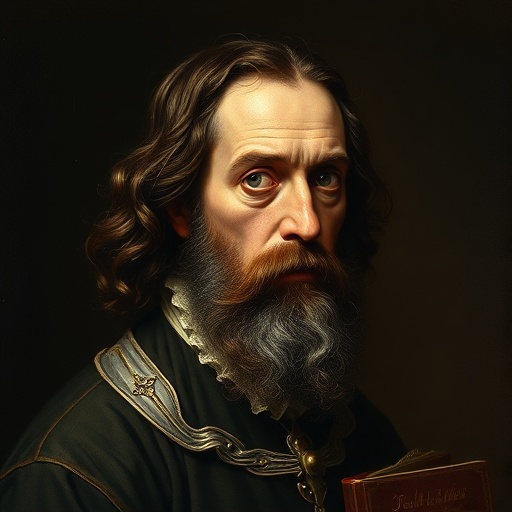
Johannes Kepler — "I have been tormented by the desire to understand the celestial motions."
I have been tormented by the desire to understand the celestial motions.
I have been tormented by the desire to understand the celestial motions.
Click any product to generate a realistic preview. Up to 3 at a time.
* Initial load can take up to 90 seconds — revising the preview in another color is nearly instant.
"I have been a scientist, and I have sought to understand the mysteries of the universe."
"I was measuring the heavens, now I must measure the shadows of the Earth. Though my soul was from the heavens, the shadow of my body lies here."
"The diversity of the phenomena of nature is so great, and the treasures hidden in the heavens so rich, precisely in order that the human mind shall never be lacking in fresh nourishment."
"The heavenly motions are nothing but a continuous song for several voices, perceived not by the ear but by the intellect."
"I have been a solitary man, but I have found joy in my work."
Found in 1 providers: grok
1 source checked
The speaker admits to an obsessive, almost painful drive to figure out how objects in the sky move. It is not casual curiosity but a consuming need that will not let them rest until the patterns behind planetary paths are uncovered. The word tormented signals real suffering, suggesting that the pursuit of this knowledge costs something personal, yet the speaker cannot abandon the question.
Kepler spent decades grinding through Tycho Brahe's raw Mars observations, reworking calculations hundreds of times before discovering that orbits are ellipses, not circles. He was a devout Lutheran who believed the heavens revealed divine geometry, and he endured religious exile, a mother tried for witchcraft, and chronic poverty. The word tormented fits a man whose three laws were wrung from genuine mathematical agony and unshakable conviction.
In the early 1600s, Europe was transitioning from Aristotelian-Ptolemaic cosmology to heliocentrism. Copernicus had proposed a sun-centered model, Galileo was aiming telescopes at Jupiter's moons, and the Thirty Years' War was tearing Protestant and Catholic lands apart. Church authority over natural philosophy remained dangerous, as Galileo's later trial would prove. Accurate planetary tables mattered for calendars, navigation, and astrology, giving Kepler's torment both scientific urgency and patronage value.
AI-generated insights based on extensive research and information for context. Factual errors? Email [email protected].
Your cart is empty