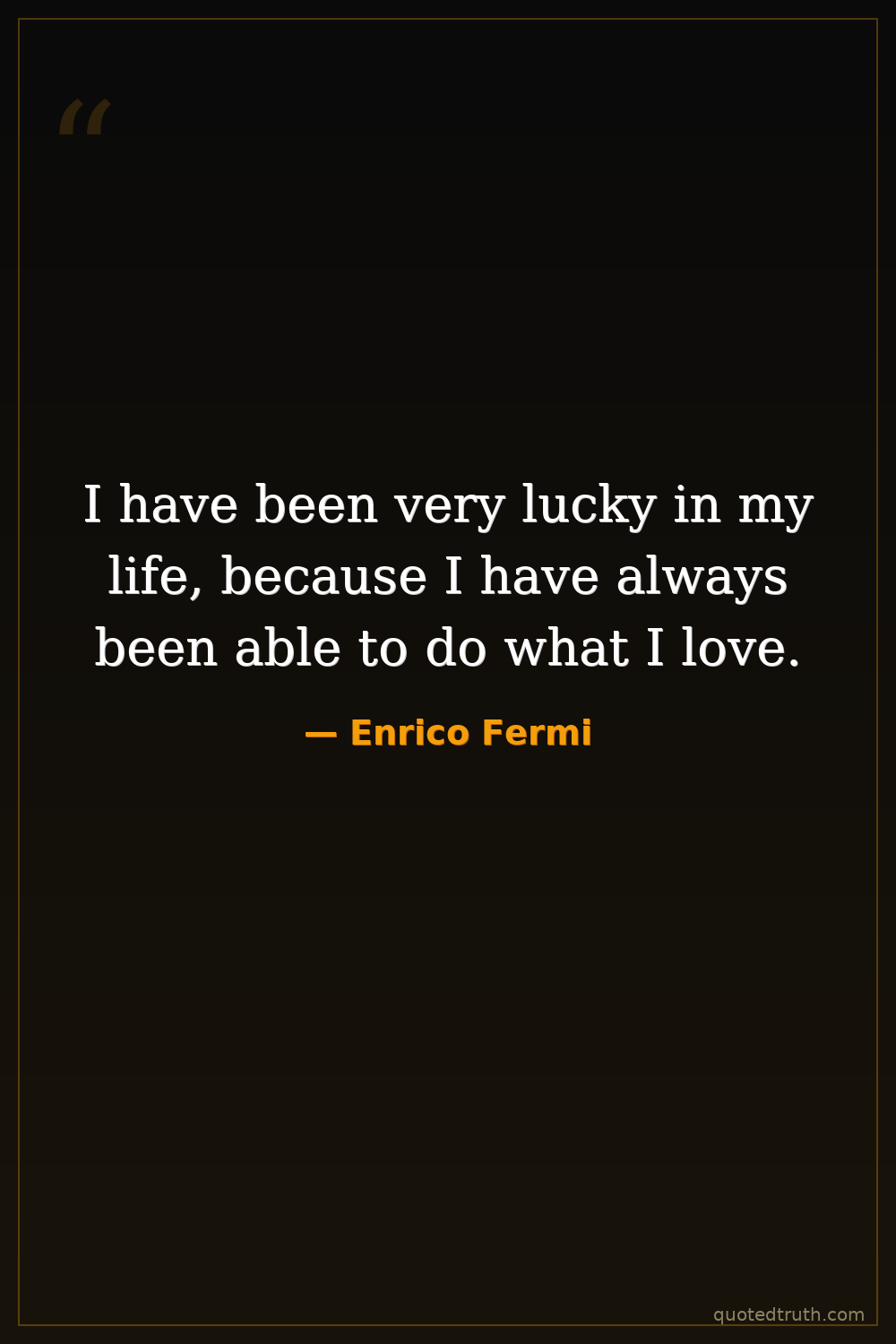
Enrico Fermi — "I have been very lucky in my life, because I have always been able to do what I …"
I have been very lucky in my life, because I have always been able to do what I love.
I have been very lucky in my life, because I have always been able to do what I love.
Click any product to generate a realistic preview. Up to 3 at a time.
* Initial load can take up to 90 seconds — revising the preview in another color is nearly instant.
"Don't ever do a calculation without knowing the answer."
"I remember my friend Johnny von Neumann used to say, 'with four parameters I can fit an elephant and with five I can make him wiggle his trunk.'"
"I consider myself a lucky man who did not have to choose between going to war and doing something else. I just did what I was doing."
"When asked what characteristics Nobel prize winning physicists had in common I cannot think of a single one not even intelligence."
"Before the war, I was doing pure physics. Now I am doing applied physics. But it is still physics."
Found in 1 providers: grok
1 source checked
Genuine fulfillment comes from spending your life doing work that excites you, not just work that pays. Most people endure careers out of necessity; Fermi recognizes that living otherwise—pursuing intellectual passion professionally—is genuinely rare. The word 'lucky' is key: he doesn't claim he earned this alignment through virtue alone, but acknowledges it as a gift, a convergence of circumstance, ability, and opportunity that most people never experience.
Fermi's love for physics began in his teenage years in Rome, where he taught himself advanced mathematics from library books. He produced groundbreaking work in both theory and experiment—an almost unheard-of combination. He built the first self-sustaining nuclear reactor under a Chicago stadium in 1942, won the 1938 Nobel Prize, and spent evenings teaching colleagues for pure joy. Physics wasn't his job; it was his nature.
Fermi worked during physics' golden age—roughly 1920s–1950s—when quantum mechanics and nuclear theory were rewriting humanity's understanding of matter. The Manhattan Project consumed his wartime years; atomic energy was simultaneously scientific triumph and existential threat. Scientists of his generation saw their pure intellectual passions reshape geopolitics and warfare. This tension between love of discovery and its consequences made gratitude for one's vocation a complicated, freighted sentiment.
AI-generated insights based on extensive research and information for context. Factual errors? Email [email protected].
Your cart is empty