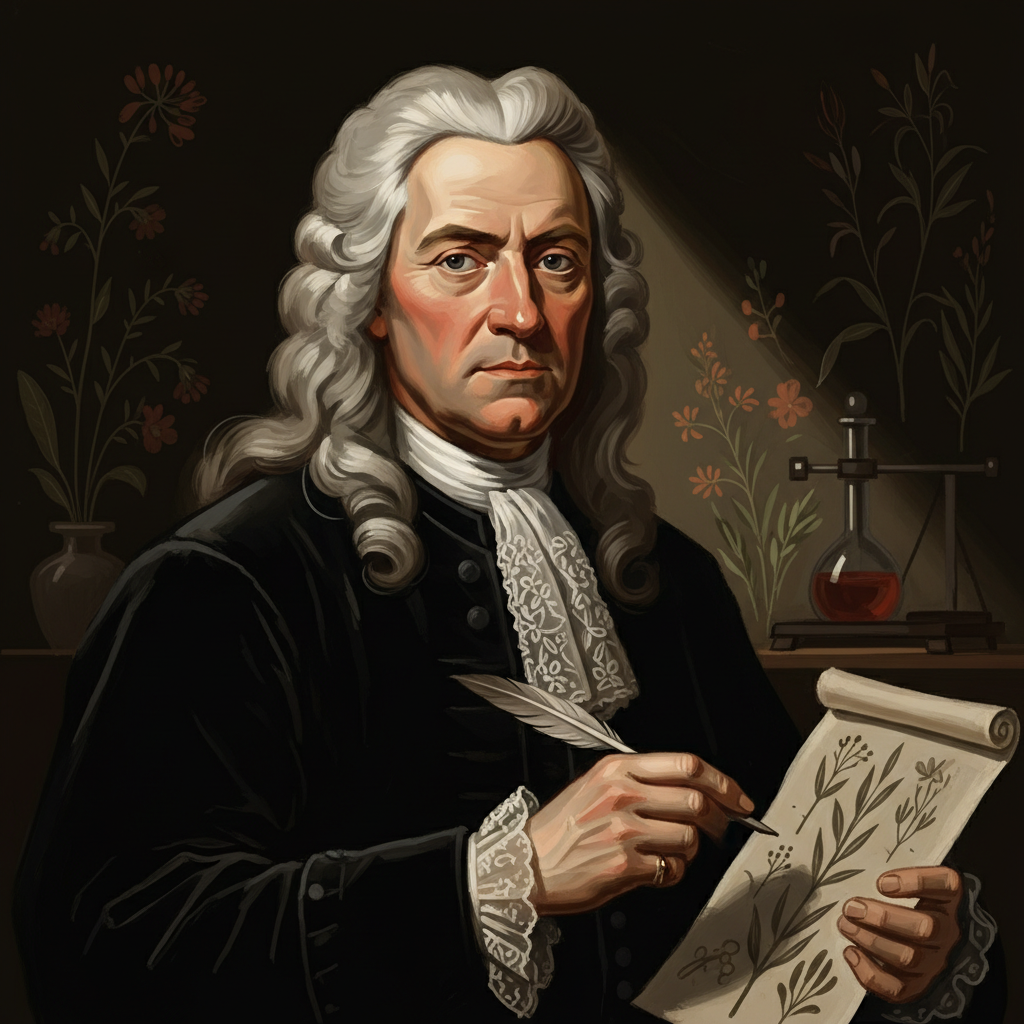
Carl Linnaeus — "I have classified all plants and animals."
I have classified all plants and animals.
I have classified all plants and animals.
Click any product to generate a realistic preview. Up to 3 at a time.
* Initial load can take up to 90 seconds — revising the preview in another color is nearly instant.
"Deus creavit, Linnaeus disposuit. (God created, Linnaeus arranged.)"
"I saw a monster today: a two-headed calf. It lived for only an hour, but I dissected it to see if God had given it two souls."
"The only way to know nature is to love it."
"I am not ashamed to confess that I am a man who loves flowers."
"If a tree were to be a god, it would be a god of solitude."
Swedish botanist and the father of modern taxonomy whose Systema Naturae (1735) introduced binomial nomenclature for naming all species. Closely associated with Joseph Banks (British naturalist who carried Linnaean classification on Cook's voyages). For an intellectual contrast, see Comte de Buffon, French naturalist and Histoire Naturelle author (1749-1788) — Buffon explicitly attacked Linnaean fixed-categories taxonomy as artificial and rejected the binomial system; his gradualist, environment-shaped natural history was the explicit alternative. Anticipates the fixed-species-vs-evolution debate Darwin would later resolve.
A statement of his monumental achievement, though work continued after him.
Date: c. 1770s
ShockingFound in 1 providers: grok
1 source checked
The speaker asserts complete mastery over nature's living diversity through systematic organization. It expresses confidence in human reason's ability to impose order on the natural world by grouping and naming every known organism. The claim reflects an Enlightenment conviction that nature, however vast, is fundamentally knowable and can be catalogued through careful observation and rational categorization.
Linnaeus literally spent his career doing exactly this—his Systema Naturae catalogued thousands of plant and animal species using binomial nomenclature, the naming system still used today. His obsessive fieldwork across Scandinavia and correspondence with naturalists worldwide fed his ambition to name every living thing. His confidence bordered on divine mandate; he reportedly said God created, Linnaeus organized.
The 18th century European Enlightenment placed supreme faith in reason and classification as tools of mastery over nature. Colonial expansion brought floods of unknown specimens to European scientists, creating urgent demand for organizing systems. Linnaeus worked precisely when naturalists faced an overwhelming influx of new organisms and lacked any standardized naming framework, making his taxonomic system a revolutionary intellectual achievement.
AI-generated insights based on extensive research and information for context. Factual errors? Email [email protected].
Your cart is empty