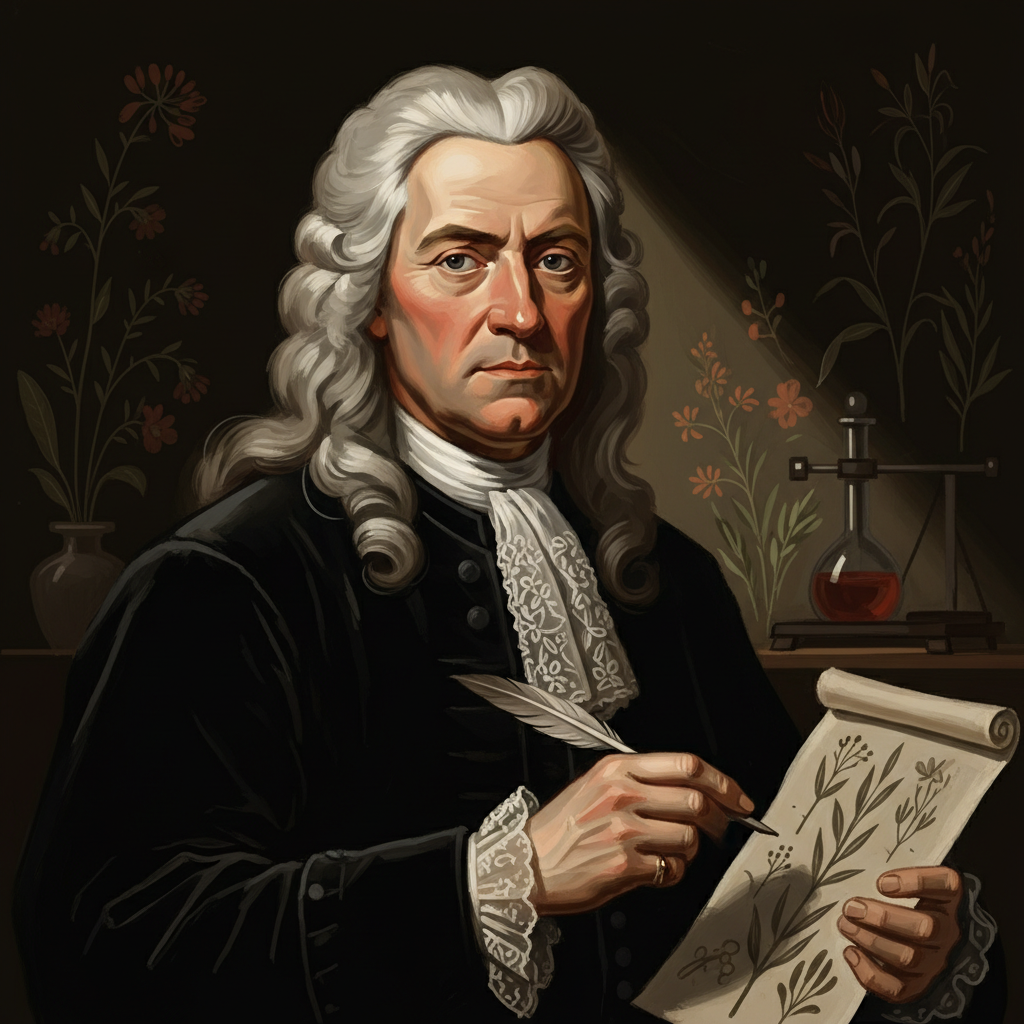
Carl Linnaeus — "I am not ashamed to confess that I am a man who loves flowers."
I am not ashamed to confess that I am a man who loves flowers.
I am not ashamed to confess that I am a man who loves flowers.
Click any product to generate a realistic preview. Up to 3 at a time.
* Initial load can take up to 90 seconds — revising the preview in another color is nearly instant.
"If a tree dies, plant another in its place."
"The aim of natural history is to know God in His works."
"Natura non facit saltus. (Nature makes no leaps.)"
"The greatest pleasure is to be found in the smallest things."
"The whole of natural history depends on the accurate knowledge of species."
Swedish botanist and the father of modern taxonomy whose Systema Naturae (1735) introduced binomial nomenclature for naming all species. Closely associated with Joseph Banks (British naturalist who carried Linnaean classification on Cook's voyages). For an intellectual contrast, see Comte de Buffon, French naturalist and Histoire Naturelle author (1749-1788) — Buffon explicitly attacked Linnaean fixed-categories taxonomy as artificial and rejected the binomial system; his gradualist, environment-shaped natural history was the explicit alternative. Anticipates the fixed-species-vs-evolution debate Darwin would later resolve.
A personal and endearing statement of his passion for botany.
Date: Uncertain (attributed)
Nature & WorldFound in 1 providers: gemini
1 source checked
This expresses unabashed passion for the natural world, specifically flowers. Linnaeus is declaring that his love of plants is not a weakness or trivial pursuit but something worth owning openly. In modern terms, it speaks to intellectual and emotional authenticity — embracing what genuinely drives you without social embarrassment, even when that passion might seem soft or insufficiently rigorous to outside critics.
Linnaeus devoted his life to cataloguing plants, creating binomial nomenclature, and classifying thousands of species. His attachment to flowers was literal and profound — he named genera after colleagues as honors, maintained botanical gardens, and wrote with evident delight in Philosophia Botanica. This confession reveals the genuine wonder underlying his systematic rigor; taxonomy for him was never cold classification but an expression of deep botanical love.
In 18th-century Enlightenment Europe, reason was prized over sentiment, and men of learning were expected to approach nature analytically. Botany straddled gentlemanly hobby and serious science, making an emotional confession slightly transgressive against pure rationalism. Yet botanical gardens were fashionable, specimen collecting was a gentleman's pursuit, and natural philosophy was ascending rapidly — so Linnaeus's admission landed as charming authenticity rather than intellectual weakness.
AI-generated insights based on extensive research and information for context. Factual errors? Email [email protected].
Your cart is empty