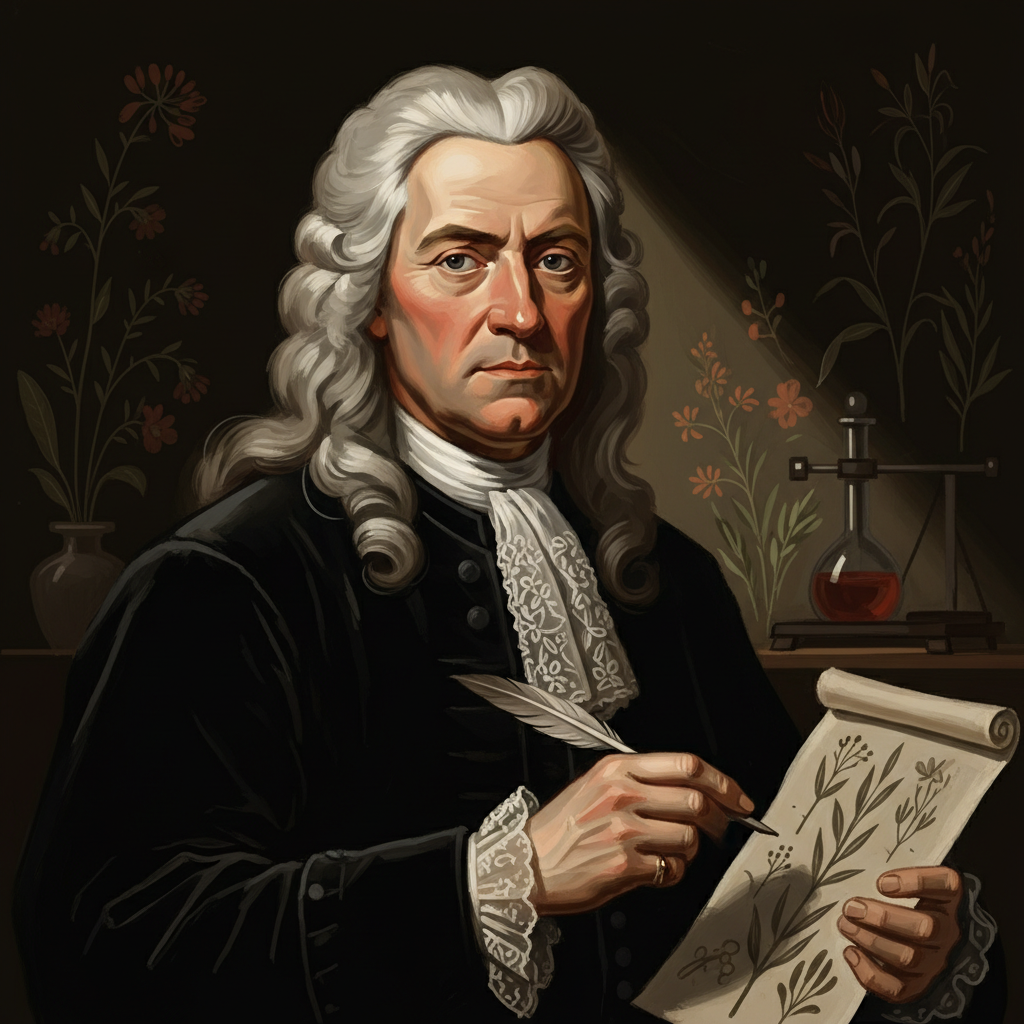
Carl Linnaeus — "The only way to know nature is to love it."
The only way to know nature is to love it.
The only way to know nature is to love it.
Click any product to generate a realistic preview. Up to 3 at a time.
* Initial load can take up to 90 seconds — revising the preview in another color is nearly instant.
"I am not ashamed to confess that I have learned much from women."
"Every plant is a book, which, if we want to understand, we must learn its language."
"It is not the business of a botanist to know all the plants, but to know how to find out what they are."
"When all the thoughts are concerning one thing and the person loses interest in other things, the melancholy begins."
"The Creator's wisdom is seen in the smallest insect as well as in the greatest elephant."
Swedish botanist and the father of modern taxonomy whose Systema Naturae (1735) introduced binomial nomenclature for naming all species. Closely associated with Joseph Banks (British naturalist who carried Linnaean classification on Cook's voyages). For an intellectual contrast, see Comte de Buffon, French naturalist and Histoire Naturelle author (1749-1788) — Buffon explicitly attacked Linnaean fixed-categories taxonomy as artificial and rejected the binomial system; his gradualist, environment-shaped natural history was the explicit alternative. Anticipates the fixed-species-vs-evolution debate Darwin would later resolve.
A philosophical statement on the emotional connection required for true understanding of nature.
Date: Uncertain (attributed)
Love & RelationshipsFound in 1 providers: gemini
1 source checked
True understanding of the natural world requires genuine passion and emotional connection, not just detached observation. When you love something, you pay closer attention, notice finer details, and develop intuitive insight that pure intellectual study alone cannot produce. Knowledge and feeling are inseparable—curiosity driven by love yields deeper comprehension than obligation or indifference ever could.
Linnaeus spent his life cataloging thousands of plant and animal species, famously walking through Lapland and European gardens with infectious enthusiasm. He described plants in near-romantic terms, naming species after botanists he admired. His binomial nomenclature system emerged from obsessive, joyful immersion in nature—not bureaucratic duty. Students flocked to his Uppsala lectures because his love for organisms was palpable and contagious.
The 18th-century Enlightenment prized systematic reason, but natural philosophy still blended wonder with science. Explorers returned from global voyages with exotic specimens, generating public excitement about nature's diversity. Linnaeus worked before strict disciplinary boundaries separated science from aesthetics. His era celebrated the 'naturalist' as someone whose emotional engagement with creation was considered a virtue, not a bias to overcome.
AI-generated insights based on extensive research and information for context. Factual errors? Email [email protected].
Your cart is empty