What it means
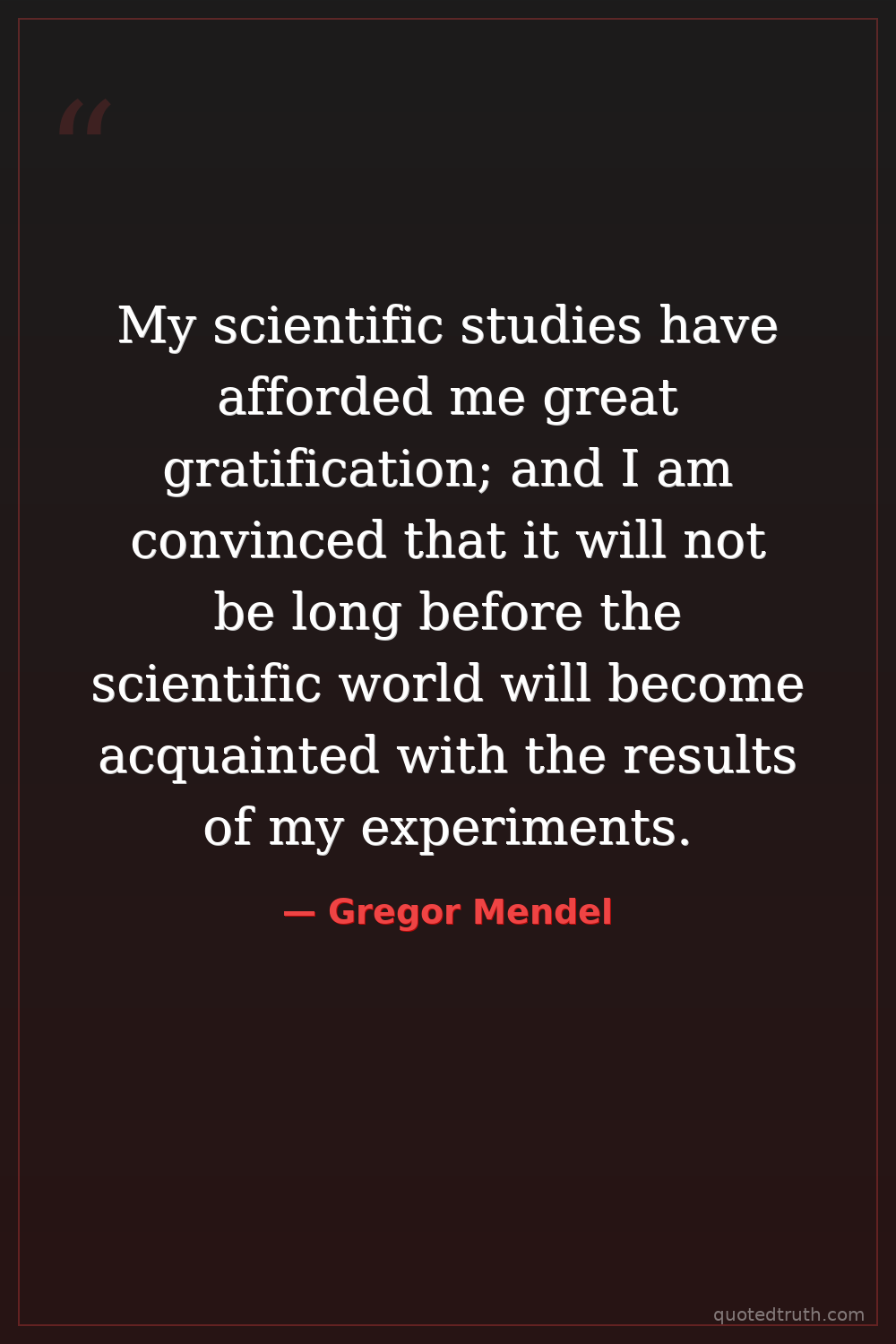
Mendel expresses two things simultaneously: deep personal satisfaction from conducting his research, and calm confidence that his findings will soon reach a wider scientific audience. He is not boasting but asserting that his work has inherent value the world will eventually recognize. It captures a scientist fulfilled by the discovery process itself, trusting that rigorous evidence will find its audience regardless of current indifference.
Relevance to Gregor Mendel
Mendel spent over a decade growing pea plants in a monastery garden, meticulously tracking hereditary traits across thousands of specimens. He published his findings in 1866 in a regional journal to near-total silence. He died in 1884 never witnessing recognition. His quiet confidence reflects a monk-scientist's temperament — patient, evidence-driven, unshaken by indifference. Tragically, his prediction came true only posthumously when his laws of heredity were rediscovered in 1900, sixteen years after his death.
The era
Mendel published in 1866, seven years after Darwin's On the Origin of Species ignited fierce debate about how biological traits are inherited. The scientific world lacked both vocabulary and statistical frameworks to appreciate his work — blending inheritance dominated, and quantitative genetics did not yet exist as a discipline. His mathematical approach to biology was decades ahead of contemporary practice, explaining why his paper sat largely unread in libraries across Europe for thirty-four years.
AI-generated insights based on extensive research and information for context. Factual errors? Email [email protected].