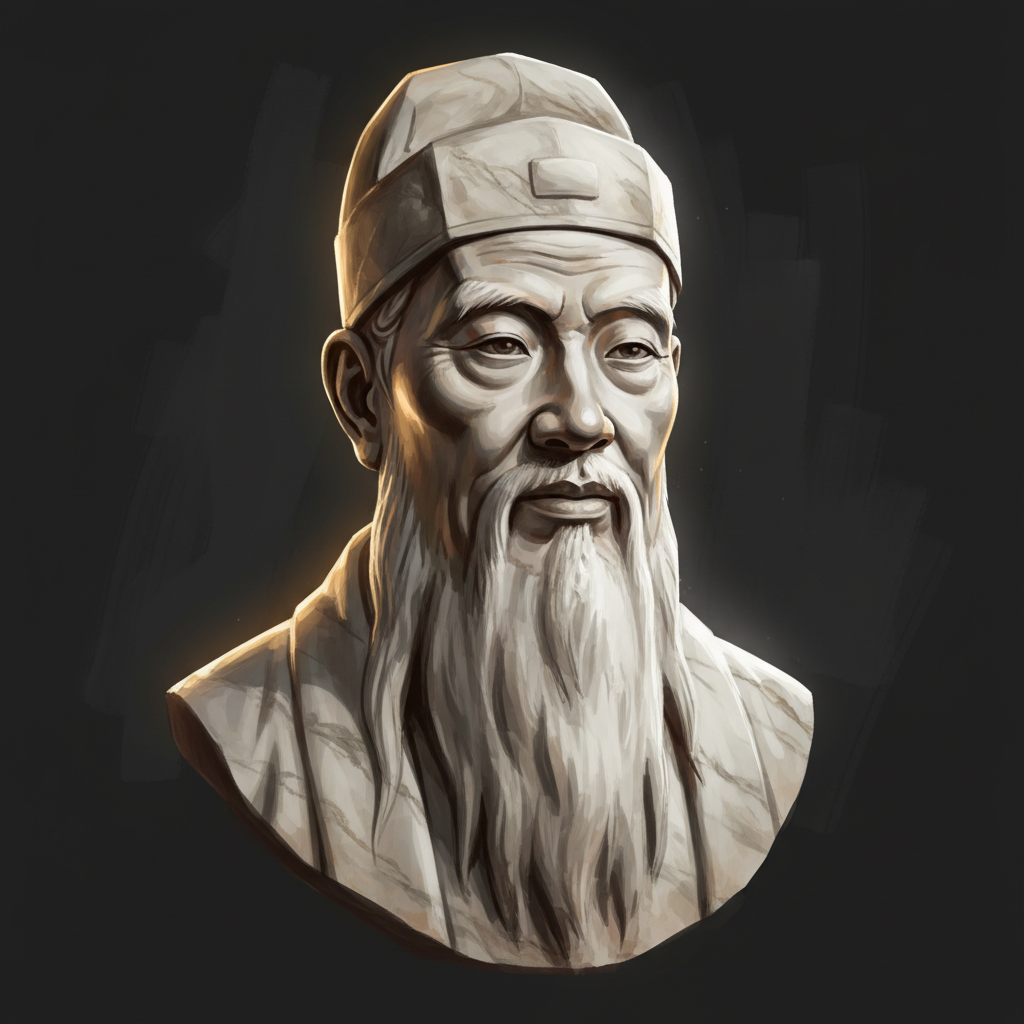
Confucius — "Is it not a pleasure, having learned something, to try it out at due intervals?"
Is it not a pleasure, having learned something, to try it out at due intervals?
Is it not a pleasure, having learned something, to try it out at due intervals?
Click any product to generate a realistic preview. Up to 3 at a time.
* Initial load can take up to 90 seconds — revising the preview in another color is nearly instant.
"The gentleman is not concerned that he is not acknowledged, but rather that he should do something worthy of being acknowledged."
"The noble-minded are calm and steady. Little people are forever fussing and fretting."
"Be strict with yourself but least reproachful of others and complaint is kept afar."
"The superior man is catholic and not partisan. The mean man is partisan and not catholic."
"To worship ancestors whom one does not know is to be presumptuous."
Chinese philosopher and teacher whose teachings (compiled by his students in the Analects) became the foundational ethical framework of East Asian civilization for 2,500 years. Closely associated with Mencius (his most-influential follower a century later). For an intellectual contrast, see Laozi, near-contemporary Chinese sage and Tao Te Ching author — Confucius systematized social order through ritual and family hierarchy; Laozi's Taoist effortless-action philosophy argued such systems were the disease, not the cure. The two founding poles of Chinese moral philosophy — every East Asian moral tradition since has positioned itself between them.
The standard scholarly entry points to Confucius's work: Philip J. Ivanhoe (Georgetown, Chinese philosophy) — Confucian Moral Self Cultivation (2000); Edward Slingerland (UBC, Asian Studies) — Effortless Action: Wu-wei as Conceptual Metaphor (2003); Tu Weiming (Harvard, Confucian scholar) — Confucian Thought: Selfhood as Creative Transformation (1985). These are the works graduate seminars cite when teaching Confucius.
Found in 1 providers: grok
1 source checked
Learning becomes truly satisfying when you actually put what you've learned into practice, revisiting and applying it regularly. Mere acquisition of knowledge is incomplete; the deeper joy comes from testing ideas in real situations, refining them through use, and making them part of how you live and work. Repetition at sensible intervals cements understanding and turns abstract lessons into practical skill.
Confucius built his legacy as a teacher who insisted knowledge must shape conduct. He ran one of the earliest private schools, taking students regardless of class, and treated moral cultivation as a daily practice. This line opens the Analects because it captures his core conviction: study paired with active application produces a virtuous person. He lived it himself, reviewing rituals, music, and ethics constantly through his career as adviser and traveling teacher.
Confucius lived roughly 551-479 BCE during the Spring and Autumn period, when the Zhou dynasty's authority was collapsing and rival states fought constantly. Old rituals and social bonds were fraying, and literacy was confined mostly to aristocrats. Against that disorder, Confucius promoted disciplined self-cultivation and revival of ancient virtues as the cure. Opening his teachings with delight in learning was pointed: it framed education as a path out of chaos, accessible beyond noble birth.
AI-generated insights based on extensive research and information for context. Factual errors? Email [email protected].
Your cart is empty