What it means
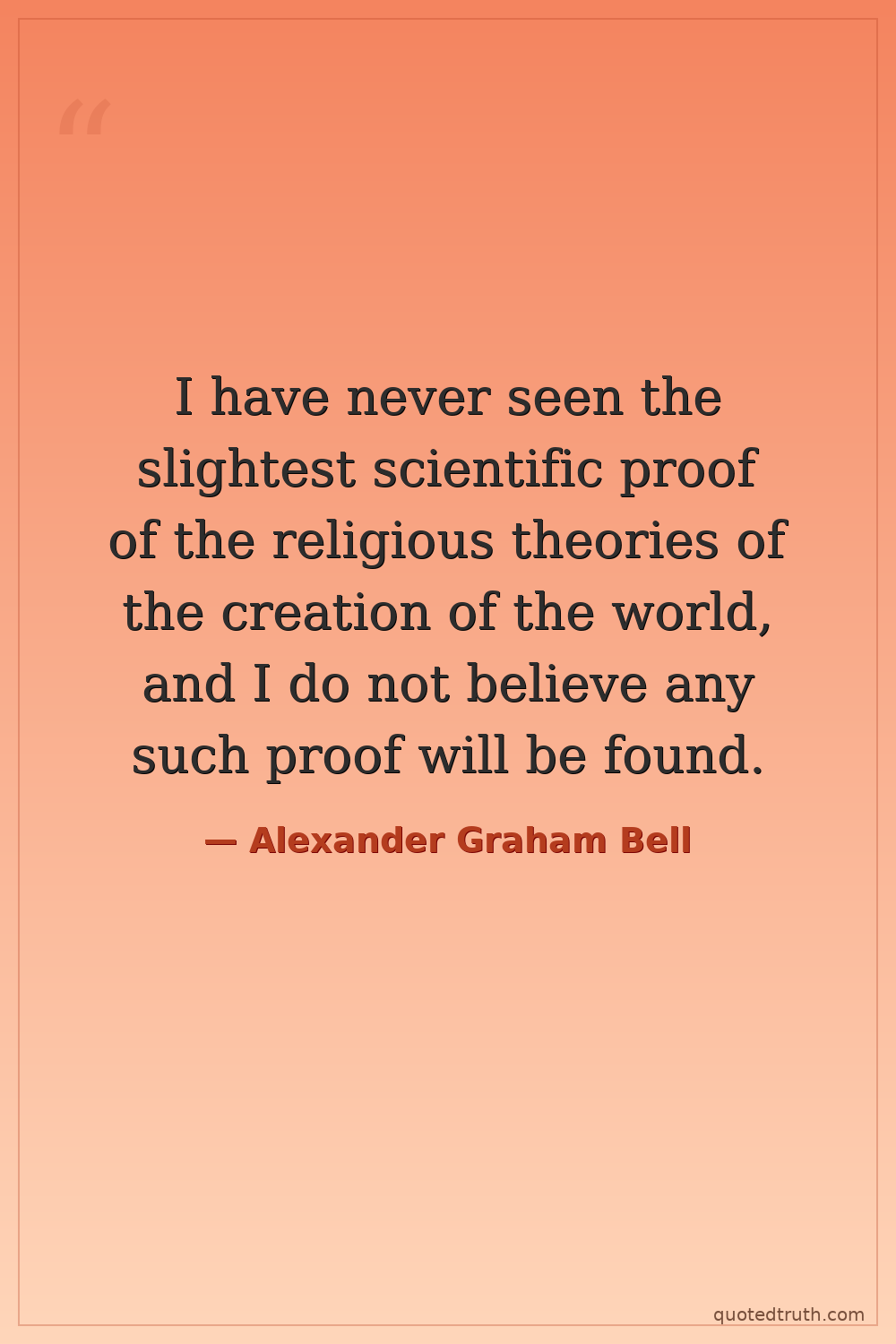
Bell states plainly that no scientific evidence supports religious accounts of how the world was created, and he doubts any will ever emerge. He isn't attacking religion broadly — he's drawing a hard boundary: the physical origins of the universe fall within science's domain, and scripture provides no empirical proof. It reflects a rationalist demand that extraordinary claims require verifiable evidence, rejecting faith-based cosmology as inadequate explanation for observable reality.
Relevance to Alexander Graham Bell
Bell's entire career rested on the scientific method — he invented the telephone through systematic experimentation, not intuition. His mother and wife were both deaf, grounding him in practical, evidence-based problem-solving from childhood. He also worked closely with the deaf community through education, demanding measurable results. A man who proved every hypothesis in the lab naturally applied the same standard to cosmological claims: show me the evidence. His skepticism here is an extension of his professional identity.
The era
Bell's productive years coincided with science's most aggressive challenge to religious cosmology. Darwin's theory of evolution had upended biblical accounts of life's origins. Geology established Earth's ancient age, contradicting Genesis timelines. Physics and chemistry revealed natural mechanisms behind phenomena once attributed to divine intervention. The conflict between scientific naturalism and religious creation accounts was the era's defining intellectual battleground, with educated figures increasingly expected to take sides. Bell's statement reflects where serious scientific minds landed.
AI-generated insights based on extensive research and information for context. Factual errors? Email [email protected].