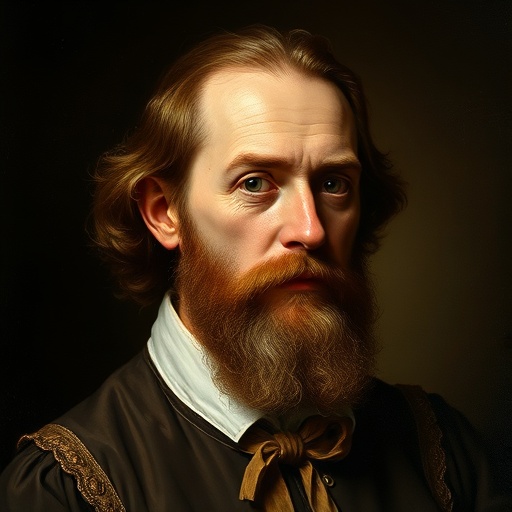
William Harvey — "It is by experiment alone that we can arrive at the knowledge of nature."
It is by experiment alone that we can arrive at the knowledge of nature.
It is by experiment alone that we can arrive at the knowledge of nature.
Click any product to generate a realistic preview. Up to 3 at a time.
* Initial load can take up to 90 seconds — revising the preview in another color is nearly instant.
"The motion of the blood is in a circle, and is in truth perpetual."
"The most important thing in life is to be useful."
"The physician must be a man of experience."
"I have often wondered, and indeed not a little, at the great difference of opinion among anatomists and physicians in the matter of the pulse and the motion of the heart."
"The heart itself is the first to live and the last to die."
English physician whose On the Motion of the Heart and Blood in Animals (1628) demonstrated blood circulation, overturning 1,400 years of Galenic medicine. Closely associated with Francis Bacon (his contemporary in the new English empiricism). For an intellectual contrast, see Galenic medicine, the 2nd-century Greek medical tradition (humors, blood-as-consumed-fuel) — Harvey calculated that the heart pumps more blood per hour than the body could possibly produce as fuel — a single quantitative observation that demolished the entire Galenic-Aristotelian medical worldview. The cleanest example in medical history of arithmetic disproving 14 centuries of authority.
Found in 1 providers: grok
1 source checked
Knowledge of nature can only be achieved through direct experimentation and observation, not through inherited authority or theoretical speculation alone. True understanding requires testing ideas against reality, measuring outcomes, and letting evidence determine what is true. Abstract reasoning divorced from empirical investigation leads nowhere; hands-on inquiry is the only reliable path to discovering how the natural world actually works.
Harvey embodied this principle completely. His discovery of blood circulation came not from accepting Galen's centuries-old anatomical theories but from systematic dissection, vivisection, and quantitative measurement. He calculated that the heart pumps too much blood for the liver to constantly produce it, proving circulation through logic grounded in experimental observation — a radical empirical approach that defined his entire career.
Harvey worked during the Scientific Revolution, when European thinkers were dismantling Aristotelian and Galenic authority that had dominated medicine for over a millennium. Figures like Galileo and Bacon were simultaneously championing empiricism and inductive reasoning. Medical faculties still taught ancient texts as gospel, making Harvey's insistence on experiment over inherited dogma genuinely controversial and professionally risky in early 17th-century England.
AI-generated insights based on extensive research and information for context. Factual errors? Email [email protected].
Your cart is empty