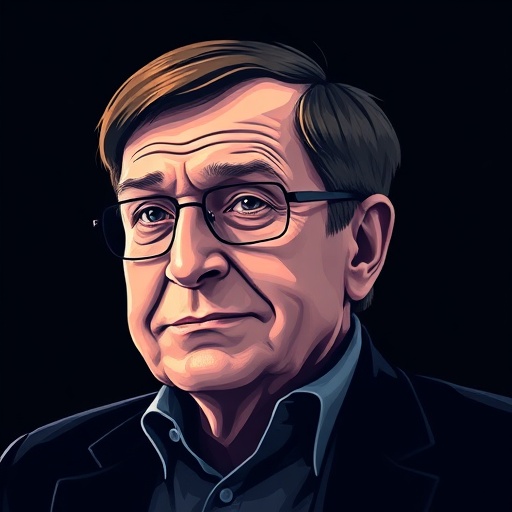
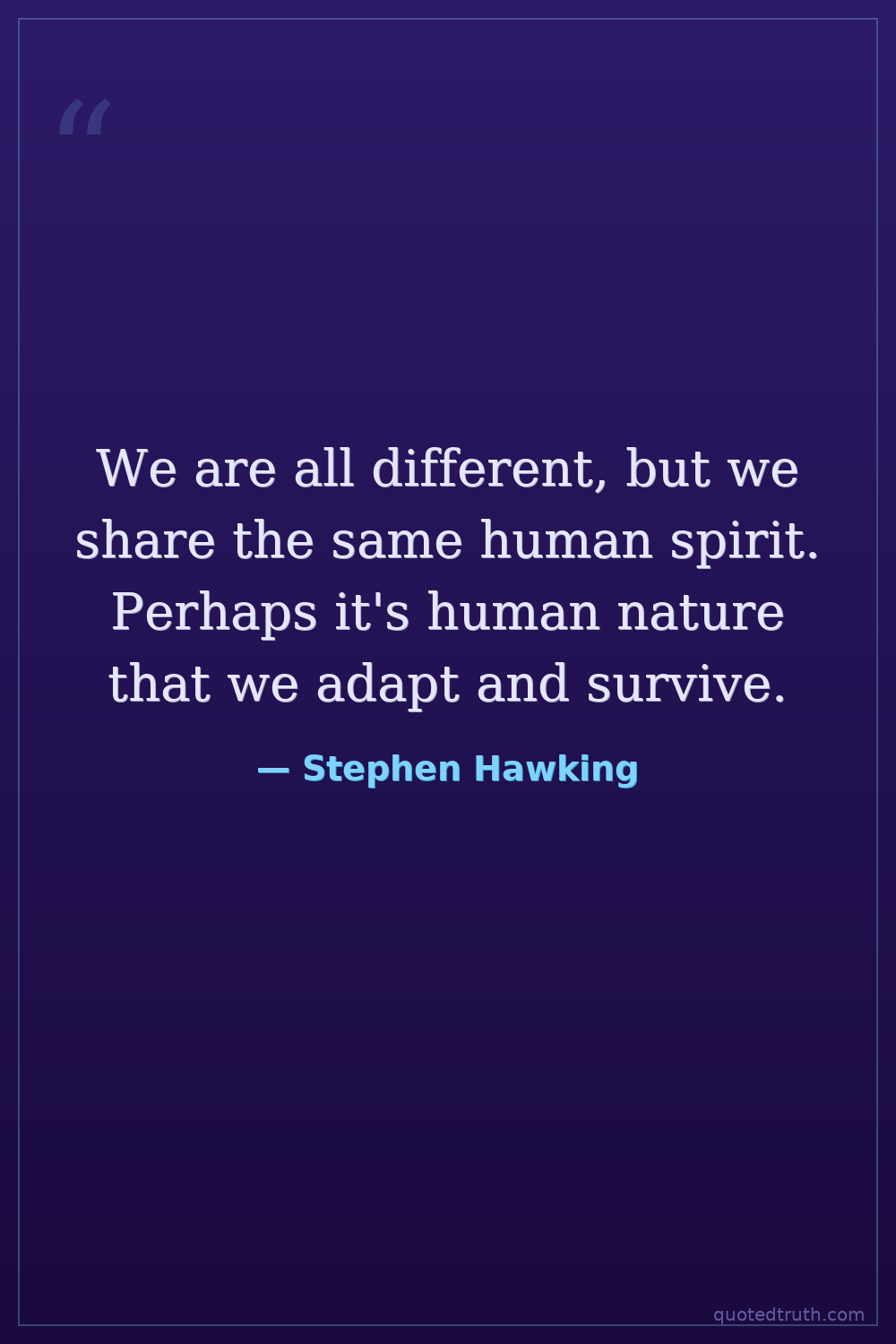
Stephen Hawking — "We are all different, but we share the same human spirit. Perhaps it's human nat…"
We are all different, but we share the same human spirit. Perhaps it's human nature that we adapt and survive.
We are all different, but we share the same human spirit. Perhaps it's human nature that we adapt and survive.
Click any product to generate a realistic preview. Up to 3 at a time.
* Initial load can take up to 90 seconds — revising the preview in another color is nearly instant.
"God did not create the universe and does not direct our fate."
"I regard the brain as a computer which will stop working when its components fail. There is no heaven or afterlife for broken-down computers; that is a fairy story for people afraid of the dark."
"The human race is just a chemical scum on a moderate-sized planet, orbiting a very average star in the outer suburb of one among a hundred billion galaxies. We are so insignificant that I can't believ…"
"The universe is a symphony of mathematical harmonies."
"The universe is a place of infinite beauty and mystery."
British theoretical physicist whose Hawking radiation work and A Brief History of Time (1988) brought black-hole physics to a mass audience while he lived with ALS for 55 years. Closely associated with Roger Penrose (his collaborator on singularity theorems) and Carl Sagan (fellow popularizer who wrote Brief History's foreword). For an intellectual contrast, see William Lane Craig, American philosopher of religion — Craig's Kalam cosmological argument depends on the Big Bang requiring a divine first cause; Hawking's no-boundary proposal was specifically designed to remove the moment that would require one — the cleanest cosmology-vs-natural-theology contrast in modern thought.
Found in 1 providers: grok
1 source checked
Despite our vast differences in background, ability, and circumstance, something fundamental connects all people. Survival and adaptation aren't special traits belonging to some — they're woven into what humans are. When faced with hardship, limitation, or change, people find ways to endure. This isn't heroism reserved for the exceptional; it's a baseline quality of the species itself.
Hawking lived this principle entirely. Diagnosed with ALS at 21 and given two years to live, he survived decades, revolutionized theoretical physics while completely paralyzed, and communicated through a speech synthesizer. He refused to frame his disability as tragedy. His career — publishing landmark work on black holes and cosmology from a wheelchair — embodied adaptation as intellectual and physical reality simultaneously.
Hawking's most productive decades spanned the Cold War's end, the disability rights movement's rise, and the emergence of global communication technology. The 1990s saw the Americans with Disabilities Act and growing awareness of inclusion. Assistive technology advanced dramatically. His words carried weight in an era actively reconsidering what 'normal' human capability meant and who deserved full participation in scientific and public life.
AI-generated insights based on extensive research and information for context. Factual errors? Email [email protected].
Your cart is empty