What it means
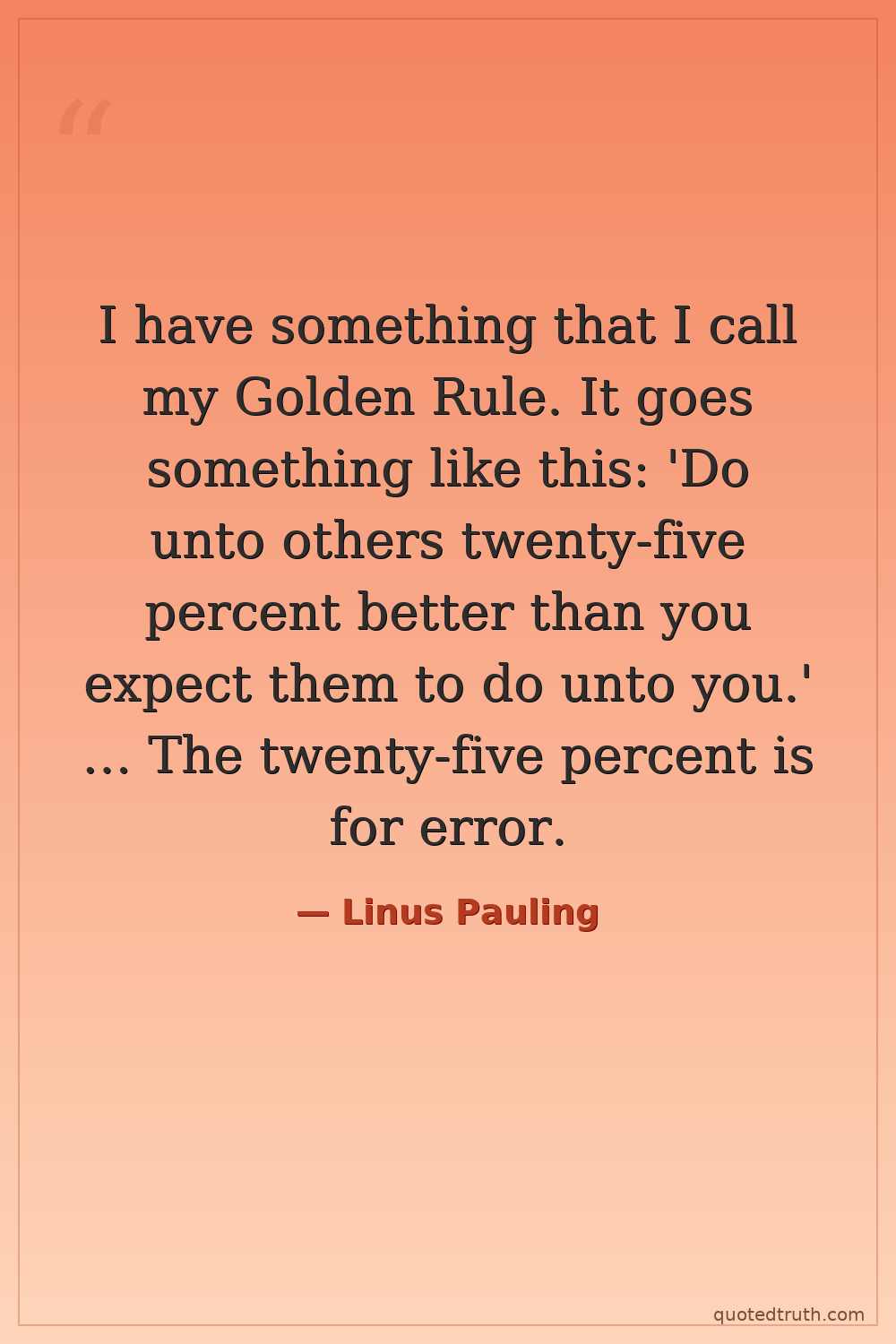
The quote updates the Golden Rule with a scientist's margin-of-error logic. Humans consistently misjudge their own treatment of others—rationalizing selfishness or underestimating slights they deliver—so Pauling proposes a deliberate 25% surplus of goodwill to correct for that bias. Practical altruism: don't aim for exact reciprocity, aim above it, because your calibration is off. The buffer absorbs human error and lands actual behavior closer to genuine fairness.
Relevance to Linus Pauling
Pauling won unshared Nobel Prizes in both Chemistry (1954) and Peace (1962)—the only person ever to do so. His chemical bond research demanded exact measurement and error quantification; his peace activism required giving far more than institutions returned, especially after the State Department revoked his passport during McCarthyism. Applying laboratory precision to personal ethics—treating moral behavior as a measurement requiring deliberate error correction—is characteristically Pauling.
The era
Pauling developed this framework during the Cold War, when nuclear arms racing made reciprocal distrust an existential risk. His 1962 Peace Prize followed years of anti-nuclear campaigning—the Partial Test Ban Treaty, the Russell-Einstein Manifesto—in an era when governments delivered far less decency than citizens demanded. McCarthyism punished those who overinvested in principle. His 25% rule argued quietly: history shows humans underdeliver on goodwill, so plan accordingly.
AI-generated insights based on extensive research and information for context. Factual errors? Email [email protected].