What it means
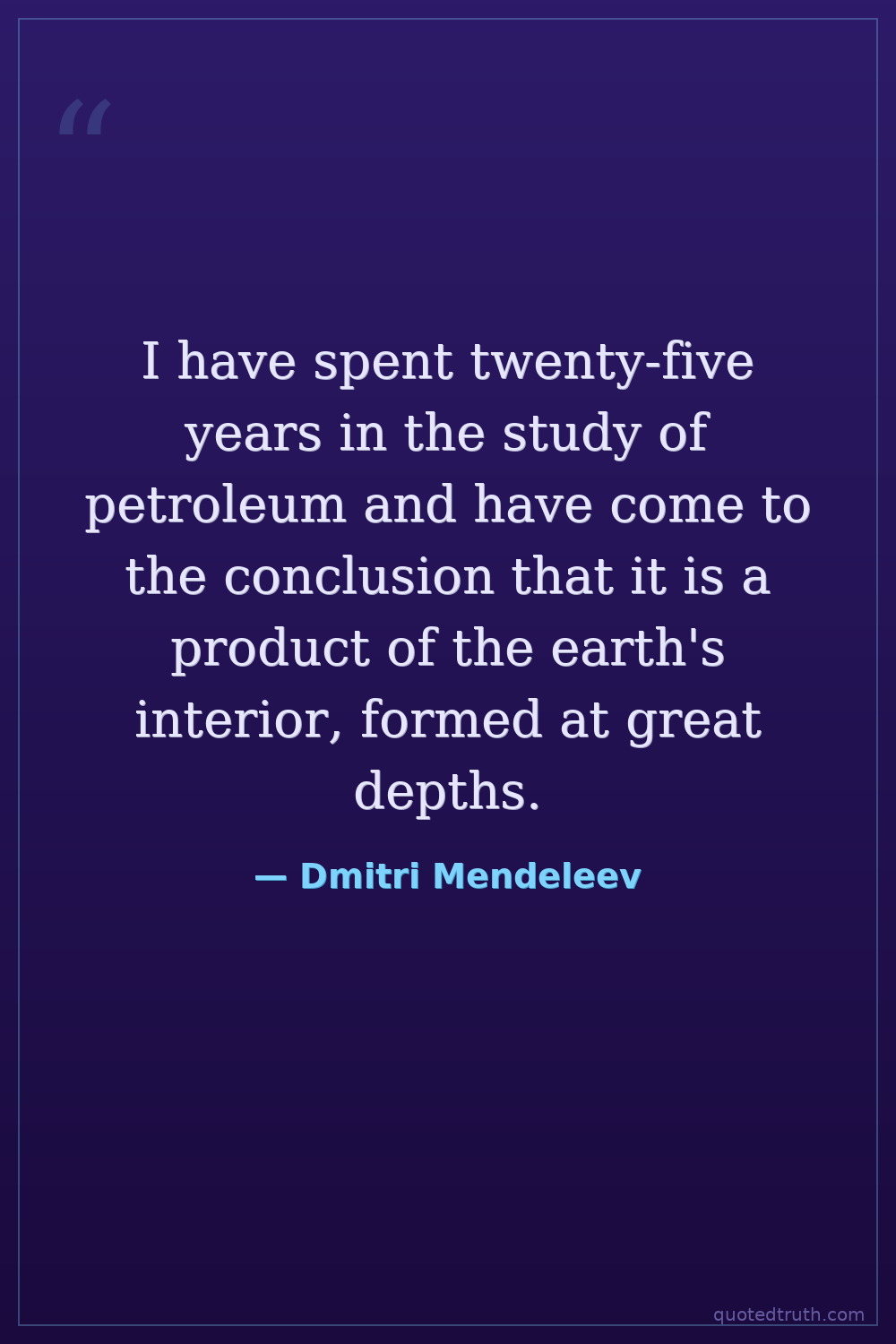
After a quarter century studying petroleum, the speaker concludes oil is not the squeezed remains of ancient plants and animals but something generated deep inside the Earth itself. In other words, he argues oil forms from inorganic processes at great depth, then migrates upward into the reservoirs we drill. It is a firm rejection of the biological origin story in favor of a geological, planetary one.
Relevance to Dmitri Mendeleev
Mendeleev was not only the chemist who organized the periodic table but also a tireless industrial consultant who toured the oilfields of Baku and Pennsylvania. His chemistry-first instinct pushed him to propose the abiogenic theory of petroleum: hydrocarbons forming when water reacts with metal carbides deep underground. The quote captures his characteristic pattern, patient empirical study followed by a sweeping theoretical claim that cut against prevailing opinion.
The era
In the late 1800s, kerosene lamps lit the world and Russia's Baku fields rivaled Pennsylvania's as petroleum became a strategic commodity. Geologists largely backed the organic theory, yet the planet's interior was still speculative territory. Mendeleev's government advisory work on tariffs, refining, and pipelines gave him access to raw field data, and his abiogenic argument fit a broader Russian scientific tradition that treated Earth's deep chemistry as an active, generative system.
AI-generated insights based on extensive research and information for context. Factual errors? Email [email protected].