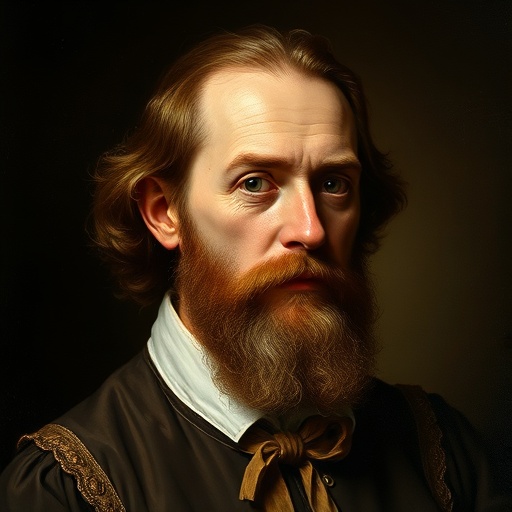
William Harvey — "I hold that the motion of the blood is in a circle, and is constantly impelled a…"
I hold that the motion of the blood is in a circle, and is constantly impelled and distributed by the pulsific action of the heart.
I hold that the motion of the blood is in a circle, and is constantly impelled and distributed by the pulsific action of the heart.
Click any product to generate a realistic preview. Up to 3 at a time.
* Initial load can take up to 90 seconds — revising the preview in another color is nearly instant.
"The physician must be a philosopher, for there is not so great a difference between them."
"The art of medicine is to be learned only by experience and observation."
"It is not the strongest of the species that survives, nor the most intelligent, but the one most responsive to change."
"The whole world is a theatre, and all the men and women merely players."
"The blood, in truth, is the fountain of life, the first to move and the last to rest."
English physician whose On the Motion of the Heart and Blood in Animals (1628) demonstrated blood circulation, overturning 1,400 years of Galenic medicine. Closely associated with Francis Bacon (his contemporary in the new English empiricism). For an intellectual contrast, see Galenic medicine, the 2nd-century Greek medical tradition (humors, blood-as-consumed-fuel) — Harvey calculated that the heart pumps more blood per hour than the body could possibly produce as fuel — a single quantitative observation that demolished the entire Galenic-Aristotelian medical worldview. The cleanest example in medical history of arithmetic disproving 14 centuries of authority.
The central thesis of 'De Motu Cordis' (1628), a revolutionary scientific discovery with philosophical implications for understanding the body as a machine.
Date: 1628
PhilosophicalFound in 1 providers: gemini
1 source checked
Blood doesn't pool or get consumed — it moves continuously in a closed loop, driven by the heart's rhythmic contractions. Every beat pushes blood outward through the body, which then returns and recirculates. Harvey is asserting a mechanical, repeating cycle rather than a one-way flow or constant liver-based production, replacing the ancient idea that organs simply use up blood as it passes through them once.
Harvey spent decades dissecting animals and humans, using mathematical calculations of blood volume to prove the liver couldn't produce blood fast enough to match what the heart pumps each hour. Published in De Motu Cordis in 1628, this thesis defined his entire career. As physician to Kings James I and Charles I, he risked professional destruction by overturning the Galenic framework every European physician had been trained under for fourteen centuries.
In early 1600s Europe, Galen's fourteen-hundred-year-old model dominated medicine — blood was produced in the liver, flowed one-way through veins, and was consumed by organs. The Scientific Revolution was dismantling ancient authorities: Vesalius had reformed anatomy, Galileo was quantifying motion. Harvey applied the same empirical, quantitative reasoning to physiology, making his circular-flow claim not just medically revolutionary but a landmark moment in the broader shift from scholastic authority to experimental science.
AI-generated insights based on extensive research and information for context. Factual errors? Email [email protected].
Your cart is empty