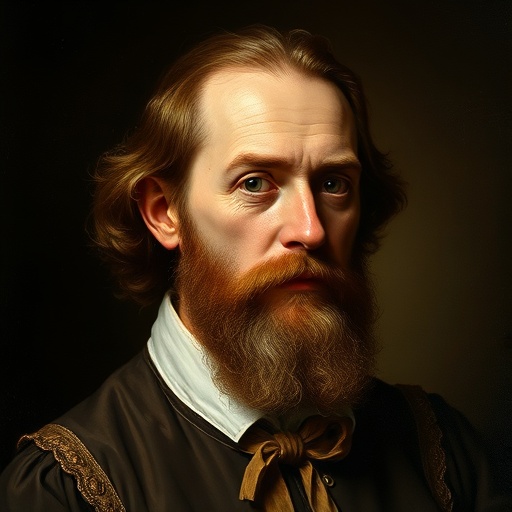
William Harvey — "The art of medicine is to be learned only by experience and observation."
The art of medicine is to be learned only by experience and observation.
The art of medicine is to be learned only by experience and observation.
Click any product to generate a realistic preview. Up to 3 at a time.
* Initial load can take up to 90 seconds — revising the preview in another color is nearly instant.
"The animal's heart is the basis of its life, its chief member, the sun of its microcosm; on the heart all its activity depends, from the heart all its liveliness and strength arise. Equally is the kin…"
"It is not by words, but by facts and arguments, that we must seek for truth."
"The greatest pleasure is to be found in the contemplation of truth."
"All animals, even man himself, are produced from an egg."
"Nature is nowhere accustomed to exhibit herself more openly than in her failures."
English physician whose On the Motion of the Heart and Blood in Animals (1628) demonstrated blood circulation, overturning 1,400 years of Galenic medicine. Closely associated with Francis Bacon (his contemporary in the new English empiricism). For an intellectual contrast, see Galenic medicine, the 2nd-century Greek medical tradition (humors, blood-as-consumed-fuel) — Harvey calculated that the heart pumps more blood per hour than the body could possibly produce as fuel — a single quantitative observation that demolished the entire Galenic-Aristotelian medical worldview. The cleanest example in medical history of arithmetic disproving 14 centuries of authority.
Reinforcing his empiricist approach to medical education and practice.
Date: 17th Century
PhilosophicalFound in 1 providers: gemini
1 source checked
Medicine cannot be mastered through books or inherited wisdom alone—only direct practice and careful watching of real patients and phenomena produces genuine knowledge. This champions empiricism: theory means nothing unless tested against reality. A physician must observe, measure, and draw conclusions from what actually happens, not from what authorities decree. True medical understanding accumulates through experience, not memorization of texts.
Harvey's discovery of blood circulation emerged entirely from dissections, vivisections, and quantitative calculations—not Galenic texts. Working as physician at St. Bartholomew's Hospital and serving kings James I and Charles I, he spent years watching hearts beat in living animals. He rejected 1,400 years of accepted doctrine because his eyes contradicted it. This quote is his professional creed: what you observe supersedes what you inherit.
In Harvey's early modern era, European medicine still deferred to Galen's 2nd-century writings as near-sacred authority. Universities taught medicine through text commentary, not autopsy or experiment. The Scientific Revolution—Bacon's empiricism, Galileo's telescopic observations—was challenging this orthodoxy, but medicine lagged. Harvey published De Motu Cordis in 1628 during this turning point, when the legitimacy of observation over ancient authority was fiercely contested across European intellectual life.
AI-generated insights based on extensive research and information for context. Factual errors? Email [email protected].
Your cart is empty