Tim Berners-Lee — "I just had to take the hypertext idea and connect it to the TCP and DNS ideas an…"
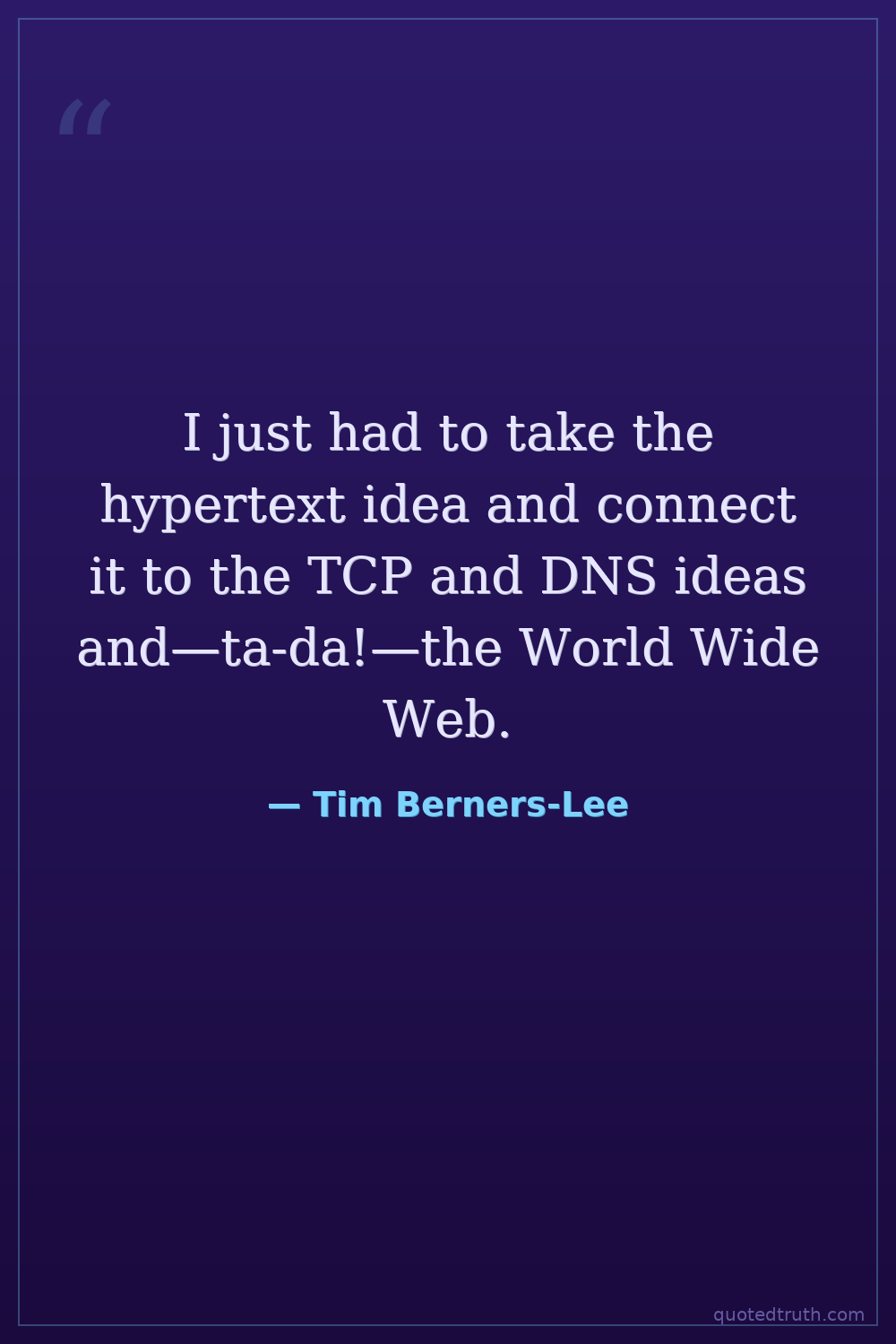
I just had to take the hypertext idea and connect it to the TCP and DNS ideas and—ta-da!—the World Wide Web.
I just had to take the hypertext idea and connect it to the TCP and DNS ideas and—ta-da!—the World Wide Web.
Click any product to generate a realistic preview. Up to 3 at a time.
* Initial load can take up to 90 seconds — revising the preview in another color is nearly instant.
"I'm not a fan of the term 'Web 2.0.' It implies that the web is a finished product, which it's not."
"I'm still dreaming of a web where everything is linked, where all information is connected."
"Centralization of the web gives too much power to a few companies. This is dangerous."
"I never thought the web would grow to be this big. It's amazing."
"The web is a fundamental right, like clean water and education."
British computer scientist who invented the World Wide Web at CERN in 1989 and founded the W3C, championing open web standards. Closely associated with Vint Cerf (TCP/IP co-creator and 'father of the internet') and Marc Andreessen (Mosaic browser creator and Netscape co-founder). For an intellectual contrast, see Mark Zuckerberg, Facebook (Meta) founder — Zuckerberg's walled-garden Facebook is the canonical contemporary opposite of Berners-Lee's open-web vision; Berners-Lee's Solid project and 'recapture the web' essays are explicitly written as a rebuttal to the platform-monopoly model Facebook pioneered.
Found in 1 providers: deepseek
1 source checked
Creating the Web required combining existing technologies—hypertext (linked documents), TCP (internet communication protocol), and DNS (address system)—rather than inventing everything from scratch. The casual 'ta-da' deliberately understates a monumental achievement, suggesting that synthesis and connection of existing ideas can produce transformative innovation, and that the greatest breakthroughs sometimes emerge from recombining what already exists rather than pure invention.
Berners-Lee proposed the Web in 1989 while working at CERN, building on Ted Nelson's hypertext concept and the existing internet infrastructure. His genius lay in integration, not isolated invention. This quote reflects his characteristic modesty—he consistently deflected credit, open-sourced the Web without patent, and later championed it as a public good through the World Wide Web Consortium he founded.
In the late 1980s, the internet existed but was fragmented and inaccessible to ordinary users—primarily academics and military personnel navigating command-line systems. Hypertext existed theoretically; TCP/IP had standardized network communication. Berners-Lee wrote his proposal in 1989 as the Cold War ended, moments before the information age explosion. His synthesis arrived precisely when global connectivity became both technically feasible and historically urgent.
AI-generated insights based on extensive research and information for context. Factual errors? Email [email protected].
Your cart is empty