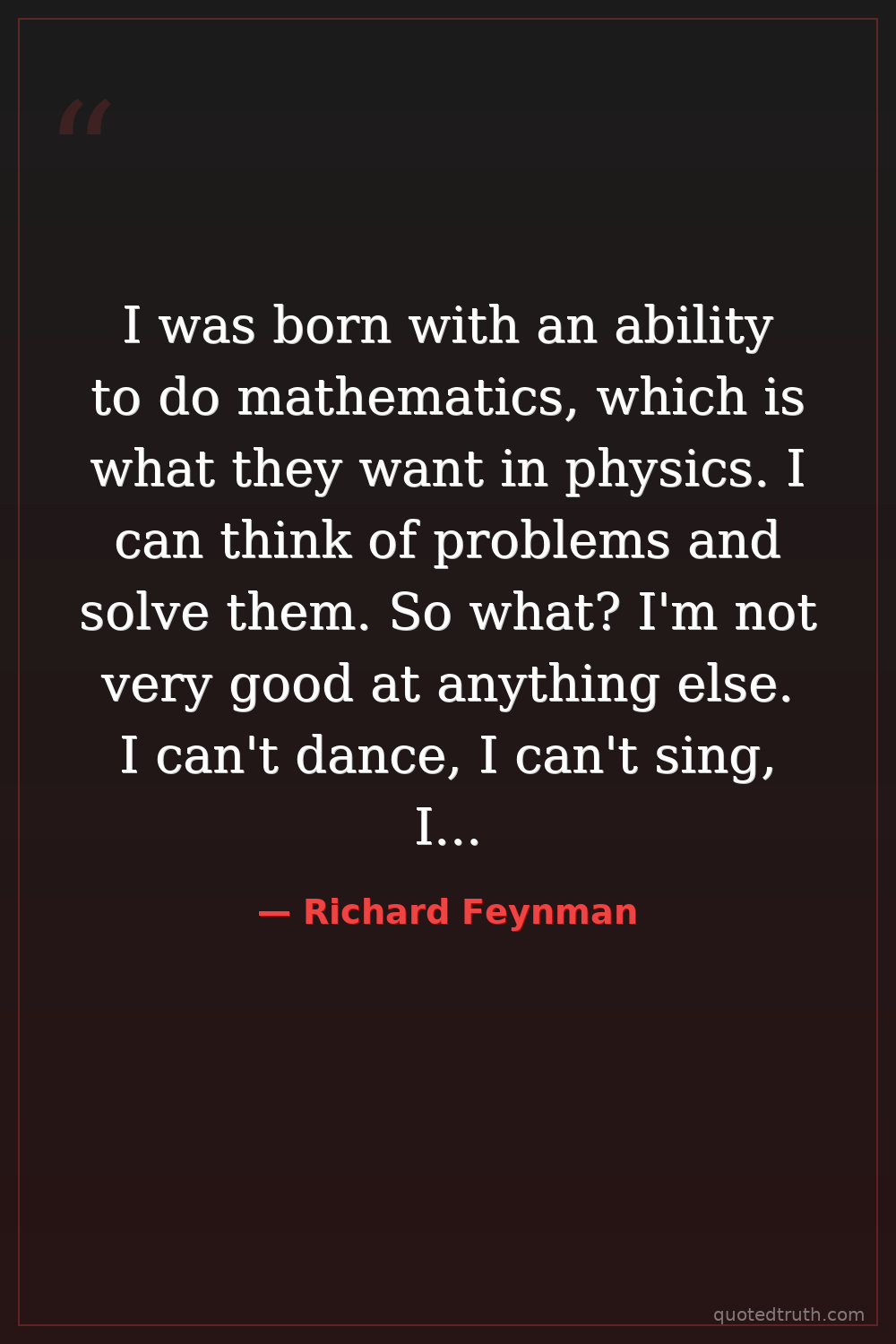
Richard Feynman — "I was born with an ability to do mathematics, which is what they want in physics…"

I was born with an ability to do mathematics, which is what they want in physics. I can think of problems and solve them. So what? I'm not very good at anything else. I can't dance, I can't sing, I can't tell jokes very well, I'm not a good administrator, I can't do anything else. I'm just a physicist.
Richard Feynman — Richard Feynman Modern · Quantum electrodynamics

Get This Quote & Author's Image Illustrated On:

Click any product to generate a realistic preview. Up to 3 at a time.
* Initial load can take up to 90 seconds — revising the preview in another color is nearly instant.

Kitchen

Apparel

Other

About Richard Feynman (1918-1988)

American theoretical physicist who shared the 1965 Nobel for QED, developed Feynman diagrams, and wrote the Feynman Lectures on Physics. Closely associated with Julian Schwinger (co-Nobelist for QED) and Murray Gell-Mann (Caltech rival and Eightfold-Way physicist). For an intellectual contrast, see Deepak Chopra, physician and quantum-mysticism author — Feynman's Caltech 'cargo cult science' commencement address is the precise template for what he saw as misuse of physics terminology — Chopra-style appropriation of quantum vocabulary for metaphysical claims is the canonical example of what Feynman called 'fooling yourself'.

Details

Interview with Omni Magazine

Date: 1979

General

Verification

Unverifiable

Found in 1 providers: grok

1 source checked

Understanding this quote

What it means

Natural talent in one area doesn't make someone exceptional overall. The speaker admits their mathematical gift enables physics work, but strips away any illusion of broader greatness — they can't dance, sing, joke, or manage. It's radical self-honesty: one skill, pursued deeply, defines them entirely. Talent is narrow, not universal.

Relevance to Richard Feynman

Feynman was a Nobel Prize-winning theoretical physicist whose genius for mathematical intuition drove breakthroughs in quantum electrodynamics. Famous for his playful bongo-drumming and storytelling, this quote is self-deprecating irony — he actually could tell jokes and perform. Yet professionally, he fiercely identified as purely a physicist, resisting administrative roles at Caltech and elsewhere.

The era

Post-WWII America elevated scientists to near-mythic status after the Manhattan Project and nuclear age. Society expected scientific geniuses to be Renaissance men. Feynman, working through the Cold War era of 1950s-80s, deliberately pushed back against that inflation — insisting physicists were specialists, not oracles, at a time when public figures faced enormous pressure to be universally capable.

AI-generated insights based on extensive research and information for context. Factual errors? Email [email protected].
Your Cart

Your cart is empty