Alan Turing — "I propose to consider the question, 'Can machines think?' This should begin with…"
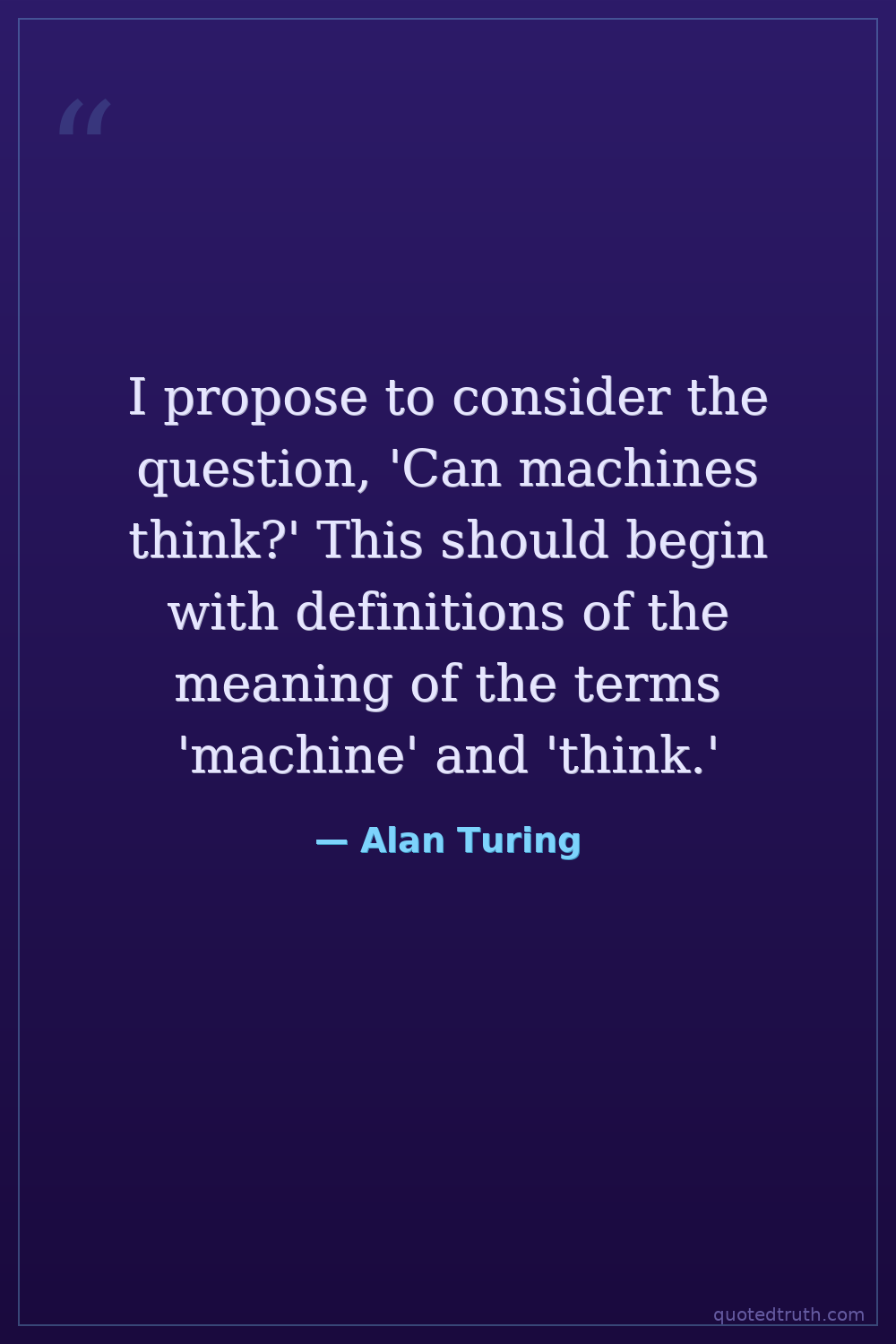
I propose to consider the question, 'Can machines think?' This should begin with definitions of the meaning of the terms 'machine' and 'think.'
I propose to consider the question, 'Can machines think?' This should begin with definitions of the meaning of the terms 'machine' and 'think.'
Click any product to generate a realistic preview. Up to 3 at a time.
* Initial load can take up to 90 seconds — revising the preview in another color is nearly instant.
"I am not very impressed with theological arguments whatever they may be used to support. Such arguments have often been found unsatisfactory in the past. In the time of Galileo it was argued that the …"
"The future belongs to those who believe in the beauty of their dreams."
"The possibility of a machine thinking is a disturbing thought for many people."
"The machine should be able to use language."
"The game of cricket is one such example of a game which can be played against the computer."
Found in 1 providers: deepseek
1 source checked
Before debating whether artificial intelligence is real, we must first agree on what 'machine' and 'think' actually mean. This is a scientist's demand for definitional clarity before philosophical inquiry — vague questions only produce vague answers. Without pinning down what counts as thinking, any claim that machines can or cannot think remains meaningless. Precise definitions are the prerequisite for honest investigation.
Turing published this in his landmark 1950 paper 'Computing Machinery and Intelligence,' where he proposed what became the Turing Test. His entire career exemplified rigorous definitional thinking — formalizing computation through the theoretical Turing machine, breaking Enigma codes through systematic logic at Bletchley Park. He believed ambiguous language masked real problems; precision in framing questions was, for him, the first step toward answering them.
Written in 1950, just five years after WWII, as the first programmable computers — ENIAC, Manchester Mark 1 — were barely operational. Most scientists still saw machines as mechanical calculators, nothing more. The Cold War was accelerating computing's military importance, yet the philosophical question of machine intelligence seemed outlandish to mainstream science. Turing's framing forced the entire field to take artificial intelligence seriously as a legitimate area of inquiry.
AI-generated insights based on extensive research and information for context. Factual errors? Email [email protected].
Your cart is empty