What it means
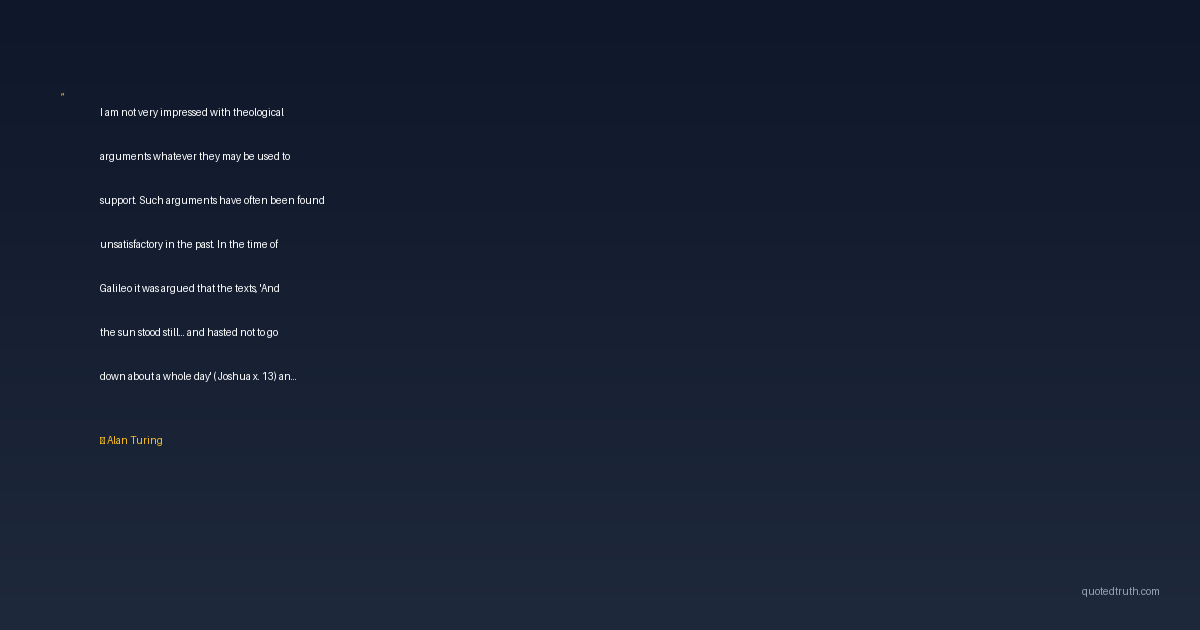
Religious or theological arguments should not be trusted to settle scientific or factual questions. History repeatedly shows that scripture-based objections to new ideas have been wrong. When the Bible was used to reject Copernicus's sun-centered model, those arguments ultimately failed. We should judge ideas by evidence and reason, not by whether they conflict with religious texts or traditional beliefs.
Relevance to Alan Turing
Turing faced theological and moral condemnation for his homosexuality, which British law criminalized. His skepticism of theological argument was personal as well as intellectual. As the architect of modern computing and a rigorous logician, he demanded evidence-based reasoning. His 1950 paper on machine intelligence directly engaged religious objections to thinking machines, dismissing them with characteristic precision.
The era
In the 1940s–50s, religious institutions still wielded significant cultural authority in Britain. Cold War anxieties reinforced appeals to Christian identity. Yet science was rapidly overturning old certainties: nuclear physics, evolutionary biology, and early computing all challenged traditional worldviews. Turing wrote amid this tension, insisting that theology had no special veto power over empirical or logical conclusions.
AI-generated insights based on extensive research and information for context. Factual errors? Email [email protected].