What it means
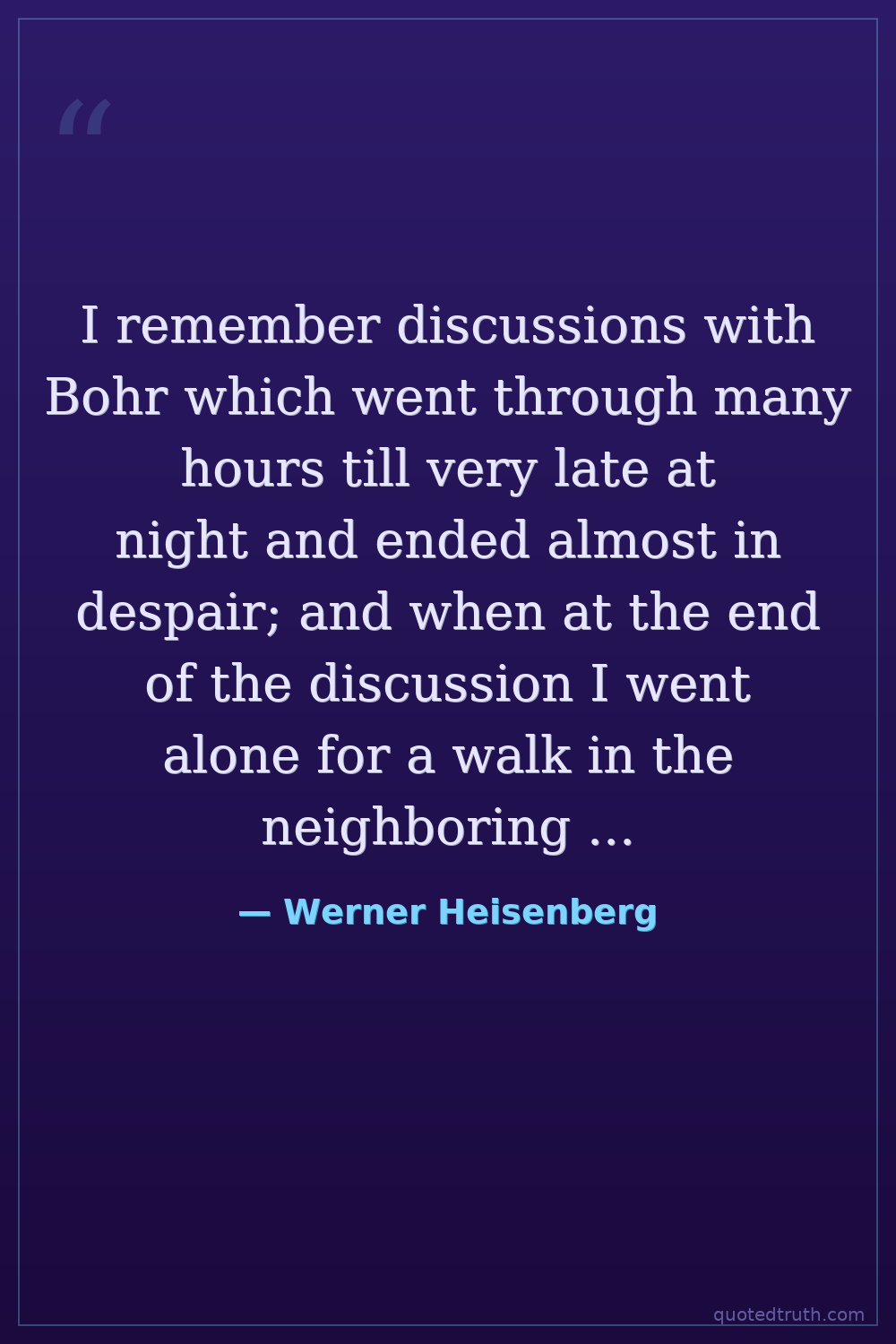
Heisenberg describes exhausting late-night debates with Niels Bohr about atomic physics that left them emotionally drained and near hopeless. Walking alone afterward, he kept asking himself whether reality at the subatomic level could really be as strange and irrational as their experiments suggested. The quote captures the shock of confronting a universe that refuses to behave according to common sense, and the mental toll of wrestling with findings that defy ordinary intuition.
Relevance to Werner Heisenberg
Heisenberg formulated the uncertainty principle in 1927 while working closely with Bohr in Copenhagen, where these exact late-night debates shaped quantum mechanics. His matrix mechanics and the Copenhagen interpretation forced physicists to abandon classical determinism. The quote reflects his genuine struggle: a mathematically gifted young physicist confronting experimental results that contradicted centuries of Newtonian certainty, shared with the mentor who pushed him hardest toward philosophical clarity about what physics could actually know.
The era
The 1920s quantum revolution overturned classical physics just as Europe was reeling from World War I and rapid modernist upheaval in art, philosophy, and politics. Einstein's relativity had already bent space and time; now Bohr's Copenhagen circle was dismantling causality and objective reality itself. Heisenberg worked amid Weimar Germany's intellectual ferment, where scientists, artists, and philosophers alike questioned whether human reason could grasp a world that suddenly seemed stranger than anyone had imagined.
AI-generated insights based on extensive research and information for context. Factual errors? Email [email protected].