Werner Heisenberg — "Modern physics has, in a certain sense, revived Plato's philosophy of forms in t…"
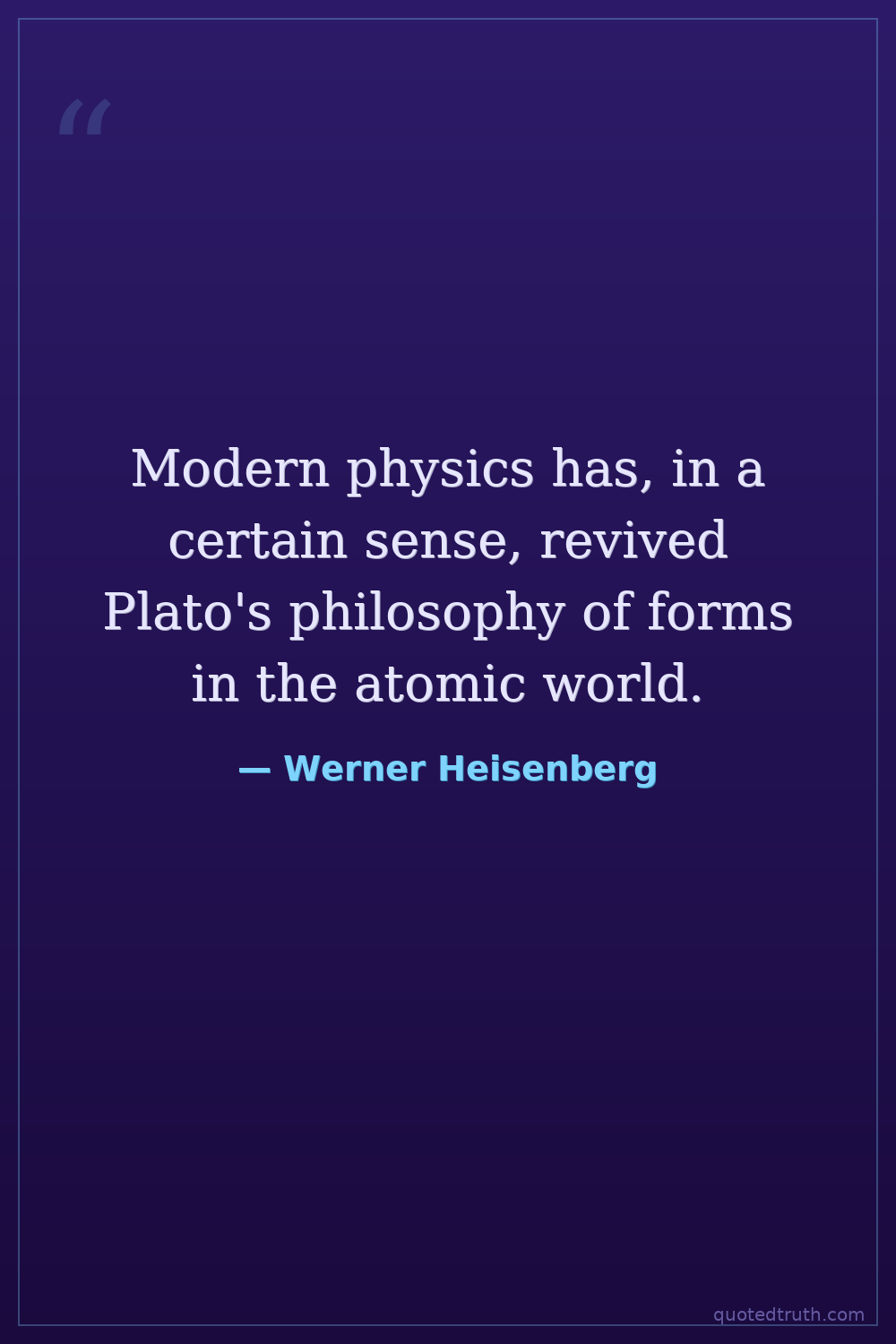
Modern physics has, in a certain sense, revived Plato's philosophy of forms in the atomic world.
Modern physics has, in a certain sense, revived Plato's philosophy of forms in the atomic world.
Click any product to generate a realistic preview. Up to 3 at a time.
* Initial load can take up to 90 seconds — revising the preview in another color is nearly instant.
"The reality we can put into words is never reality itself."
"The very act of observing changes the observed."
"The history of physics is not only a sequence of experimental discoveries and observations, but also a history of concepts."
"Every word or concept, clear as it may seem to be, has only a limited range of applicability."
"One can't say that one could equally well say that's the quickest way of ending the war."
Connecting quantum physics to ancient Greek philosophy
Date: 1955 (Physics and Philosophy)
EducationalFound in 1 providers: grok
1 source checked
Heisenberg argues that contemporary physics has rediscovered Plato's ancient idea that reality is built from abstract mathematical forms rather than tangible matter. At the atomic scale, particles behave less like solid objects and more like mathematical patterns, symmetries, and probabilities. The deepest layer of nature turns out to be ideal structures expressible in equations, echoing Plato's claim that pure forms underlie physical appearances. Matter, in the end, is mathematics made manifest.
Heisenberg was philosophically trained and read Plato's Timaeus as a teenager, a moment he credited with shaping his entire scientific outlook. As the founder of matrix mechanics and author of the uncertainty principle, he discovered that electrons have no definite classical trajectory, only mathematical states. He repeatedly wrote that elementary particles resemble Platonic forms more than Democritus's hard atoms, viewing symmetry groups as the true fundamental reality beneath observable phenomena.
Heisenberg worked during the 1920s–1970s, when quantum mechanics, relativity, and particle physics overturned the Newtonian clockwork universe. Physicists were shocked that subatomic behavior defied visualization and demanded abstract mathematics. Postwar discoveries of symmetry groups, quarks, and gauge theories deepened the sense that reality was mathematical rather than mechanical. Amid atomic bombs and Cold War science, thinkers sought philosophical meaning in physics, reviving classical questions about the nature of matter, form, and knowledge.
AI-generated insights based on extensive research and information for context. Factual errors? Email [email protected].
Your cart is empty