What it means
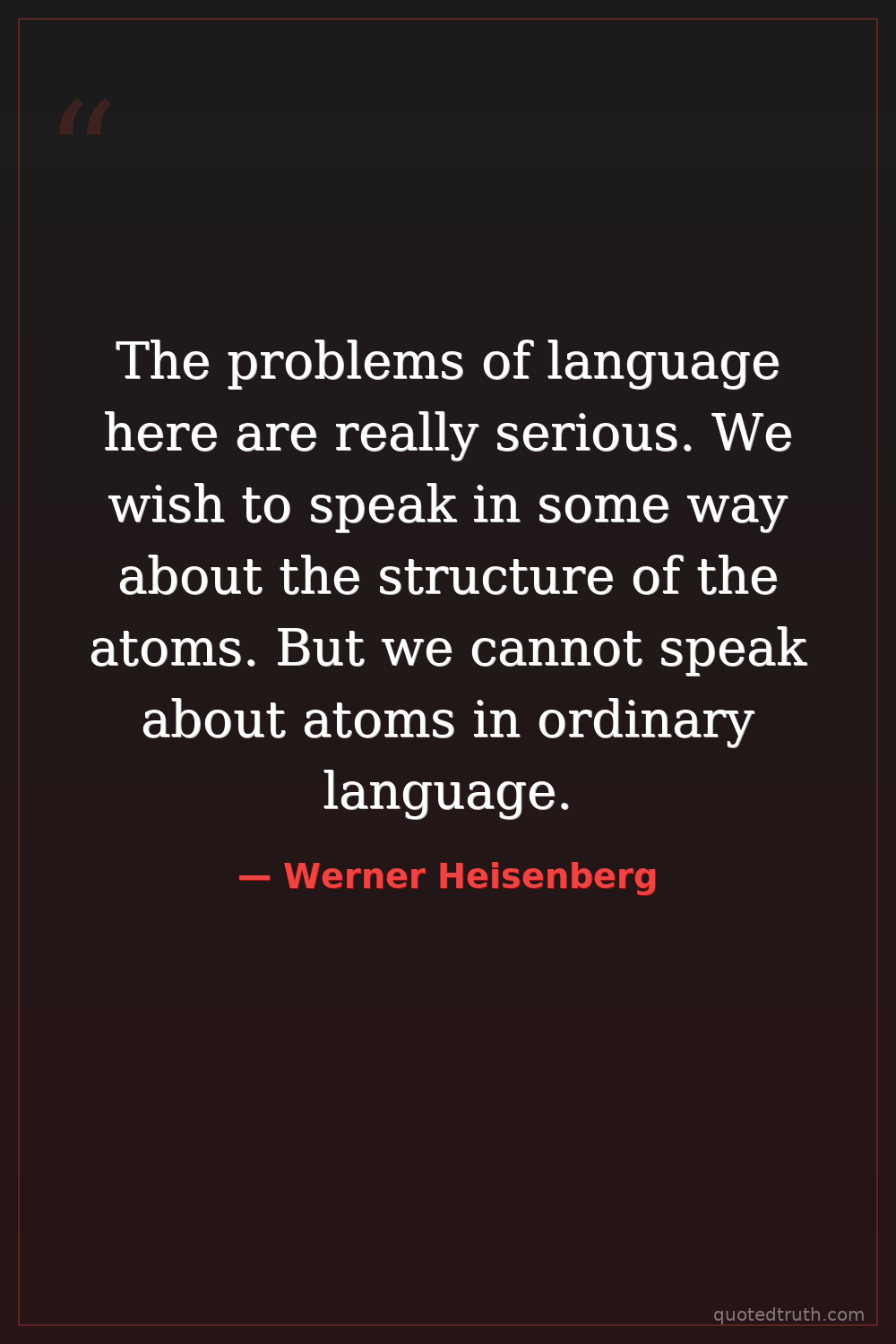
Everyday words were built to describe things we can see and touch, like tables or rivers. Atoms behave nothing like those familiar objects, so normal vocabulary distorts what they actually are. Any attempt to describe subatomic reality in plain speech forces it into misleading pictures, like waves or tiny balls. Heisenberg is saying we hit a genuine wall: the tools of ordinary language simply cannot carry the strangeness of what happens at that scale.
Relevance to Werner Heisenberg
Heisenberg formulated the uncertainty principle in 1927, showing a particle cannot have a precise position and momentum at once. He wrestled constantly with how to describe electrons that were neither clearly waves nor particles, ultimately relying on abstract matrix mathematics. His Copenhagen interpretation, developed with Bohr, insisted that quantum objects have no classical analog. This frustration with vocabulary mirrors his entire career translating counterintuitive mathematical formalisms into words physicists and philosophers could argue about.
The era
The early twentieth century shattered physics. Between 1900 and 1930, Planck, Einstein, Bohr, Schrodinger, and Heisenberg overturned Newtonian certainty with quanta, relativity, and probabilistic electrons. Philosophers like Wittgenstein were simultaneously questioning whether language could represent reality at all. Science popularization was booming, yet the new physics resisted metaphor. Heisenberg spoke during a moment when educated audiences demanded explanations, but the mathematics had outrun German, English, and every ordinary tongue available to describe the newly discovered subatomic world.
AI-generated insights based on extensive research and information for context. Factual errors? Email [email protected].