What it means
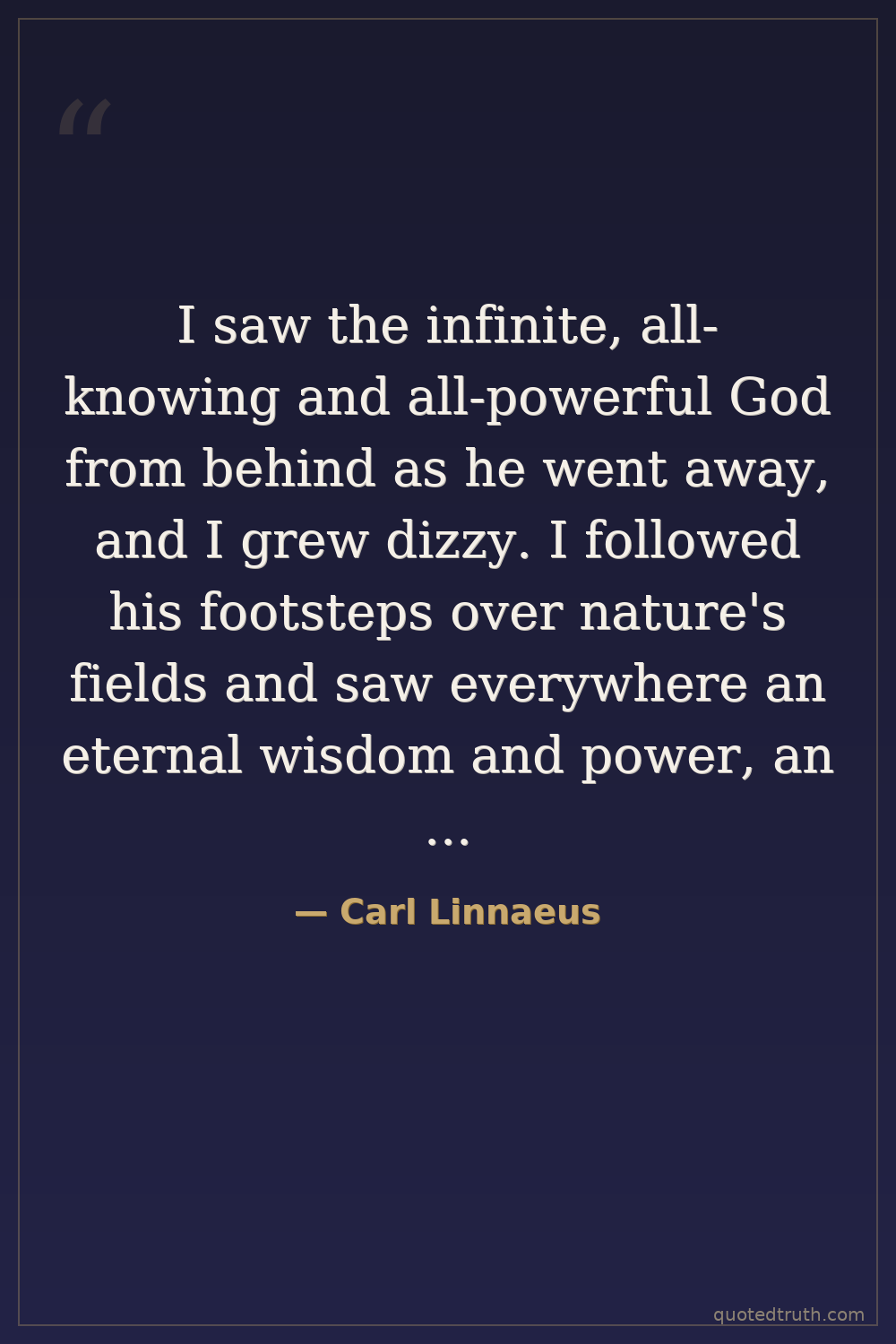
This expresses the overwhelming awe of confronting nature's vastness and complexity. Linnaeus describes following God's path through the natural world and discovering perfect rational order everywhere. The dizziness captures how human minds struggle to grasp infinite complexity. In modern terms: the deeper you look into nature, the more you find elegant, incomprehensible patterns suggesting something far greater than human understanding—a universe operating by principles too grand to fully perceive.
Relevance to Carl Linnaeus
Linnaeus devoted his life to classifying every known organism, creating binomial nomenclature still used today. As a devout Lutheran, he saw taxonomy as literally tracing God's blueprint—his Systema Naturae was as much theological as scientific. He believed the rational order he catalogued was God's order. This quote reflects his lifelong conviction that scientific discovery and religious devotion were identical acts: both were efforts to understand the mind of the Creator.
The era
Linnaeus worked during the 18th-century Enlightenment, when natural philosophy and theology were deeply intertwined. Natural theology—studying creation to reveal God's nature—was mainstream among educated Europeans. Newton had demonstrated mathematical order in physics; naturalists sought equivalent order in biology. Classification systems were as much theological maps as scientific tools. Skepticism of religious claims was rare; scientific discovery was routinely framed as uncovering divine design, making Linnaeus's fusion of reverence and empirical inquiry entirely unremarkable.
AI-generated insights based on extensive research and information for context. Factual errors? Email [email protected].