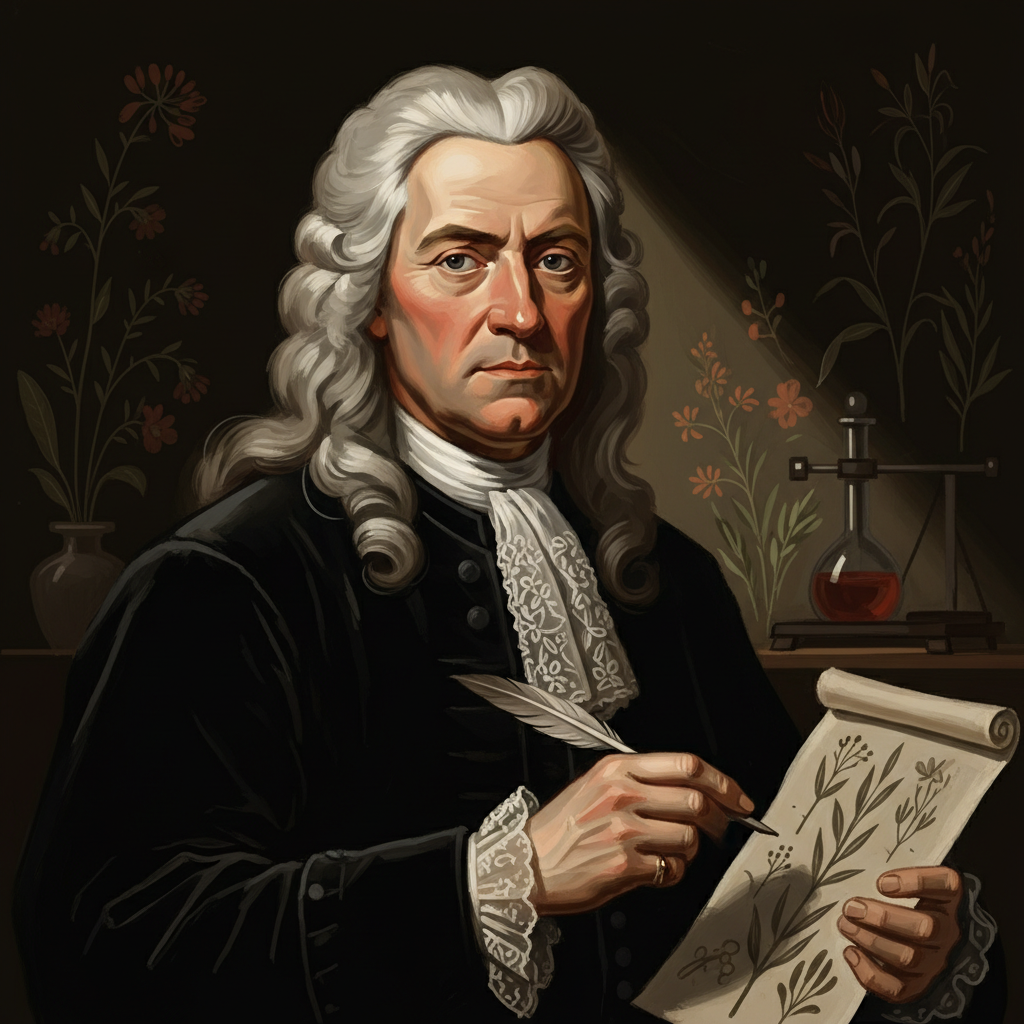
Carl Linnaeus — "The world is ruled by three things: money, women, and botany."
The world is ruled by three things: money, women, and botany.
The world is ruled by three things: money, women, and botany.
Click any product to generate a realistic preview. Up to 3 at a time.
* Initial load can take up to 90 seconds — revising the preview in another color is nearly instant.
"I have been called the Prince of Botanists."
"For wealth disappears, the most magnificent houses fall into decay, the most numerous family at some time or another comes to an end: the greatest and the most prosperous kingdoms can be overthrown: b…"
"My mind reels when, on this height, I look down on the long ages that have flowed by like waves in the sound and have left traces of the ancient world, traces so nearly obscured that they can only whi…"
"The Asiatic is haughty, greedy, and governed by opinions."
"The stony rocks are not primeval, but daughters of Time."
Swedish botanist and the father of modern taxonomy whose Systema Naturae (1735) introduced binomial nomenclature for naming all species. Closely associated with Joseph Banks (British naturalist who carried Linnaean classification on Cook's voyages). For an intellectual contrast, see Comte de Buffon, French naturalist and Histoire Naturelle author (1749-1788) — Buffon explicitly attacked Linnaean fixed-categories taxonomy as artificial and rejected the binomial system; his gradualist, environment-shaped natural history was the explicit alternative. Anticipates the fixed-species-vs-evolution debate Darwin would later resolve.
A humorous or eccentric personal observation, attributed.
Date: Uncertain (attributed)
Money & BusinessFound in 1 providers: gemini
1 source checked
Power and influence in human affairs come from three forces: economic wealth that drives commerce and politics, human relationships and desire that motivate behavior, and the natural world's study that unlocks knowledge and resources. The inclusion of botany is partly playful self-promotion, but reflects genuine belief that understanding nature grants mastery over medicine, agriculture, and civilization itself.
Linnaeus devoted his life to cataloguing all plant life on Earth, creating the binomial nomenclature system still used today. This quip reveals his pride and conviction that botany wasn't merely academic but a civilizational force. He believed plants governed medicine, food, and trade — and his own work literally reshaped how humanity understood the natural world.
In 18th-century Europe, botanical knowledge was inseparable from colonial economic power — spice routes, plantation crops, and apothecary medicine depended on plant science. The Swedish Empire sought botanical expertise to identify commercially valuable species. Linnaeus trained students as botanical explorers sent globally, making taxonomy a geopolitical tool, not idle scholarship.
AI-generated insights based on extensive research and information for context. Factual errors? Email [email protected].
Your cart is empty