What it means
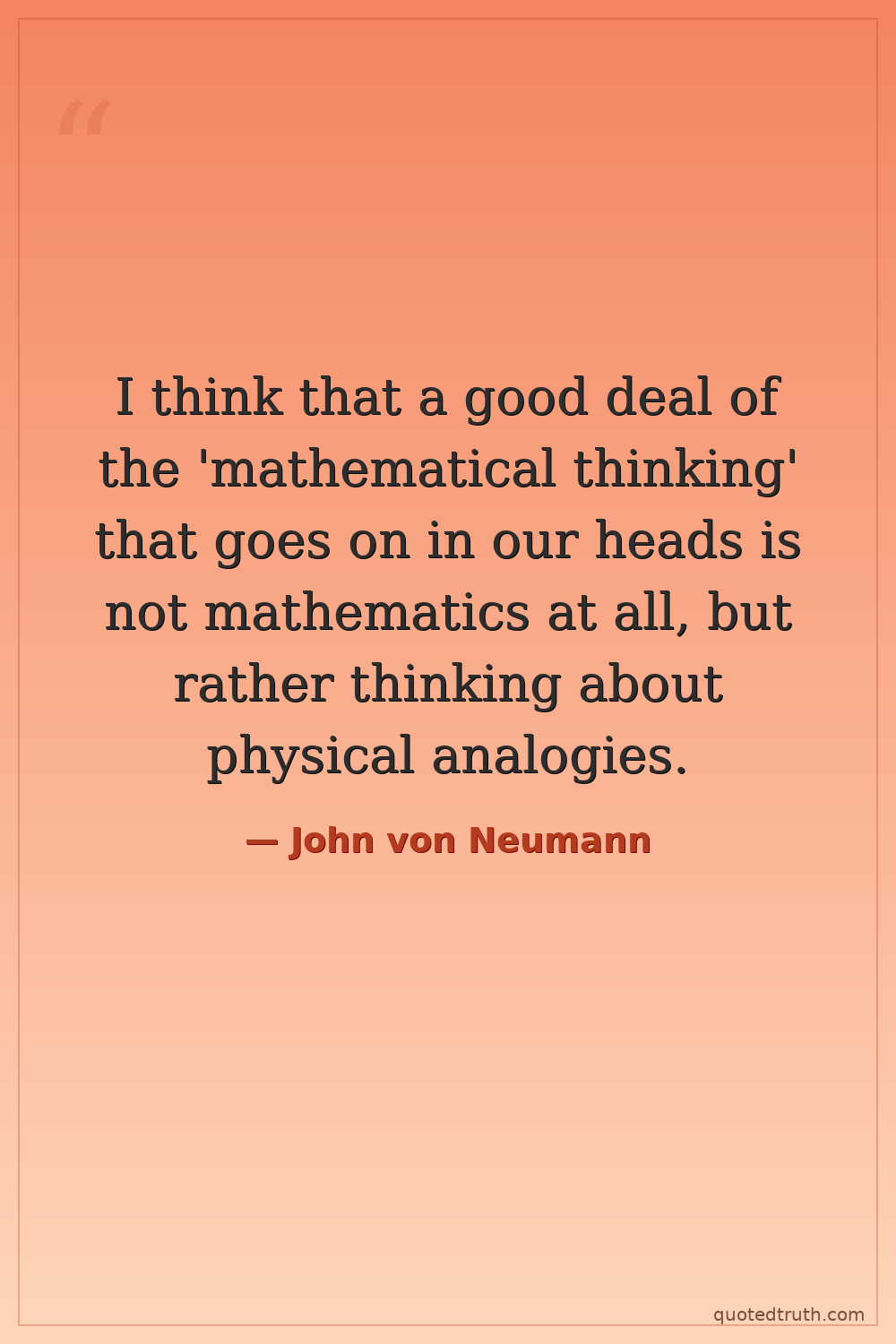
When we believe we're reasoning purely mathematically, we're often actually thinking by analogy to physical objects or processes—using mental images of space, motion, or shape as cognitive shortcuts. True formal mathematics operates through symbols and logic divorced from physical reality, but human minds naturally ground abstract ideas in concrete, tangible analogies. Von Neumann observes that what feels like rigorous mathematical thought is frequently intuition dressed in mathematical clothing.
Relevance to John von Neumann
Von Neumann simultaneously advanced pure mathematics, theoretical physics, and computer engineering—rare fluency across all three. His mathematical formulation of quantum mechanics required translating physical phenomena into Hilbert space abstractions. Working on the Manhattan Project and designing the von Neumann computer architecture, he constantly moved between physical reality and formal abstraction. This self-aware observation reflects his unique vantage point: someone who genuinely knew both pure mathematical rigor and physical intuition from the inside.
The era
Von Neumann worked during the 1920s–1950s, when quantum mechanics shattered the boundary between physics and mathematics—physicists invented new math, mathematicians formalized physical intuitions. Simultaneously, the Bourbaki movement pushed toward purely axiomatic, abstract mathematics stripped of physical meaning. Computing was emerging, forcing engineers to translate physical circuits into logical abstractions. Whether mathematics describes physical reality or transcends it was hotly contested among Einstein, Hilbert, and their contemporaries.
AI-generated insights based on extensive research and information for context. Factual errors? Email [email protected].