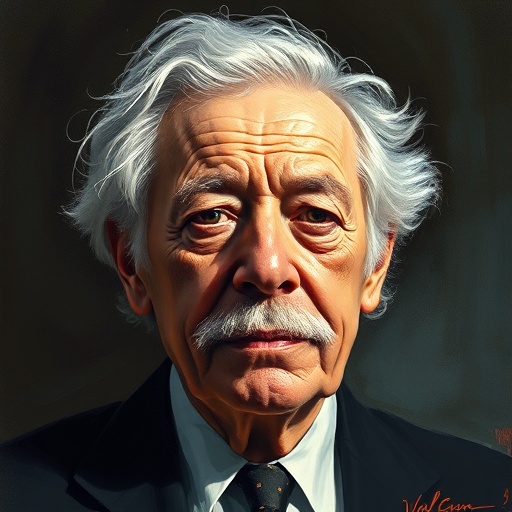
Linus Pauling — "I think that the human mind is capable of understanding almost anything."
I think that the human mind is capable of understanding almost anything.
I think that the human mind is capable of understanding almost anything.
Click any product to generate a realistic preview. Up to 3 at a time.
* Initial load can take up to 90 seconds — revising the preview in another color is nearly instant.
"Do you think that an American who insists on making up his own mind, who objects to being told what to do, to being pushed around by officious officials, is thereby made un-American? I do not. I think…"
"I have always been a curious individual, and I believe that curiosity is the engine of progress."
"Every man of science has some favorite hypothesis which he cultivates, and with which he is so intimately bound up, that he would be glad to see it universally adopted."
"I believe that there is no such thing as an 'unimportant' discovery."
"I am convinced that there is no disease that cannot be cured by a proper intake of vitamin C."
Found in 1 providers: grok
1 source checked
Human intelligence has virtually no ceiling when properly applied. The mind can grasp complex systems, abstract concepts, and counterintuitive truths given sufficient effort, education, and curiosity. This is a statement of radical optimism about cognitive potential — rejecting the idea that certain knowledge is permanently beyond ordinary people and insisting that understanding is achievable rather than reserved for a privileged few.
Pauling embodied this belief through his own career: he taught himself quantum mechanics as an adult researcher and pioneered chemical bonding theory, then pivoted to biology and crystallography, winning Nobel Prizes in two unrelated fields — Chemistry and Peace. His campaign against nuclear testing required mastering political communication alongside radiobiology, demonstrating that a disciplined mind could transcend disciplinary boundaries repeatedly.
Pauling's peak decades spanned the Cold War, when scientific expertise was increasingly siloed and the nuclear arms race felt incomprehensible to citizens. Simultaneously, postwar optimism about science and mass education surged — the GI Bill, Sputnik, and expanding universities challenged elitism in knowledge. Pauling's faith in human understanding also fueled his conviction that ordinary citizens could grasp the dangers of radioactive fallout and demand nuclear disarmament.
AI-generated insights based on extensive research and information for context. Factual errors? Email [email protected].
Your cart is empty