What it means
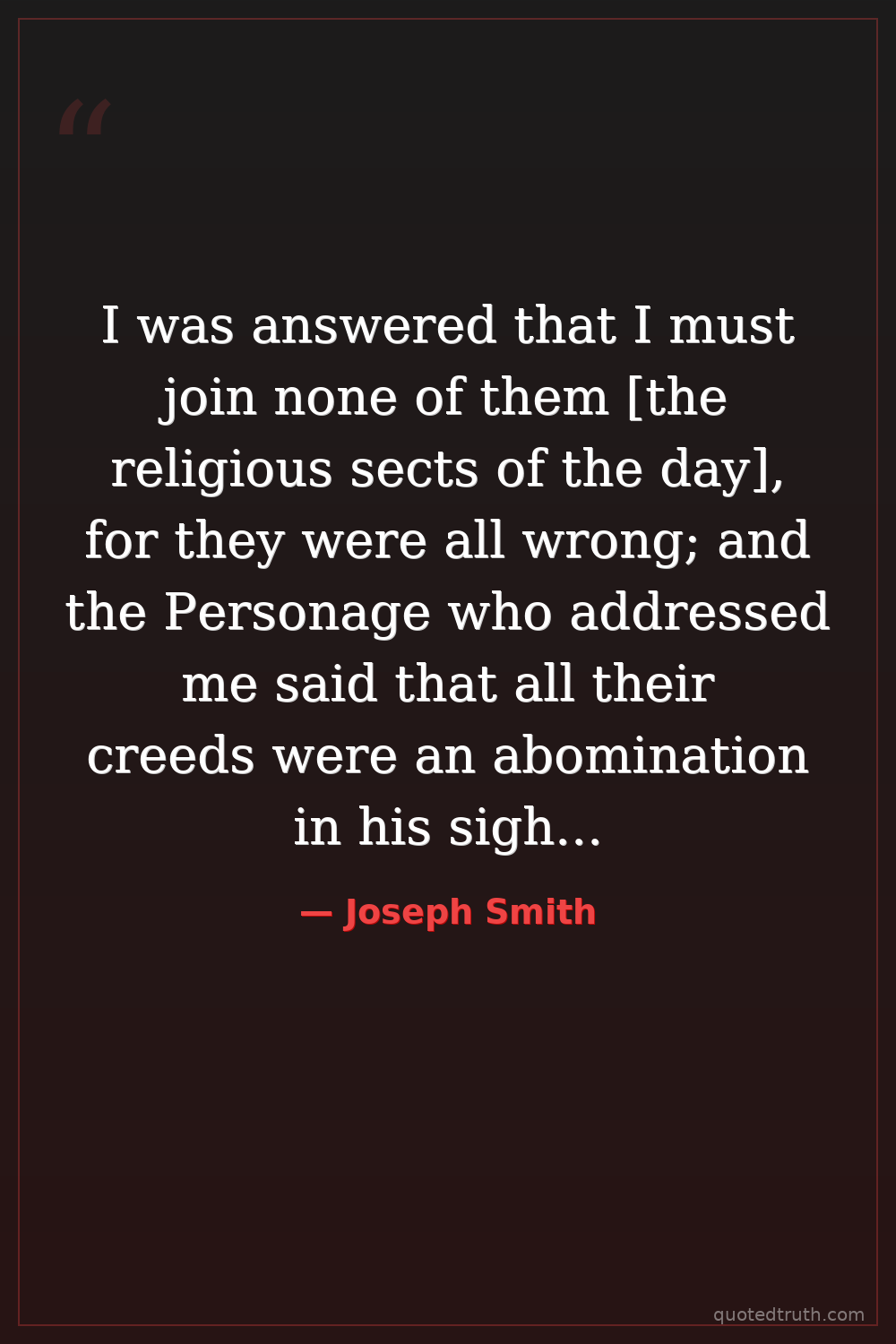
God directly told Smith that every existing Christian denomination had gone spiritually wrong — their creeds were corrupt, their clergy hollow performers, and their teachings man-made rather than divine. The faithful mouthed devotion but lacked genuine connection to God. No existing church deserved his membership. This was a divine mandate to start over entirely, not reform an existing tradition but replace all of them with something restored to original truth.
Relevance to Joseph Smith
This quote is the hinge of Smith's entire life. In 1820, as a 14-year-old in upstate New York, he claimed God and Christ appeared to him during prayer, delivering this verdict. It became the founding rationale for the Church of Christ (later LDS) in 1830. Rather than a reformer, Smith positioned himself as a restorer — chosen specifically because existing Christianity had failed, making his prophetic role not optional but cosmically necessary.
The era
The early 1800s in upstate New York was called the 'burned-over district' — so scorched by competing revival movements it seemed nothing new could ignite. The Second Great Awakening sent Methodist, Baptist, and Presbyterian preachers into fierce competition for souls. Families split over denominations; teenagers like Smith were genuinely confused which church held truth. This cacophony of competing claims made a divine answer cutting through the noise feel both necessary and believable to many contemporaries.
AI-generated insights based on extensive research and information for context. Factual errors? Email [email protected].