What it means
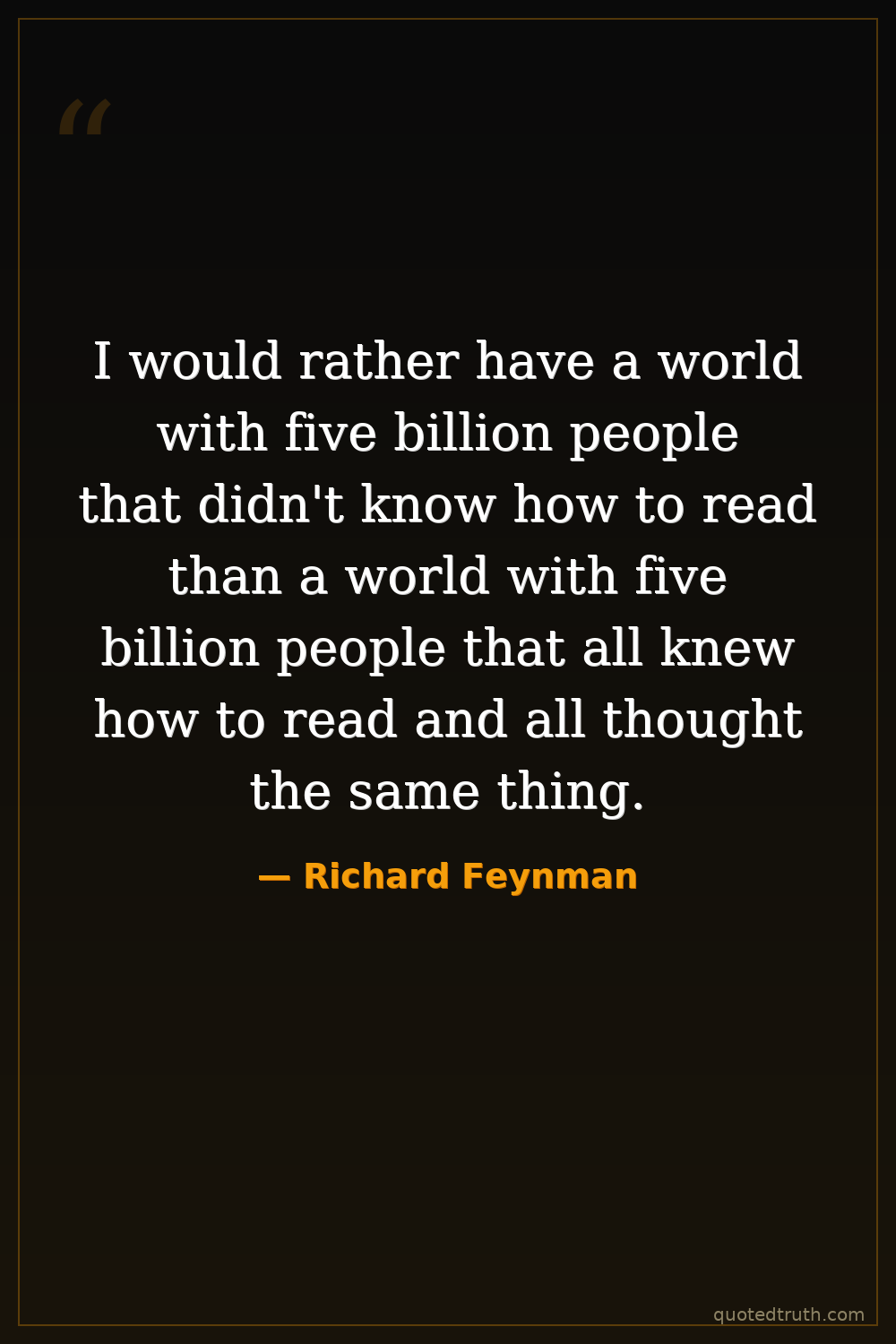
Feynman argues that cognitive diversity matters more than universal education if literacy produces uniform thinking. A world where everyone reasons identically—however educated—is more impoverished and dangerous than one with widespread illiteracy. He prioritizes independent thought and intellectual plurality over mere access to information. Knowledge's real value lies in what people do with it: question, challenge, and diverge—not absorb consensus and agree.
Relevance to Richard Feynman
Feynman earned the Nobel Prize for quantum electrodynamics and built his career on skepticism over authority. He resigned from the National Academy of Sciences, distrusted institutional consensus, and exposed NASA's Challenger disaster through independent investigation against official pressure. His famous cargo cult science lectures warned that following scientific ritual without genuine inquiry is worthless. Teaching students to think rather than memorize was his defining pedagogical principle.
The era
Feynman worked through the Cold War, when both superpowers showed how mass literacy could serve ideological conformity. Soviet and Maoist propaganda, McCarthyism in America, standardized postwar curricula, and the rise of television all demonstrated that educated populations could be directed toward uniform belief. His quote challenges the Enlightenment assumption that spreading literacy automatically produces free minds, pointing out that the medium of education matters far less than its spirit.
AI-generated insights based on extensive research and information for context. Factual errors? Email [email protected].