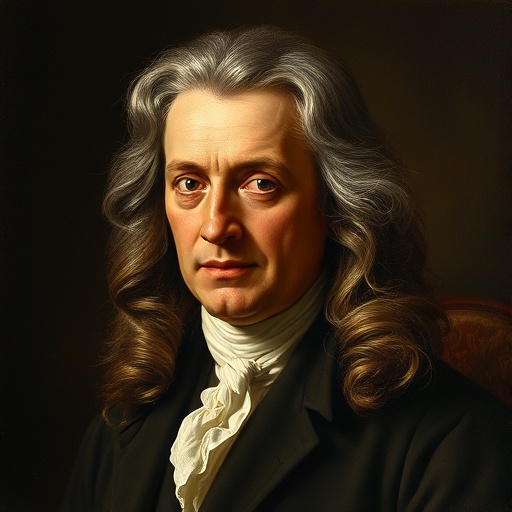
Isaac Newton — "If I have done the public any service, it is due to my patient thought."
If I have done the public any service, it is due to my patient thought.
If I have done the public any service, it is due to my patient thought.
Click any product to generate a realistic preview. Up to 3 at a time.
* Initial load can take up to 90 seconds — revising the preview in another color is nearly instant.
"I do not know what I may appear to the world, but to myself I seem to have been only like a boy playing on the seashore, and diverting myself in now and then finding a smoother pebble or a prettier sh…"
"Nature is pleased with simplicity. And nature is no dummy."
"God is the same God, always and everywhere. He is omnipresent not virtually only, but also substantially; for virtue cannot subsist without substance."
"Plato is my friend, Aristotle is my friend, but truth is more my friend."
"What is there in places almost empty of air (such as the space between the planets) to hinder the free motion of bodies?"
Found in 2 providers: grok,deepseek
2 sources checked
Whatever contributions Newton made to humanity came not from innate genius or sudden inspiration, but from the discipline of thinking deeply and persistently. He credits patient, sustained mental effort as the true engine of discovery — arguing that breakthroughs emerge through long, careful contemplation rather than fleeting brilliance. It quietly rejects the lone-genius myth, replacing it with the virtue of methodical, unhurried thought applied to hard problems over time.
Newton spent 1665–1666 in forced isolation during the Great Plague at Woolsthorpe, where sustained solitary thinking yielded calculus, optics, and the foundations of gravity. He delayed publishing the Principia Mathematica for over twenty years, refining ideas quietly before releasing them. Notoriously introverted and obsessive, he reportedly forgot meals while working. This quote perfectly captures his actual method: not sudden insight, but relentless, painstaking intellectual labor over months and years.
Newton lived during the Scientific Revolution, when Aristotelian natural philosophy still dominated European universities and Church authority shaped acceptable knowledge. Methodical empirical reasoning was displacing centuries of received doctrine — a genuinely radical shift. The Royal Society, founded in 1660, championed systematic experiment over tradition. Newton's insistence on patient reasoning reflected the era's deepest intellectual current: that disciplined human inquiry, not inherited wisdom or scripture, could reveal the mathematical laws governing nature.
AI-generated insights based on extensive research and information for context. Factual errors? Email [email protected].
Your cart is empty