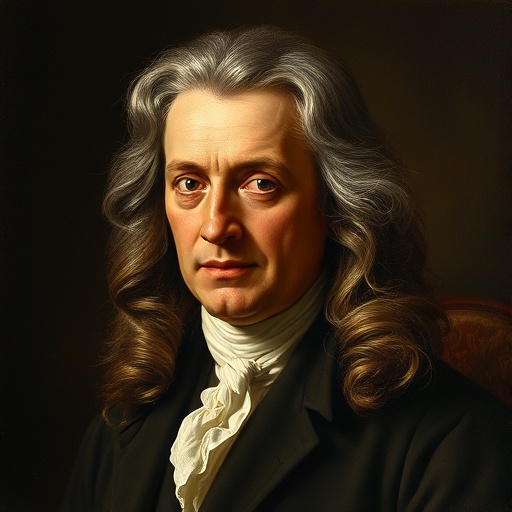
Isaac Newton — "Nature is pleased with simplicity. And nature is no dummy."
Nature is pleased with simplicity. And nature is no dummy.
Nature is pleased with simplicity. And nature is no dummy.
Click any product to generate a realistic preview. Up to 3 at a time.
* Initial load can take up to 90 seconds — revising the preview in another color is nearly instant.
"I have not been able to discover the cause of those properties of gravity from phenomena, and I frame no hypotheses."
"I feign no hypotheses."
"The great ocean of truth lay all undiscovered before me."
"The best way to understand is by examples."
"I have studied these things – you have not."
Attributed, but precise source in this exact phrasing is elusive. Reflects his general scientific approach.
Date: Uncertain
GeneralFound in 1 providers: grok
1 source checked
Nature operates on elegant, simple principles — and those principles are extraordinarily effective. Simplicity isn't a limitation but a design feature of reality. The universe doesn't need complexity to function brilliantly. When we strip away the unnecessary and identify the core rule governing a phenomenon, we're not oversimplifying — we're finally seeing clearly. Nature's preference for simplicity is a mark of sophistication, not naivety, and it rewards those who recognize it.
Newton built his entire legacy on reducing seemingly chaotic phenomena to elegantly simple laws. His three laws of motion and universal law of gravitation — a handful of equations — explained everything from falling apples to planetary orbits. His Principia Mathematica explicitly listed simplicity as a rule of scientific reasoning. Newton believed the universe ran on clean mathematical principles discoverable through observation, and his life's work proved nature's simplicity was its greatest power.
During the 17th-century Scientific Revolution, European thinkers were dismantling Aristotelian scholasticism — elaborate qualitative frameworks explaining nature through complex categories and final causes. Newton, Galileo, and Descartes demonstrated that concise mathematical laws explained far more than volumes of philosophical argument. This was radical: nature's workings weren't mysterious or baroque but governed by a few powerful, verifiable principles. Simplicity became the hallmark of genuine scientific understanding, displacing centuries of ornate metaphysical speculation.
AI-generated insights based on extensive research and information for context. Factual errors? Email [email protected].
Your cart is empty