What it means
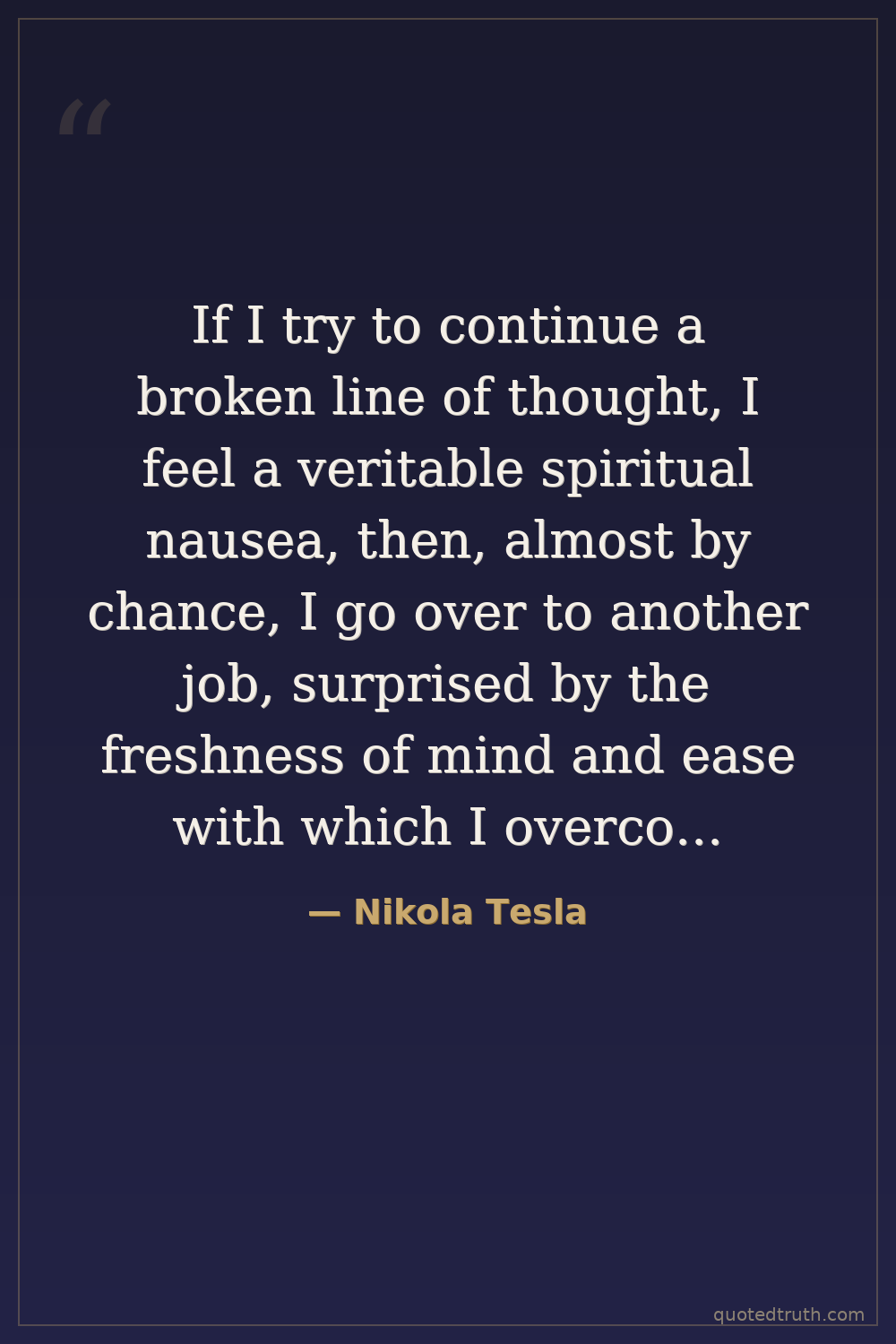
Forcing a stuck train of thought produces a kind of mental sickness that makes progress impossible. But deliberately switching to a different task resets the mind, and when you return, problems that once felt immovable become easy. The insight is practical: strategic abandonment isn't giving up — it's how the brain actually solves hard problems, through rest and subconscious processing rather than brute-force persistence.
Relevance to Nikola Tesla
Tesla routinely juggled dozens of experiments simultaneously in his Manhattan lab, a habit born partly from necessity and partly from temperament. His most celebrated breakthrough — visualizing the rotating magnetic field underlying AC motors — came not at a workbench but during a walk reciting Goethe. He documented working in intense mental bursts followed by deliberate disengagement, and described complete inventions appearing fully formed in his mind only after stepping away.
The era
Tesla wrote this during the Second Industrial Revolution, when inventors competed ferociously and exhaustion was common. Psychology barely existed as a discipline — Freud was just theorizing the unconscious, William James was mapping consciousness. There was no scientific framework for 'incubation' in creativity. Most contemporaries valorized relentless grind, so Tesla's disciplined task-switching was unconventional self-knowledge, anticipating by decades what cognitive scientists would later confirm about diffuse thinking and insight.
AI-generated insights based on extensive research and information for context. Factual errors? Email [email protected].