Gregor Mendel — "If I were to live a hundred years, I would not have enough time to test all the …"
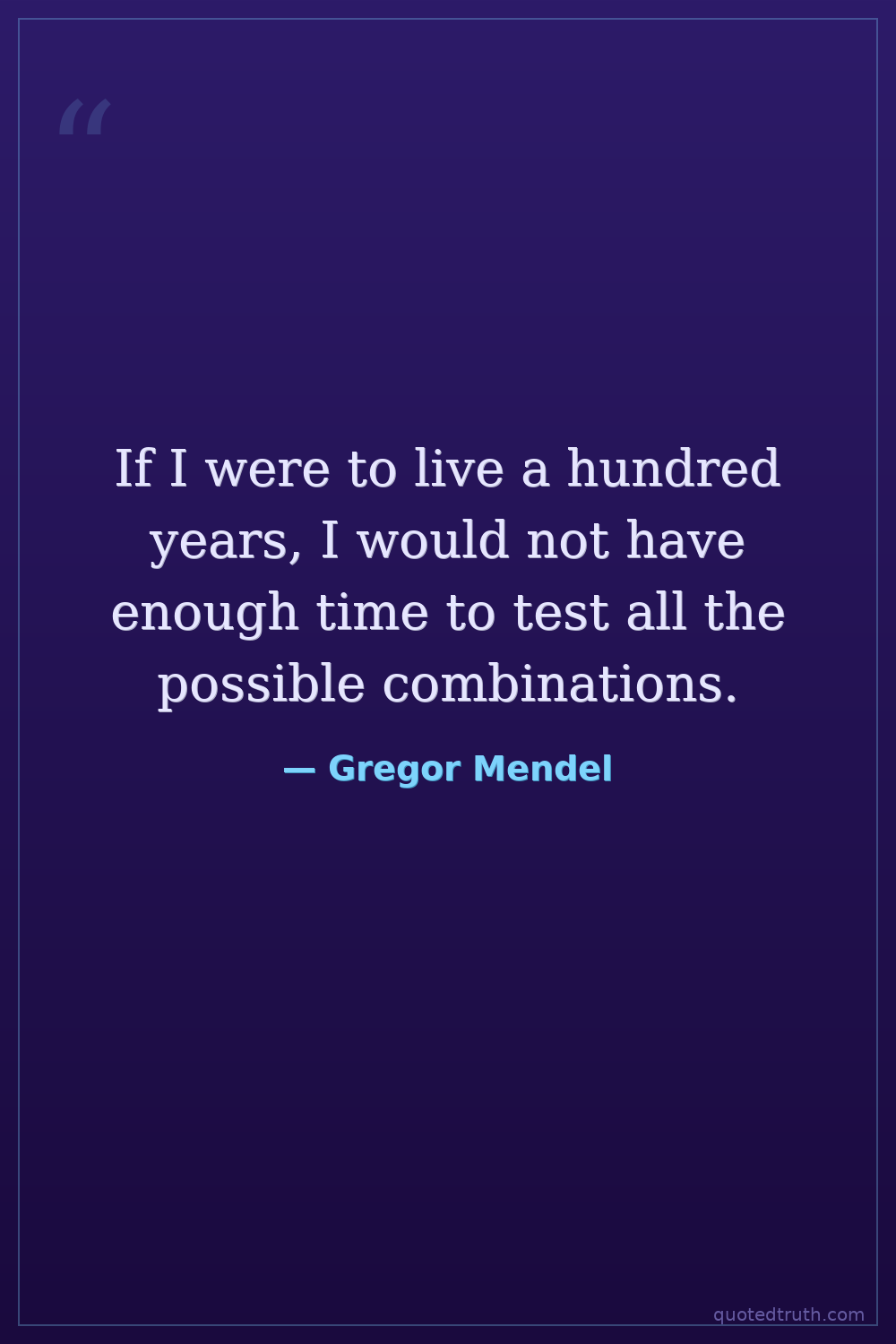
If I were to live a hundred years, I would not have enough time to test all the possible combinations.
If I were to live a hundred years, I would not have enough time to test all the possible combinations.
Click any product to generate a realistic preview. Up to 3 at a time.
* Initial load can take up to 90 seconds — revising the preview in another color is nearly instant.
"My scientific studies have afforded me great satisfaction; and I am convinced that it will not be long before the whole world acknowledges the results of my work."
"I have seen the future of biology, and it is in the numbers."
"The truth is often hidden in the smallest details."
"The pea does not lie."
"Thus, on the average, among four plants two have the hybrid trait Aa, one the parental trait A, and the other the parental trait a. Therefore, 2Aa+ A +a or A + 2Aa + a is the empirical simple series f…"
Found in 1 providers: deepseek
1 source checked
Even a century of work wouldn't be enough to test every possible combination of inherited traits. The speaker recognizes that nature's combinatorial complexity is effectively infinite — the number of ways traits can mix and recombine across generations dwarfs any single scientist's capacity to catalog them. It's an honest admission that curiosity outpaces what experimentation alone can ever fully resolve, even with total dedication.
Mendel spent eight years in his Brno monastery garden cross-breeding pea plants across seven distinct traits, tracking tens of thousands of individual plants by hand. He knew firsthand how fast combinations multiply — seven traits alone yield 128 possible outcomes. His laws of segregation and independent assortment were built from this combinatorial logic. The quote reflects both his mathematical precision and his intellectual humility about the scale of what remained undiscovered.
Mendel worked in the 1850s–1860s, before DNA was identified, before statistical genetics existed as a discipline, and long before computing could model biological systems. Scientists still debated whether traits blended like paint or passed as discrete units. His work was largely ignored until 1900. The combinatorial vastness he intuited would only be fully appreciated in the 20th century, when population genetics and molecular biology confirmed heredity's staggering depth.
AI-generated insights based on extensive research and information for context. Factual errors? Email [email protected].
Your cart is empty