What it means
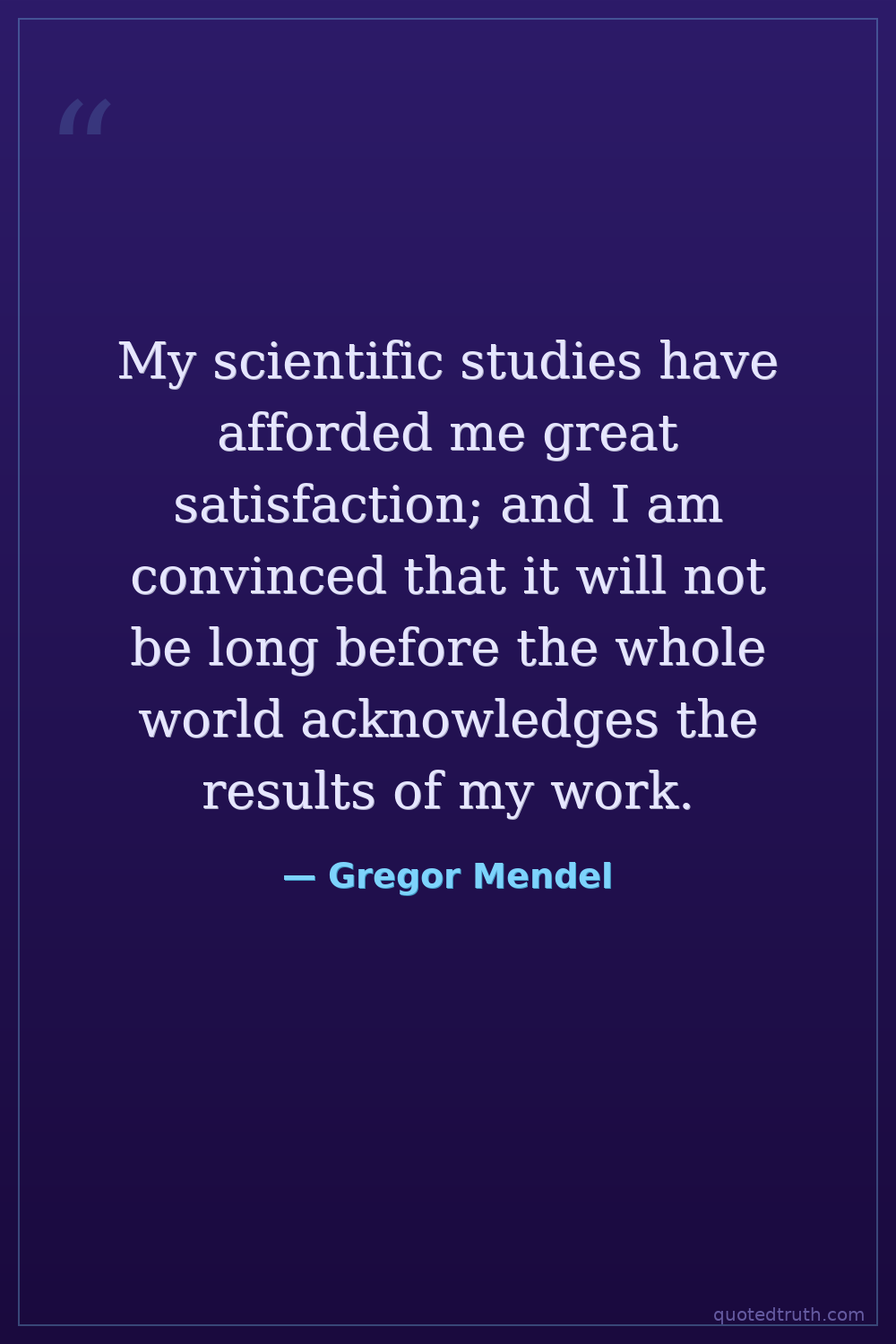
Satisfaction can come from the work itself, not from being recognized for it — but recognition will come. Mendel is saying he finds deep personal reward in his research and is confident the world will eventually catch up and validate what he discovered, even if it hasn't yet. The quote captures the tension between a scientist's private certainty in their findings and the slow pace at which society acknowledges groundbreaking ideas.
Relevance to Gregor Mendel
Mendel spent years quietly breeding pea plants in a monastery garden in Brno, publishing his landmark 1866 paper on inheritance patterns to near silence. His work was ignored by the scientific establishment during his lifetime — he died in 1884 never seeing the recognition he anticipated. This quote perfectly reflects both his monastic patience and his prophetic self-awareness: he knew what he had found was real, even if others did not yet.
The era
Darwin's On the Origin of Species (1859) had just transformed biology, creating urgent demand for a mechanism explaining how traits pass between generations. Yet scientific communication in the 1860s was slow — journals had limited reach, statistics were distrusted in biology, and Mendel's monastery setting placed him outside elite networks. Revolutionary findings routinely took decades to spread. His work was rediscovered only in 1900, sixteen years after his death, proving his prediction correct.
AI-generated insights based on extensive research and information for context. Factual errors? Email [email protected].