What it means
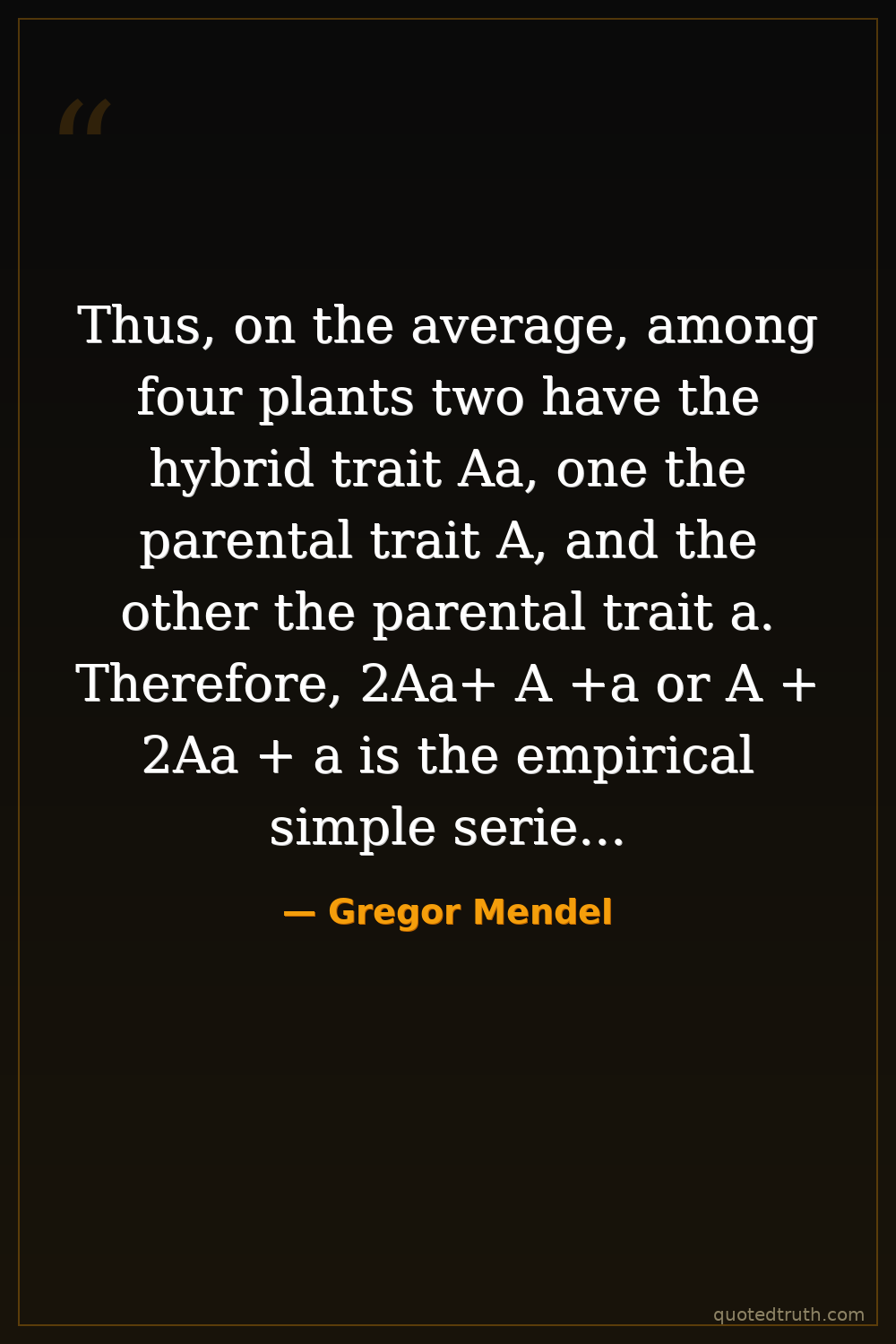
When two plants carrying different trait versions are bred together, their offspring don't blend randomly — they sort into a predictable mathematical pattern: one plant expresses the pure dominant form, two carry a hybrid mixed form, and one expresses the pure recessive form. This 1:2:1 ratio proves that hereditary units are discrete and obey fixed statistical rules, not the gradual averaging most scientists assumed governed inheritance.
Relevance to Gregor Mendel
Mendel was an Augustinian friar who spent eight years crossing pea plants in his Brno monastery garden, tracking traits across roughly 29,000 plants. His instinct to render heredity as an algebraic series — A + 2Aa + a — reflects his rare mathematical training alongside natural science. He didn't merely observe patterns; he counted, quantified, and formalized them into transferable laws, a methodological rigor entirely foreign to contemporary naturalists.
The era
Mendel published in 1866, seven years after Darwin's Origin of Species reordered biology but left heredity unexplained. The era's dominant theory — blending inheritance — held that offspring simply averaged parental traits, making evolution by selection mathematically unstable. Mendel's discrete ratios directly contradicted blending theory and supplied the missing mechanism Darwin lacked. Yet his statistical framing was so unfamiliar that the paper was ignored until three scientists independently rediscovered it in 1900.
AI-generated insights based on extensive research and information for context. Factual errors? Email [email protected].