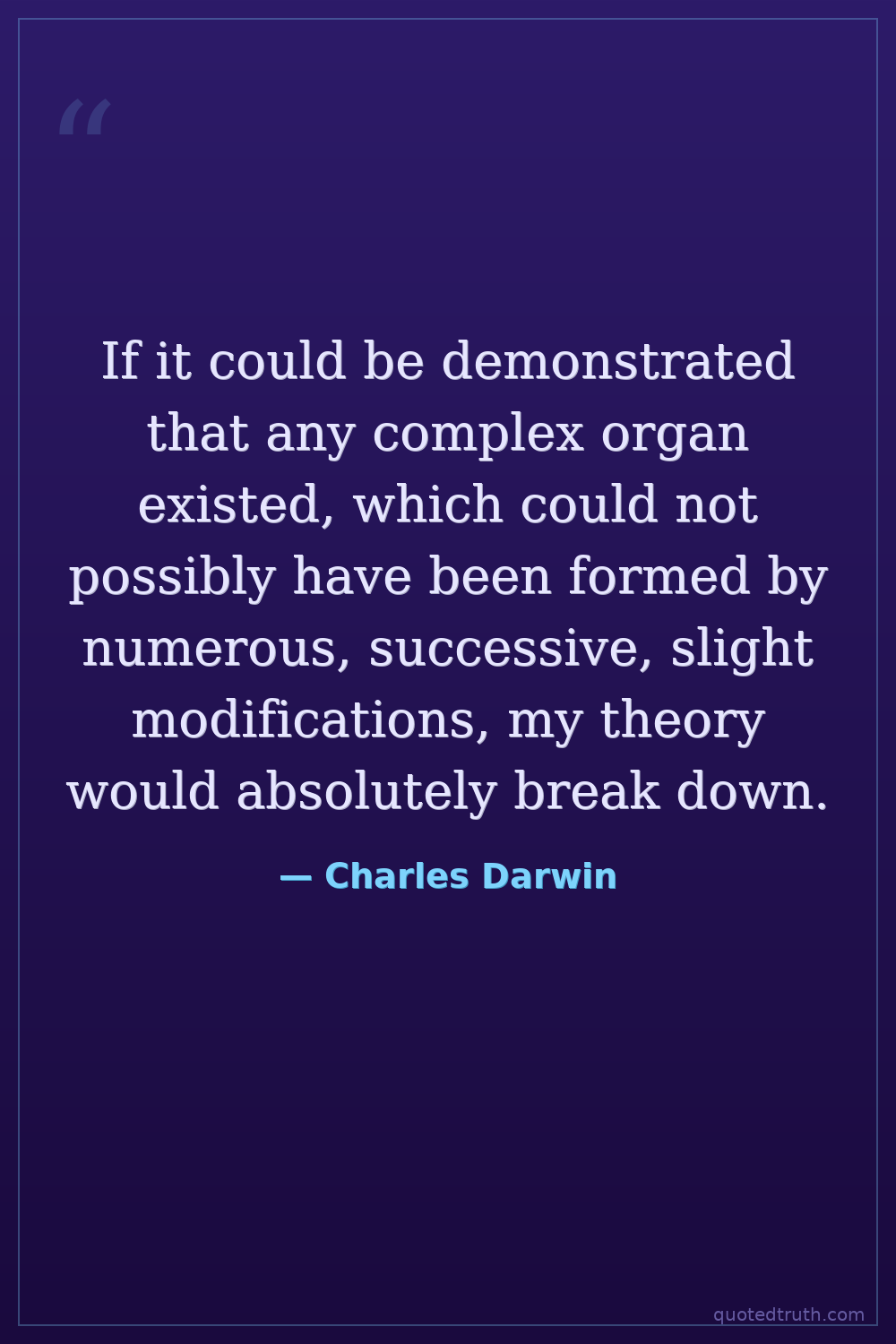
Charles Darwin — "If it could be demonstrated that any complex organ existed, which could not poss…"

If it could be demonstrated that any complex organ existed, which could not possibly have been formed by numerous, successive, slight modifications, my theory would absolutely break down.
Charles Darwin — Charles Darwin Modern · Theory of evolution

Get This Quote & Author's Image Illustrated On:

Click any product to generate a realistic preview. Up to 3 at a time.
* Initial load can take up to 90 seconds — revising the preview in another color is nearly instant.

Kitchen

Apparel

Other

About Charles Darwin (1809-1882)

British naturalist whose On the Origin of Species (1859) established evolution by natural selection — the unifying theory of modern biology. Closely associated with Thomas Henry Huxley (his 'bulldog' public defender) and Alfred Russel Wallace (independent co-discoverer of natural selection). For an intellectual contrast, see William Paley, Anglican theologian and Natural Theology author (1743-1805) — Origin of Species is structurally a 400-page reply to Paley — Darwin admired Paley's watchmaker-argument as an undergraduate at Cambridge and then spent 20 years building the empirical machinery to displace him. The cleanest 'design argument vs natural selection' founding rebuttal in science.

The standard scholarly entry points to Charles Darwin's work: Janet Browne (Harvard, history of science) — Charles Darwin: Voyaging (1995) and The Power of Place (2002); Adrian Desmond (UCL, biographer) — Darwin: The Life of a Tormented Evolutionist (1991, with James Moore). These are the works graduate seminars cite when teaching Charles Darwin.

Details

On the Origin of Species

Date: 1859

Educational

Verification

Unverifiable

Found in 1 providers: grok

1 source checked

Understanding this quote

What it means

Darwin is stating the exact condition that would disprove his theory of evolution by natural selection. If any biological structure existed that could not have formed through small, gradual, advantageous steps, natural selection fails as an explanation. It is a rare act of intellectual courage — openly declaring how to falsify your own theory rather than protecting it — embedding scientific honesty at the core of his argument rather than claiming certainty he could not prove.

Relevance to Charles Darwin

Darwin spent over twenty years refining his theory before publishing, obsessively testing its limits. He wrestled publicly with the eye's complexity, dedicating pages to showing how it could evolve incrementally. As a meticulous naturalist who spent eight years studying barnacles alone, this statement reflects his character: rigorous, self-critical, unwilling to claim more than evidence supports. He understood that naming failure conditions was the only way science could advance beyond theological assertion.

The era

Darwin published in 1859 when natural theology dominated Western science — William Paley's watchmaker argument held that intricate biological structures proved divine creation. Complex organs like the eye were the central evidence against any naturalistic theory. By explicitly naming irreducible complexity as his theory's death condition, Darwin converted a theological argument into an empirical challenge, demanding evidence over philosophy and permanently shifting how biology handled questions of design and purpose.

AI-generated insights based on extensive research and information for context. Factual errors? Email [email protected].
Your Cart

Your cart is empty