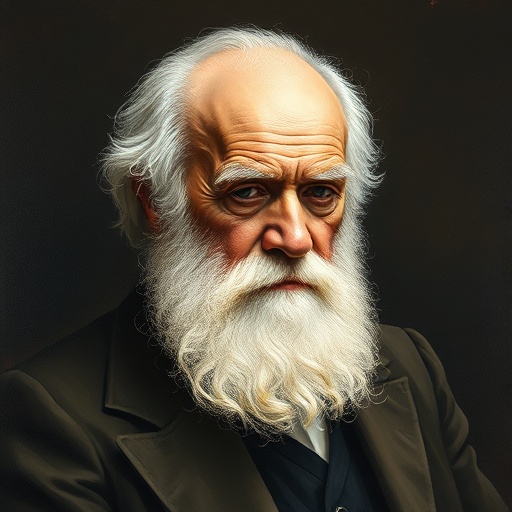
Charles Darwin — "I have tried to be a good boy, and I have done my best."
I have tried to be a good boy, and I have done my best.
I have tried to be a good boy, and I have done my best.
Click any product to generate a realistic preview. Up to 3 at a time.
* Initial load can take up to 90 seconds — revising the preview in another color is nearly instant.
"No one can feel more strongly than I do the extreme difficulty of accounting for the origin of species."
"The greatest error of all is to stop at the first result."
"I am not apt to follow blindly the lead of other men."
"If a man were to read a book on the cultivation of fruit trees, and then attempt to practice it without having seen a single tree, he would not be more unsuccessful than those who attempt to philosoph…"
"Ultimately, the universe must be the outcome of chance."
British naturalist whose On the Origin of Species (1859) established evolution by natural selection — the unifying theory of modern biology. Closely associated with Thomas Henry Huxley (his 'bulldog' public defender) and Alfred Russel Wallace (independent co-discoverer of natural selection). For an intellectual contrast, see William Paley, Anglican theologian and Natural Theology author (1743-1805) — Origin of Species is structurally a 400-page reply to Paley — Darwin admired Paley's watchmaker-argument as an undergraduate at Cambridge and then spent 20 years building the empirical machinery to displace him. The cleanest 'design argument vs natural selection' founding rebuttal in science.
The standard scholarly entry points to Charles Darwin's work: Janet Browne (Harvard, history of science) — Charles Darwin: Voyaging (1995) and The Power of Place (2002); Adrian Desmond (UCL, biographer) — Darwin: The Life of a Tormented Evolutionist (1991, with James Moore). These are the works graduate seminars cite when teaching Charles Darwin.
Attributed as a deathbed statement, though exact wording and context can vary in accounts.
Date: 1882 (approx)
WisdomFound in 1 providers: grok
1 source checked
A humble, almost childlike plea for moral acceptance at the end of a life. The speaker asks to be judged not on perfection but on sincere effort and good character. 'Good boy' signals a craving for approval — from God, loved ones, or society — while 'done my best' is a quiet self-defense: whatever the outcomes or controversies, the intention behind the work was honest and the effort was wholehearted.
Darwin reportedly spoke these words on his deathbed in April 1882. Despite revolutionizing science with On the Origin of Species, he was a modest, gentle man who agonized over the theological fallout of his findings. Raised in a religious household and briefly trained in theology, he never stopped caring about personal virtue. The phrase reveals a man who pursued uncomfortable truths yet craved the same simple moral validation as any Victorian husband and father.
Victorian England judged men above all by duty, character, and Christian virtue. Darwin's theory directly challenged biblical creation, and clergy accused him publicly of corrupting civilization's moral foundation. Yet this was also an era of scientific revolution — geology, biology, and physics were dismantling ancient certainties. To claim 'I have been good' amid those accusations meant asserting that truth-seeking itself was a moral act, not a sin, at the precise moment when that argument was most contested and consequential.
AI-generated insights based on extensive research and information for context. Factual errors? Email [email protected].
Your cart is empty