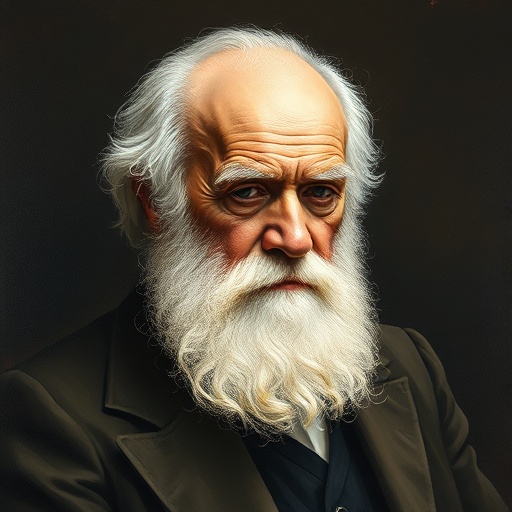
Charles Darwin — "If the misery of the poor be caused not by the laws of nature, but by our instit…"
If the misery of the poor be caused not by the laws of nature, but by our institutions, great is our sin.
If the misery of the poor be caused not by the laws of nature, but by our institutions, great is our sin.
Click any product to generate a realistic preview. Up to 3 at a time.
* Initial load can take up to 90 seconds — revising the preview in another color is nearly instant.
"I am almost convinced that species are not (it is like confessing a murder) immutable."
"The greatest discovery of all is that the world is not as we thought it was."
"The very essence of instinct is that it's followed independently of reason."
"Man tends to increase at a greater rate than his means of subsistence."
"I confess I am not much interested in the future, for I am too much occupied with the present."
British naturalist whose On the Origin of Species (1859) established evolution by natural selection — the unifying theory of modern biology. Closely associated with Thomas Henry Huxley (his 'bulldog' public defender) and Alfred Russel Wallace (independent co-discoverer of natural selection). For an intellectual contrast, see William Paley, Anglican theologian and Natural Theology author (1743-1805) — Origin of Species is structurally a 400-page reply to Paley — Darwin admired Paley's watchmaker-argument as an undergraduate at Cambridge and then spent 20 years building the empirical machinery to displace him. The cleanest 'design argument vs natural selection' founding rebuttal in science.
The standard scholarly entry points to Charles Darwin's work: Janet Browne (Harvard, history of science) — Charles Darwin: Voyaging (1995) and The Power of Place (2002); Adrian Desmond (UCL, biographer) — Darwin: The Life of a Tormented Evolutionist (1991, with James Moore). These are the works graduate seminars cite when teaching Charles Darwin.
Found in 1 providers: grok
1 source checked
Human suffering rooted in poverty is not inevitable fate handed down by nature — it is a product of the systems, laws, and social structures that humans design and maintain. When society chooses arrangements that produce mass misery and then tolerates them, it bears active moral responsibility for that suffering. The guilt is proportional to the power we had to change things but didn't use.
Darwin spent years aboard the Beagle witnessing extreme poverty and colonial exploitation in South America and beyond. His scientific framework separated natural necessity from human choice — a distinction central to this quote. A man who overturned assumptions about fixed natural order, Darwin applied that same scrutiny to social institutions, refusing to let 'the way things are' excuse preventable human suffering.
Darwin lived through the height of Britain's Industrial Revolution, when factory slums, child labor, and workhouses concentrated misery among the poor while laissez-faire economics justified it as natural law. The Poor Laws, Malthusian arguments blaming poverty on overpopulation, and imperial extraction framed deprivation as inevitable. Darwin's insistence on institutional blame was a direct challenge to the era's comfortable fatalism.
AI-generated insights based on extensive research and information for context. Factual errors? Email [email protected].
Your cart is empty