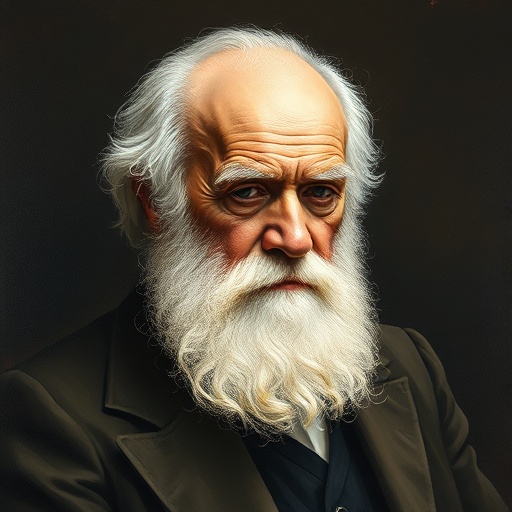
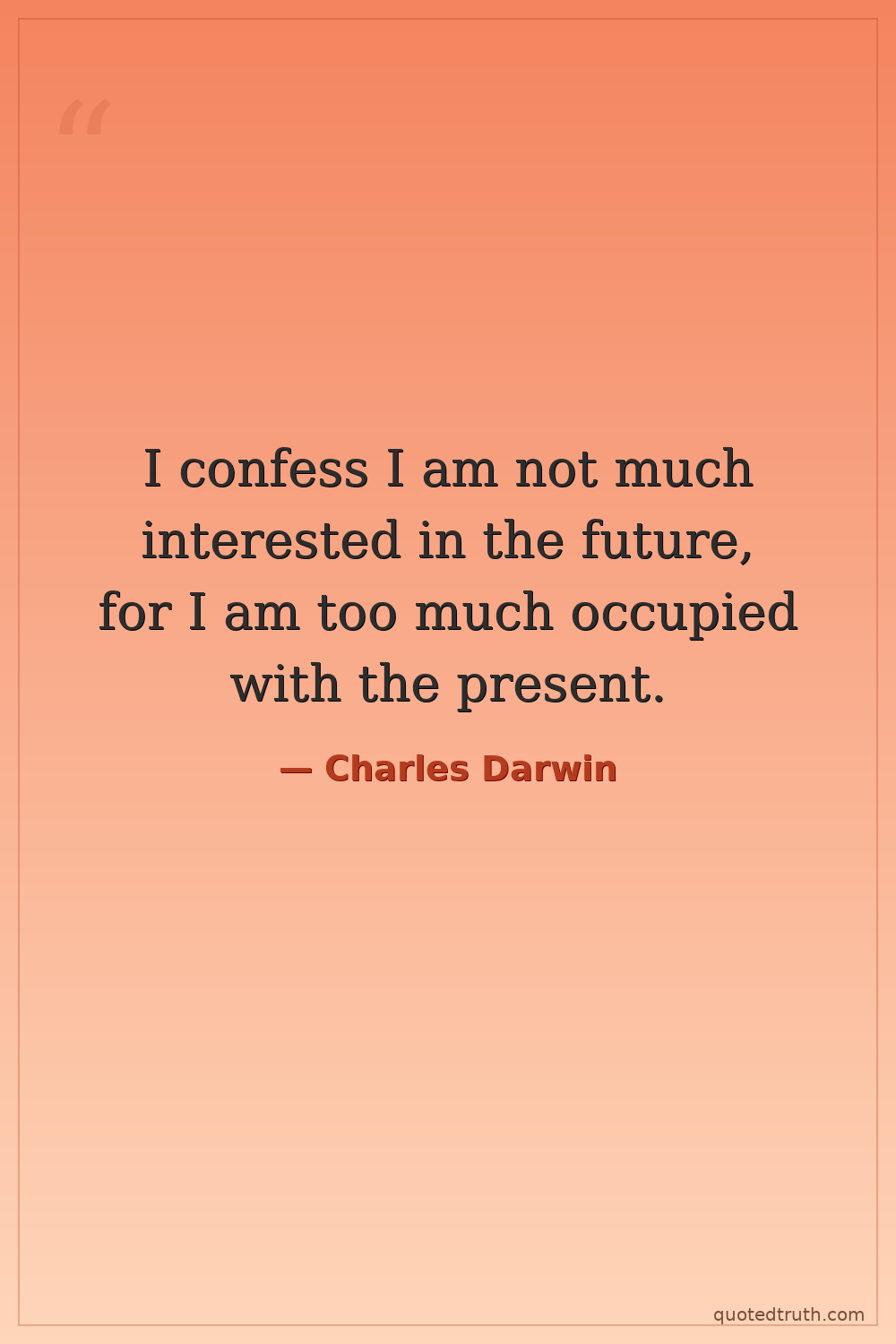
Charles Darwin — "I confess I am not much interested in the future, for I am too much occupied wit…"
I confess I am not much interested in the future, for I am too much occupied with the present.
I confess I am not much interested in the future, for I am too much occupied with the present.
Click any product to generate a realistic preview. Up to 3 at a time.
* Initial load can take up to 90 seconds — revising the preview in another color is nearly instant.
"We are not to be discouraged by the smallness of the means, but to remember that the greatest results are often produced by the accumulation of small effects."
"I hate a Barnacle as no man ever did before, not even a Sailor in a slow-sailing ship."
"I have gradually come to disbelieve in Christianity as a divine revelation."
"I am turned into a sort of machine for observing facts and grinding out generalizations."
"Ignorance more frequently begets confidence than does knowledge: it is those who know little, and not those who know much, who so positively assert that this or that problem will never be solved by sc…"
British naturalist whose On the Origin of Species (1859) established evolution by natural selection — the unifying theory of modern biology. Closely associated with Thomas Henry Huxley (his 'bulldog' public defender) and Alfred Russel Wallace (independent co-discoverer of natural selection). For an intellectual contrast, see William Paley, Anglican theologian and Natural Theology author (1743-1805) — Origin of Species is structurally a 400-page reply to Paley — Darwin admired Paley's watchmaker-argument as an undergraduate at Cambridge and then spent 20 years building the empirical machinery to displace him. The cleanest 'design argument vs natural selection' founding rebuttal in science.
The standard scholarly entry points to Charles Darwin's work: Janet Browne (Harvard, history of science) — Charles Darwin: Voyaging (1995) and The Power of Place (2002); Adrian Desmond (UCL, biographer) — Darwin: The Life of a Tormented Evolutionist (1991, with James Moore). These are the works graduate seminars cite when teaching Charles Darwin.
From a letter, indicating his focus on immediate scientific work.
Date: 1860
Self-DeprecatingFound in 1 providers: grok
1 source checked
Complete absorption in present work leaves no mental space for future-gazing. The speaker isn't dismissing the future — they simply can't reach it because right now demands everything they have. It's an honest admission that deep, focused engagement with current reality is more consuming than any forward-looking ambition. True intellectual labor is present-tense: the work in front of you is always more pressing than the horizon.
Darwin spent over twenty years cataloguing barnacles, breeding pigeons, and filling notebooks before publishing On the Origin of Species. After that landmark work, he immediately turned to orchids, earthworms, and emotional expression in animals — always the next immediate problem. He was a relentless empiricist who let observation drive him forward, not theorizing about legacy or where science would lead humanity. His entire method was grounded in what he could observe and test right now.
Victorian Britain was an era of volcanic scientific and industrial change — geology, biology, and physics were overturning centuries of religious certainty simultaneously. Darwin published during fierce cultural battles over evolution, biblical authority, and humanity's place in nature. Amid that ideological noise, choosing present-focused empirical rigor over prophetic speculation was itself a philosophical stance: science advances by watching carefully, not by declaring where the future must go.
AI-generated insights based on extensive research and information for context. Factual errors? Email [email protected].
Your cart is empty