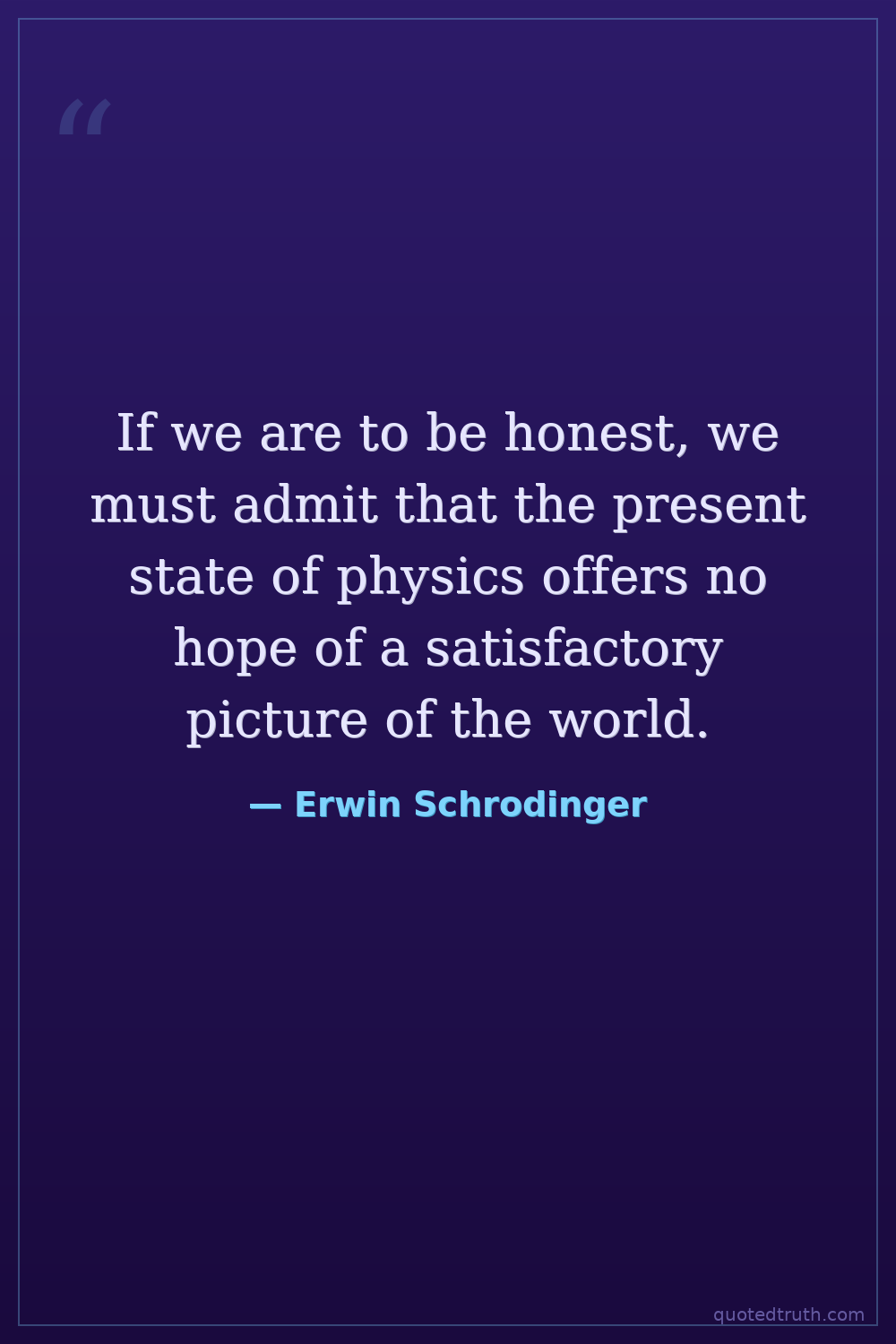
Erwin Schrodinger — "If we are to be honest, we must admit that the present state of physics offers n…"
If we are to be honest, we must admit that the present state of physics offers no hope of a satisfactory picture of the world.
If we are to be honest, we must admit that the present state of physics offers no hope of a satisfactory picture of the world.
Click any product to generate a realistic preview. Up to 3 at a time.
* Initial load can take up to 90 seconds — revising the preview in another color is nearly instant.
"God's existence or non-existence, and the validity of moral laws, are not matters for scientific inquiry."
"The total number of minds in the universe is one. In fact, consciousness is a singularity."
"We are told such a number as the square root of 2 worried Pythagoras and his school almost to exhaustion. Being used to such queer numbers from early childhood, we must be careful not to form a low id…"
"The problem of consciousness is the most difficult problem in science."
"The world is a construct of our sensations, perceptions, memories. It is convenient to regard it as existing objectively. But it is not a logical necessity."
Austrian physicist who shared the 1933 Nobel for the wave equation that bears his name and the famous cat thought-experiment. Closely associated with Werner Heisenberg (matrix-mechanics rival who reached the same physics by different math) and Albert Einstein (his pen-pal on quantum interpretation). For an intellectual contrast, see Niels Bohr, Danish physicist and architect of the Copenhagen interpretation — Schrödinger's cat thought-experiment was specifically designed to ridicule Bohr's 'observer-dependent reality' reading of quantum mechanics — Schrödinger thought the Copenhagen interpretation was absurd; the cat was meant as reductio ad absurdum.
Found in 1 providers: grok
1 source checked
Physics, despite its advances, cannot yet give us a complete and coherent picture of reality. The theories work mathematically but don't fully explain what matter, energy, and the universe actually are at a fundamental level. Honesty requires admitting this gap between calculating results and truly understanding nature's underlying structure.
Schrödinger spent his career troubled by quantum mechanics' incompleteness. He invented wave mechanics in 1926, yet grew increasingly dissatisfied with Copenhagen's probabilistic interpretation. His famous cat paradox was a protest against quantum theory's failure to describe objective reality. He sought a unified, visualizable account of nature that physics couldn't deliver.
Mid-20th century physics had triumphed with relativity and quantum mechanics yet produced deep philosophical contradictions. Quantum theory predicted experimental results perfectly but offered no agreed-upon picture of what was really happening. Bohr, Einstein, Heisenberg, and Schrödinger publicly disagreed about reality's nature, exposing a crisis in scientific foundations despite unprecedented technological success.
AI-generated insights based on extensive research and information for context. Factual errors? Email [email protected].
Your cart is empty