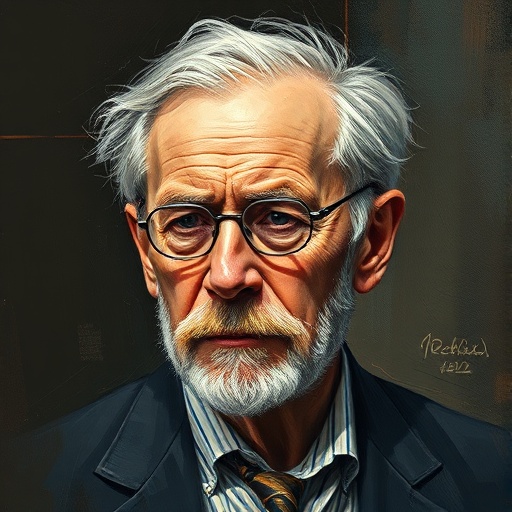
Erwin Schrodinger — "The problem of consciousness is the most difficult problem in science."
The problem of consciousness is the most difficult problem in science.
The problem of consciousness is the most difficult problem in science.
Click any product to generate a realistic preview. Up to 3 at a time.
* Initial load can take up to 90 seconds — revising the preview in another color is nearly instant.
"The most important thing for a scientist is to be open to new ideas and to be willing to question established beliefs."
"The world is not a static place, but is constantly changing and evolving."
"If we were to pursue the idea to its logical conclusion, we would have to assume that every thought, every feeling, every sensation is somehow connected with an elementary process in the brain, with a…"
"It is not possible that this unity of knowledge, feeling and choice which you call your own should have sprung into being from nothingness at a given moment not so long ago; rather this knowledge, fee…"
"Consciousness is a singular of which the plural is unknown."
Austrian physicist who shared the 1933 Nobel for the wave equation that bears his name and the famous cat thought-experiment. Closely associated with Werner Heisenberg (matrix-mechanics rival who reached the same physics by different math) and Albert Einstein (his pen-pal on quantum interpretation). For an intellectual contrast, see Niels Bohr, Danish physicist and architect of the Copenhagen interpretation — Schrödinger's cat thought-experiment was specifically designed to ridicule Bohr's 'observer-dependent reality' reading of quantum mechanics — Schrödinger thought the Copenhagen interpretation was absurd; the cat was meant as reductio ad absurdum.
Found in 1 providers: grok
1 source checked
Understanding consciousness — how physical brain processes give rise to subjective inner experience — is harder than any other scientific problem. Unlike physics or chemistry, it resists standard methods because the observer is the very thing being studied. We can measure neurons firing but cannot explain why there is something it feels like to see red, feel pain, or think a thought. Science still has no agreed framework for bridging this gap.
Schrödinger's career extended far beyond wave mechanics. His 1944 book 'What Is Life?' pioneered biophysics and directly influenced Watson and Crick's discovery of DNA's structure. He followed it with 'Mind and Matter' in 1958, confronting consciousness directly. Deeply shaped by Vedantic philosophy and Schopenhauer, he believed consciousness was a fundamental unity rather than a neural byproduct. His refusal to separate physics from philosophy made grappling with mind the natural culmination of his life's work.
Schrödinger worked in the mid-20th century when quantum mechanics had just shattered classical physics, raising unsettling questions about the observer's role in measurement. Behaviorism dominated psychology, dismissing inner experience as unscientific. Turing's 1950 paper on machine intelligence pushed consciousness further into debate. Yet neuroscience lacked modern tools. Schrödinger's era sensed that consciousness was science's final frontier — and that quantum theory's own measurement problem hinted the mind could not simply be excluded from physics.
AI-generated insights based on extensive research and information for context. Factual errors? Email [email protected].
Your cart is empty