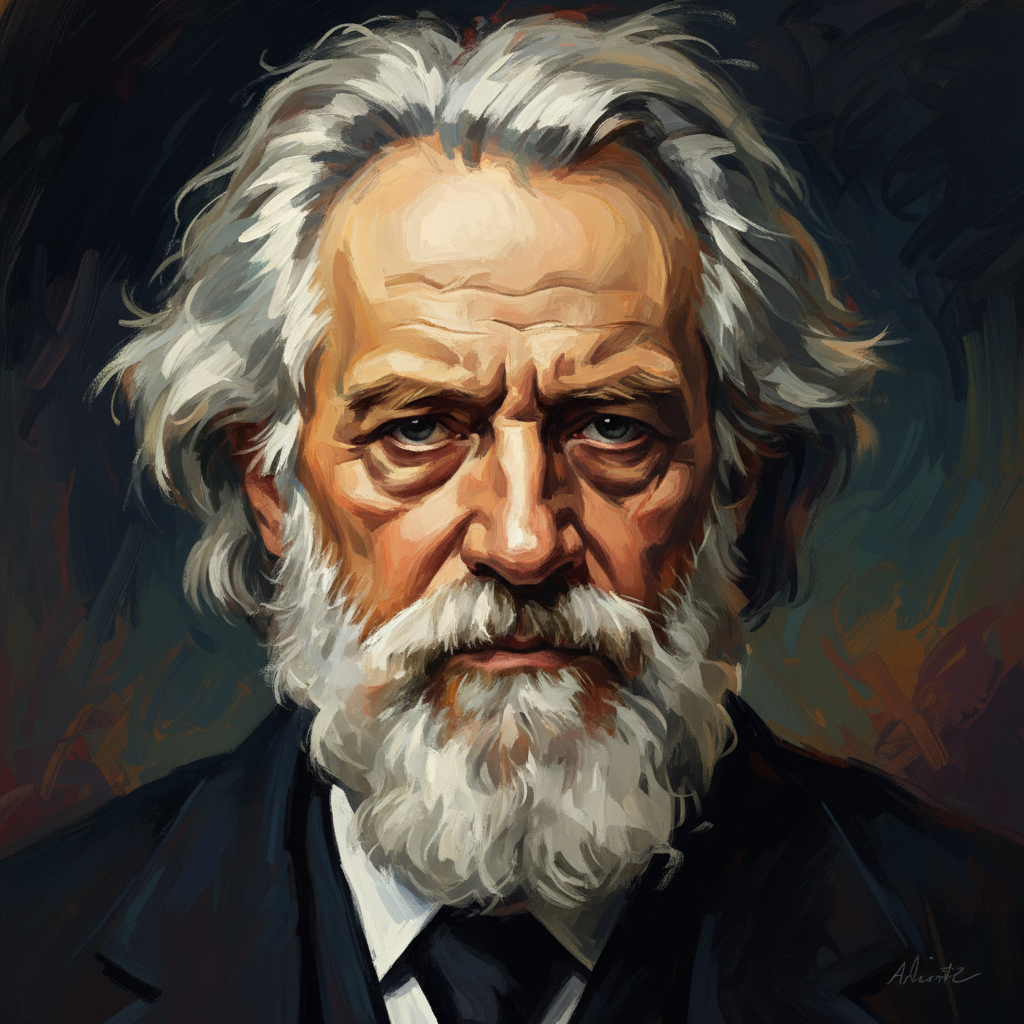
Arthur Schopenhauer — "If we were not all so pitifully and ridiculously constituted, we should be asham…"
If we were not all so pitifully and ridiculously constituted, we should be ashamed to be alive.
If we were not all so pitifully and ridiculously constituted, we should be ashamed to be alive.
Click any product to generate a realistic preview. Up to 3 at a time.
* Initial load can take up to 90 seconds — revising the preview in another color is nearly instant.
"We are like lambs in a field, disporting themselves under the eye of the butcher, who chooses out first one and then another for his prey."
"What people commonly call fate is mostly their own stupidity."
"If you want to know your true opinion of someone, watch the effect produced in you by the first sight of a letter from him."
"The only original philosophical thought possible is the one that starts from the fact of suffering."
"One need only look at a woman's shape to discover that she is not intended for either too much mental or too much physical work. Women are directly adapted to act as the nurses and educators of our ea…"
German philosopher of pessimism whose The World as Will and Representation (1819) defined the suffering-and-renunciation tradition. Closely associated with Immanuel Kant (the system Schopenhauer built on and revised). For an intellectual contrast, see G.W.F. Hegel, German Idealist of the rational unfolding of Spirit — Schopenhauer scheduled his Berlin lectures opposite Hegel's and spent decades attacking Hegel's optimistic system as deliberately mystifying nonsense — the foundational rivalry of 19th-century German philosophy.
The standard scholarly entry points to Arthur Schopenhauer's work: Bryan Magee (Oxford, populariser-philosopher) — The Philosophy of Schopenhauer (1983); Christopher Janaway (Southampton, Schopenhauer specialist) — Self and World in Schopenhauer's Philosophy (1989); David E. Cartwright (Wisconsin–Whitewater) — Schopenhauer: A Biography (2010). These are the works graduate seminars cite when teaching Arthur Schopenhauer.
Your cart is empty