What it means
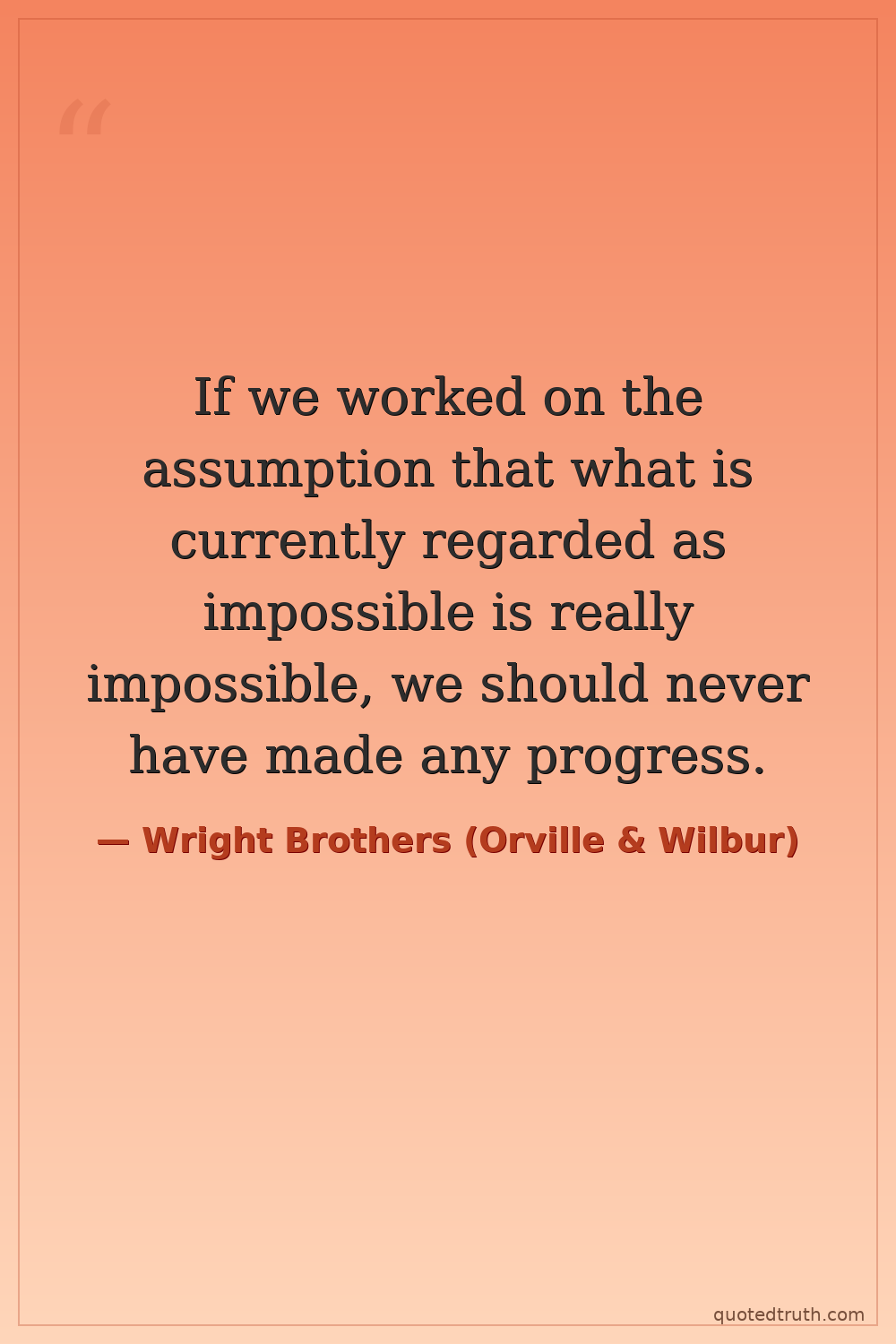
Treating current consensus about impossibility as permanent truth stops all progress. Real advancement requires questioning what society labels as impossible, because those labels reflect the limits of present knowledge, not the limits of reality. When people stop attempting what experts call impossible, innovation dies. History repeatedly proves that persistence and fresh thinking can overturn what everyone assumed was fixed and final.
Relevance to Wright Brothers (Orville & Wilbur)
Orville and Wilbur were bicycle mechanics with no engineering degrees who ignored experts — including Lord Kelvin and Smithsonian-backed Samuel Langley — who declared heavier-than-air flight physically impossible. They built their own wind tunnel, collected original aerodynamic data, and flew at Kitty Hawk in 1903. Their career was a direct refutation of inherited impossibility. They succeeded precisely because they treated expert consensus as a hypothesis, not a verdict.
The era
In the early 1900s, leading scientists publicly declared human flight impossible, and the Smithsonian Institution had already spent federal money trying and failing. The Second Industrial Revolution had made steam, electricity, and telegraphs ordinary — yet powered flight remained taboo. This tension between rapid industrialization and persistent expert skepticism made the Wright Brothers' success culturally explosive, proving that working-class empiricists could outpace credentialed institutions by simply refusing to accept their conclusions.
AI-generated insights based on extensive research and information for context. Factual errors? Email [email protected].