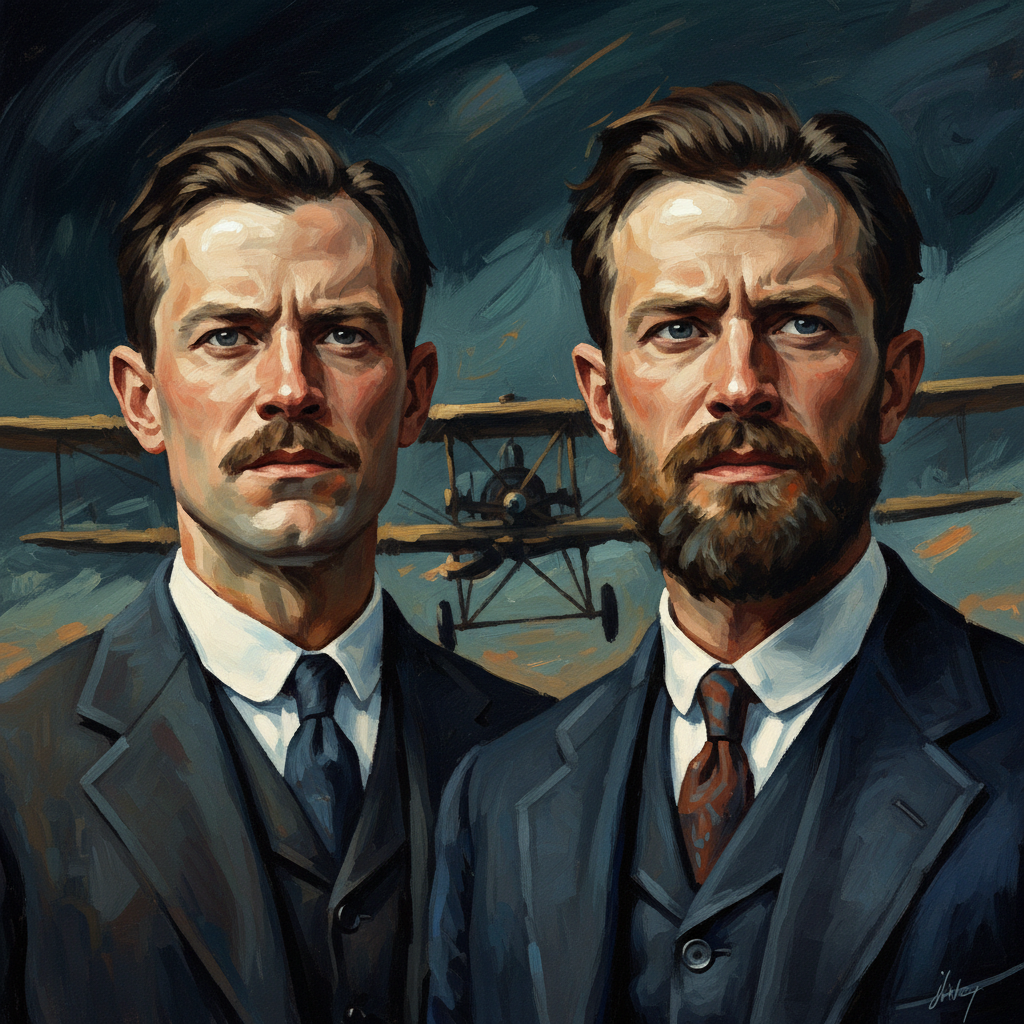
Wright Brothers (Orville & Wilbur) — "We had taken up the invention of the flying machine as a sport."
We had taken up the invention of the flying machine as a sport.
We had taken up the invention of the flying machine as a sport.
Click any product to generate a realistic preview. Up to 3 at a time.
* Initial load can take up to 90 seconds — revising the preview in another color is nearly instant.
"It is not in the nature of man to be content with things as they are."
"We are trying to arrange a demonstration in Europe."
"The time will come when man will fly."
"We could hardly wait to get up in the morning."
"The greatest value of our experiments has been their negative results."
American aviation pioneers who achieved the first sustained powered controlled airplane flight at Kitty Hawk, NC, on December 17, 1903. Closely associated with Octave Chanute (their gliding mentor and aeronautical correspondent). For an intellectual contrast, see Samuel Pierpont Langley, Smithsonian Institution Secretary and government-funded aviation researcher — Langley's Aerodrome crashed twice into the Potomac in October-December 1903 with $50,000 of War Department funding; the Wright Brothers' bicycle-shop empiricism beat Langley's institutional Big Science by 9 days. The most-cited example in engineering history of empirical-tinkerer beating institution-funded credentialism.
Found in 1 providers: grok
1 source checked
They approached building an airplane the way someone picks up a hobby — out of curiosity and love of the challenge, not because someone hired or paid them to solve it. They weren't chasing a contract or a prize. The joy was in the puzzle itself. Today we'd call this intrinsic motivation: doing hard, ambitious work because the problem fascinates you, not because the reward demands it.
Orville and Wilbur Wright were bicycle mechanics in Dayton, Ohio — self-funded, self-taught, with no government grants or university backing. They began reading about flight out of curiosity after Otto Lilienthal's glider work. Their playful, iterative approach — testing, failing, adjusting at Kitty Hawk — was precisely what formally funded institutions had failed to replicate, and it produced the first powered flight in December 1903.
In the early 1900s, human flight was widely considered impossible. Samuel Langley's government-funded Aerodrome had crashed spectacularly into the Potomac just days before the Wrights' success. America was in a tinkerer's golden age: Edison, Bell, and Tesla had shown that workshop amateurs could reshape civilization. That culture made it natural for two bicycle shop owners to treat the greatest unsolved engineering challenge of their generation as a sport.
AI-generated insights based on extensive research and information for context. Factual errors? Email [email protected].
Your cart is empty