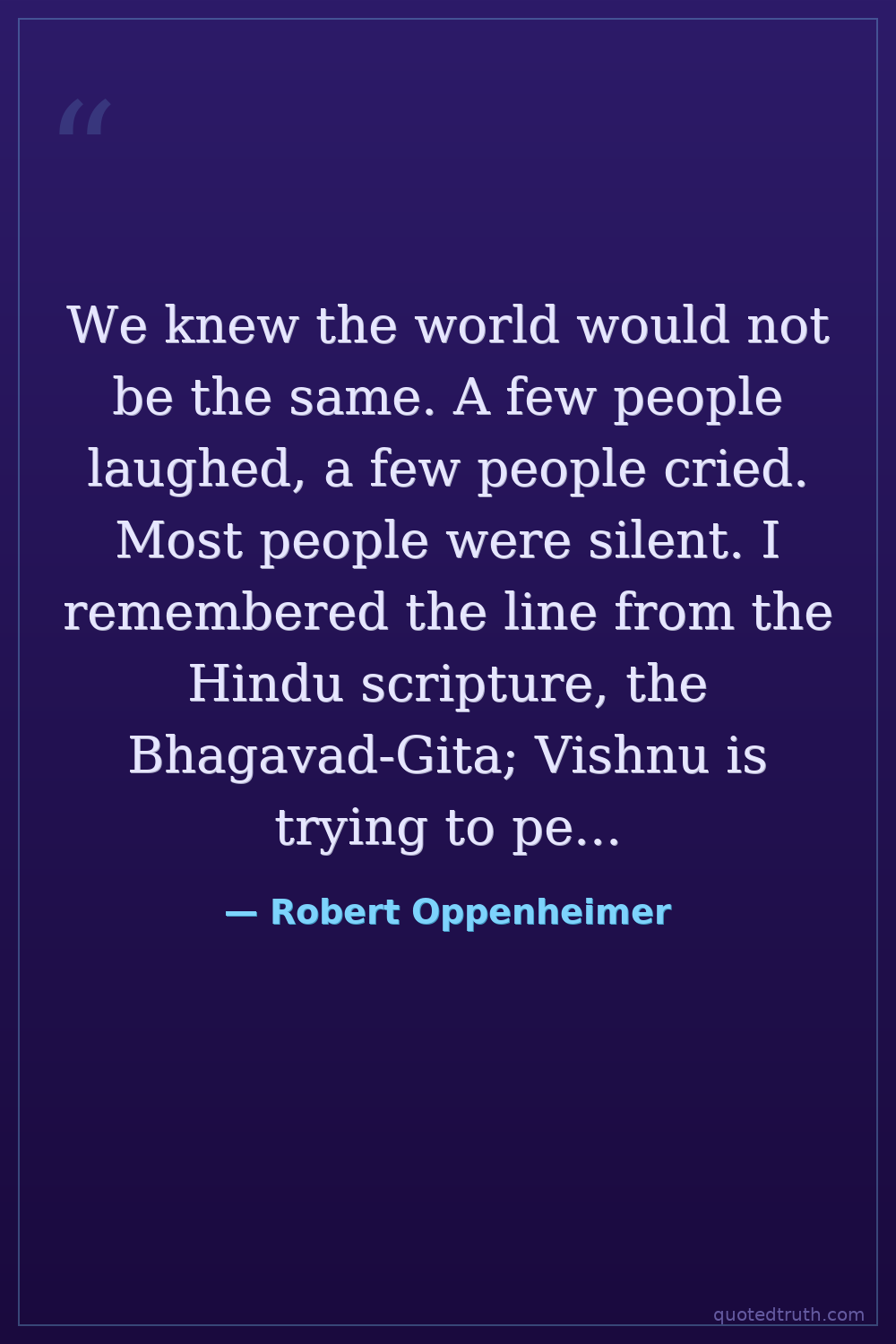
Robert Oppenheimer — "We knew the world would not be the same. A few people laughed, a few people crie…"

We knew the world would not be the same. A few people laughed, a few people cried. Most people were silent. I remembered the line from the Hindu scripture, the Bhagavad-Gita; Vishnu is trying to persuade the Prince that he should do his duty and, to impress him, takes on his multi-armed form and says, 'Now I am become Death, the destroyer of worlds.' I suppose we all thought that, one way or another.
Robert Oppenheimer — Robert Oppenheimer Modern · Manhattan Project leader

Get This Quote & Author's Image Illustrated On:

Click any product to generate a realistic preview. Up to 3 at a time.
* Initial load can take up to 90 seconds — revising the preview in another color is nearly instant.

Kitchen

Apparel

Other

About Robert Oppenheimer (1904-1967)

American theoretical physicist who directed the Manhattan Project's Los Alamos Laboratory and oversaw the atomic bombs; lost his security clearance in 1954. Closely associated with Niels Bohr (Manhattan Project consultant and atomic-policy advisor) and Hans Bethe (Los Alamos theoretical-division chief). For an intellectual contrast, see Edward Teller, Hungarian-American physicist and 'father of the H-bomb' — Teller pushed the H-bomb against Oppenheimer's objections and testified against him at his 1954 security hearing — the precise moment that ended Oppenheimer's career. The canonical 'physicist-of-conscience vs physicist-of-state' pairing in nuclear-age ethics; Christopher Nolan's Oppenheimer (2023) dramatized this rivalry for a mass audience.

Details

NBC News documentary 'The Decision to Drop the Bomb'

Date: 1965

Biblical

Verification

Unverifiable

Found in 1 providers: grok

1 source checked

Understanding this quote

What it means

This quote captures the moral and existential weight of witnessing the first nuclear detonation. Oppenheimer describes three human responses — laughter, tears, silence — then reaches for ancient Hindu scripture to name what language alone cannot hold: humanity had just acquired the power to destroy itself. The Bhagavad-Gita's image of Vishnu-as-Death becomes the only frame large enough for the threshold they had crossed, and could never uncross.

Relevance to Robert Oppenheimer

Oppenheimer read the Bhagavad-Gita in Sanskrit — his classical education was inseparable from his scientific identity. As Manhattan Project director he assembled the minds that built Trinity, yet spent his postwar years advocating arms control and opposing the hydrogen bomb. His 1954 security clearance revocation was the political cost of that conscience. This reflection, recalled two decades later in a 1965 NBC documentary, shows the Trinity test never stopped haunting him.

The era

The Trinity test detonated July 16, 1945, three weeks before Hiroshima and Nagasaki killed roughly 200,000 people. WWII's Pacific theater was still grinding toward a land invasion. The bomb ended that war and immediately launched a Cold War arms race — the Soviet Union tested its own device in 1949. Oppenheimer voiced this reflection in 1965, after two decades of living inside the nuclear age his own hands had opened.

AI-generated insights based on extensive research and information for context. Factual errors? Email [email protected].
Your Cart

Your cart is empty