What it means
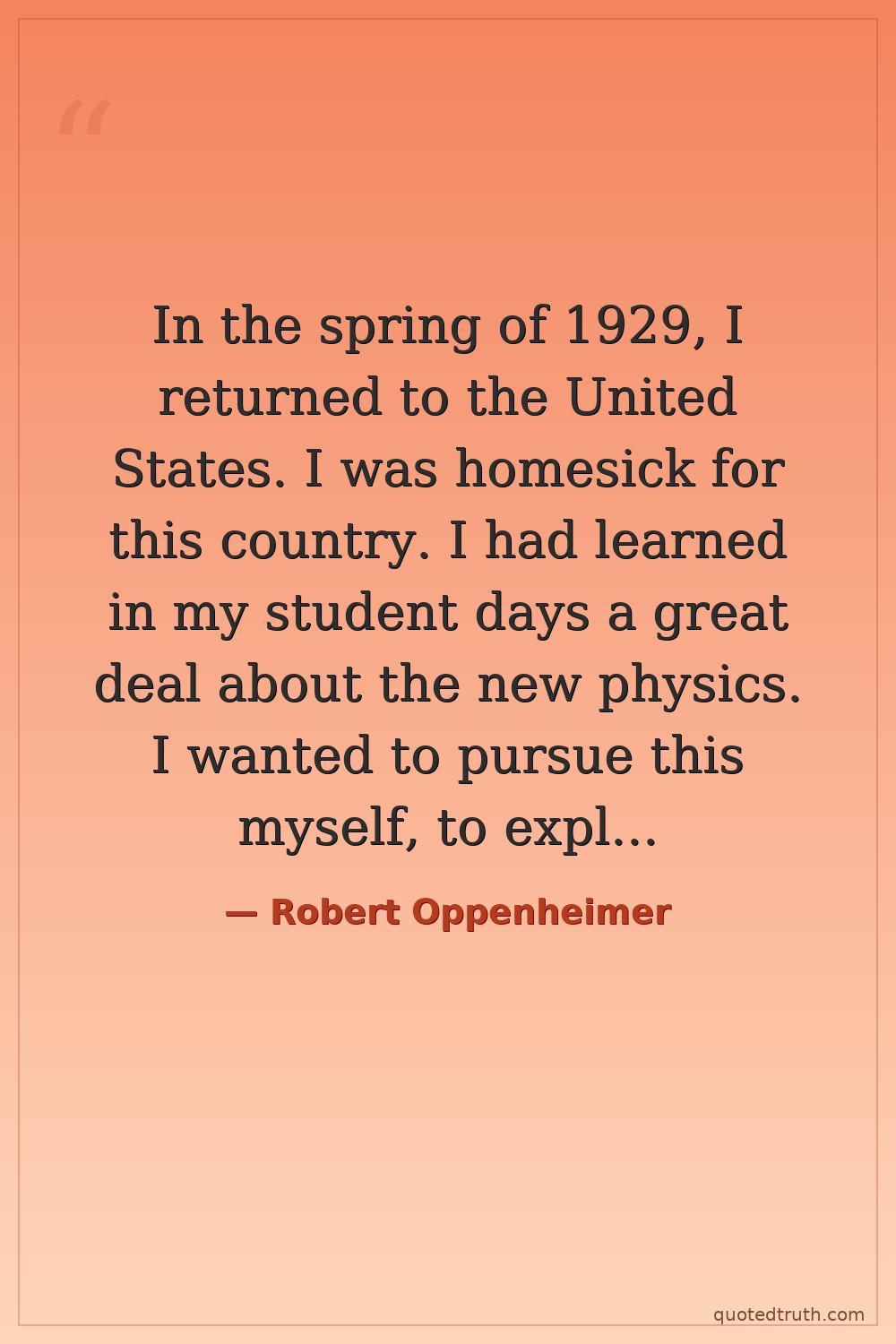
After studying quantum mechanics in Europe, Oppenheimer felt pulled back to America. He'd absorbed revolutionary ideas about how matter and energy behave at atomic scales—the 'new physics'—and returned with a clear mission: practice this cutting-edge science himself, teach it, and help it take root in American academia. The quote captures the patriotic drive of someone who wanted to transplant an intellectual revolution into his home country and build something lasting there.
Relevance to Robert Oppenheimer
Oppenheimer earned his PhD at Göttingen under Max Born in 1927, immersed in quantum mechanics' epicenter. Returning in 1929, he took dual appointments at Berkeley and Caltech, building America's premier theoretical physics school. His drive to 'foster its cultivation' proved prophetic—he trained a generation of physicists who later joined the Manhattan Project. This early idealism about science as a calling defined him before the moral weight of the bomb complicated everything he believed.
The era
By 1929, European universities—especially Göttingen and Copenhagen—dominated theoretical physics, having just produced quantum mechanics' foundational breakthroughs: Heisenberg's uncertainty principle (1927) and Dirac's equation (1928). American physics was considered provincial by comparison. Oppenheimer's return was a deliberate effort to close that gap. Within a decade, Nazi persecution would drive Europe's top physicists to America anyway, but Oppenheimer helped build the institutional infrastructure that made the US ready to receive and deploy them.
AI-generated insights based on extensive research and information for context. Factual errors? Email [email protected].