What it means
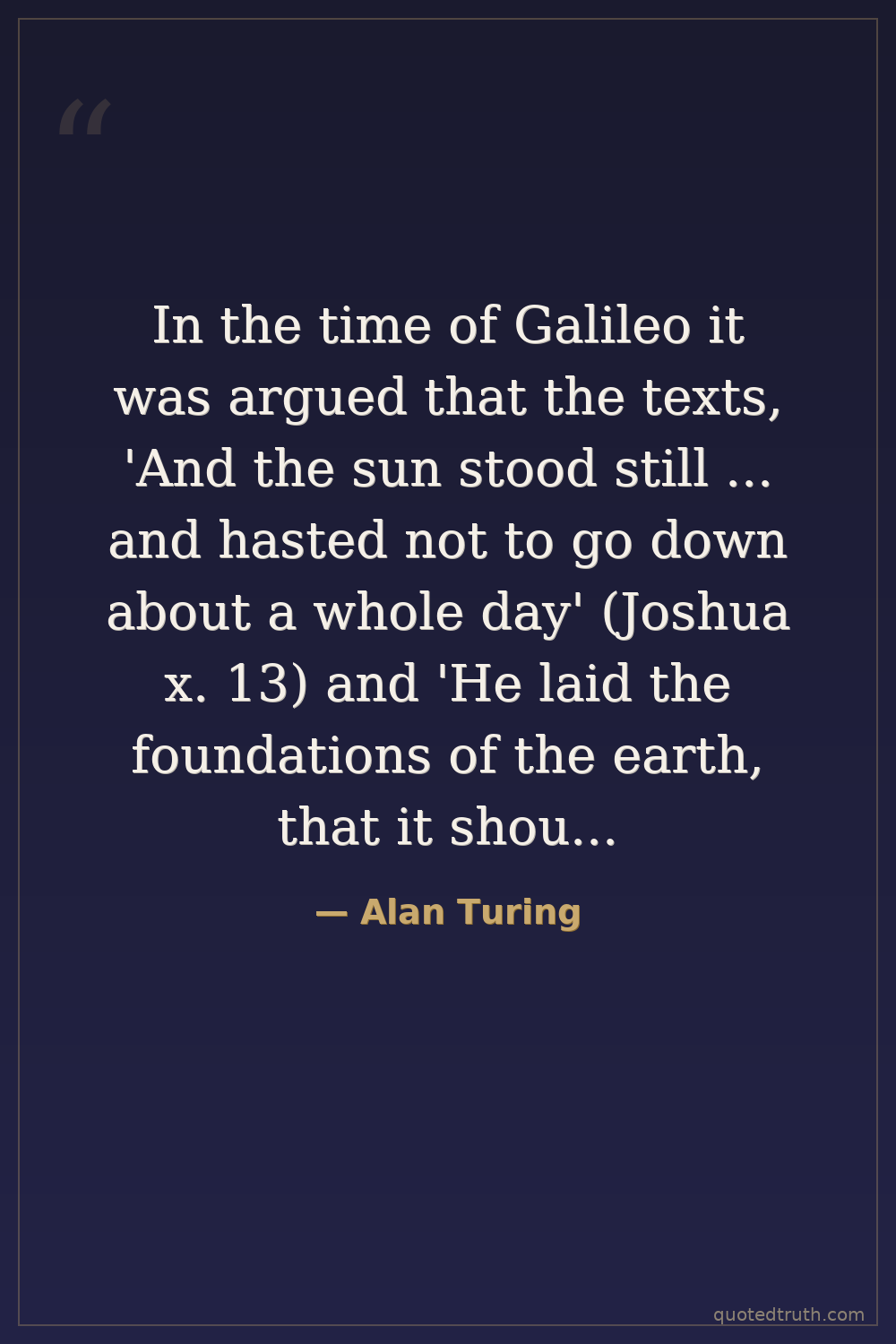
The quote highlights how biblical passages were once treated as conclusive scientific proof against heliocentrism — the idea that Earth, not the sun, moves. Turing uses this to expose a recurring error: invoking authoritative texts to shut down empirical inquiry. The lesson is that sacred or traditional arguments don't automatically refute new theories, and history often vindicates the scientist over the scripture-citer.
Relevance to Alan Turing
Turing wrote this in his 1950 paper proposing the Turing Test, using Galileo's persecution as an analogy for objections to machine intelligence. He was directly countering theological arguments that machines could never think or possess souls. Turing himself faced institutional persecution — the British government prosecuted him for homosexuality in 1952 — making him acutely aware of how authority weaponizes tradition to suppress inconvenient truths.
The era
Written in 1950, as the first computers emerged and the Cold War reshaped science's role in society, Turing's era saw intense debate over what machines could do. Postwar Britain retained strong religious-cultural conservatism. Questions about artificial minds threatened conventional ideas about human uniqueness. By invoking Galileo, Turing reminded readers that science had won such battles before, legitimizing his radical claim that machines might one day think.
AI-generated insights based on extensive research and information for context. Factual errors? Email [email protected].