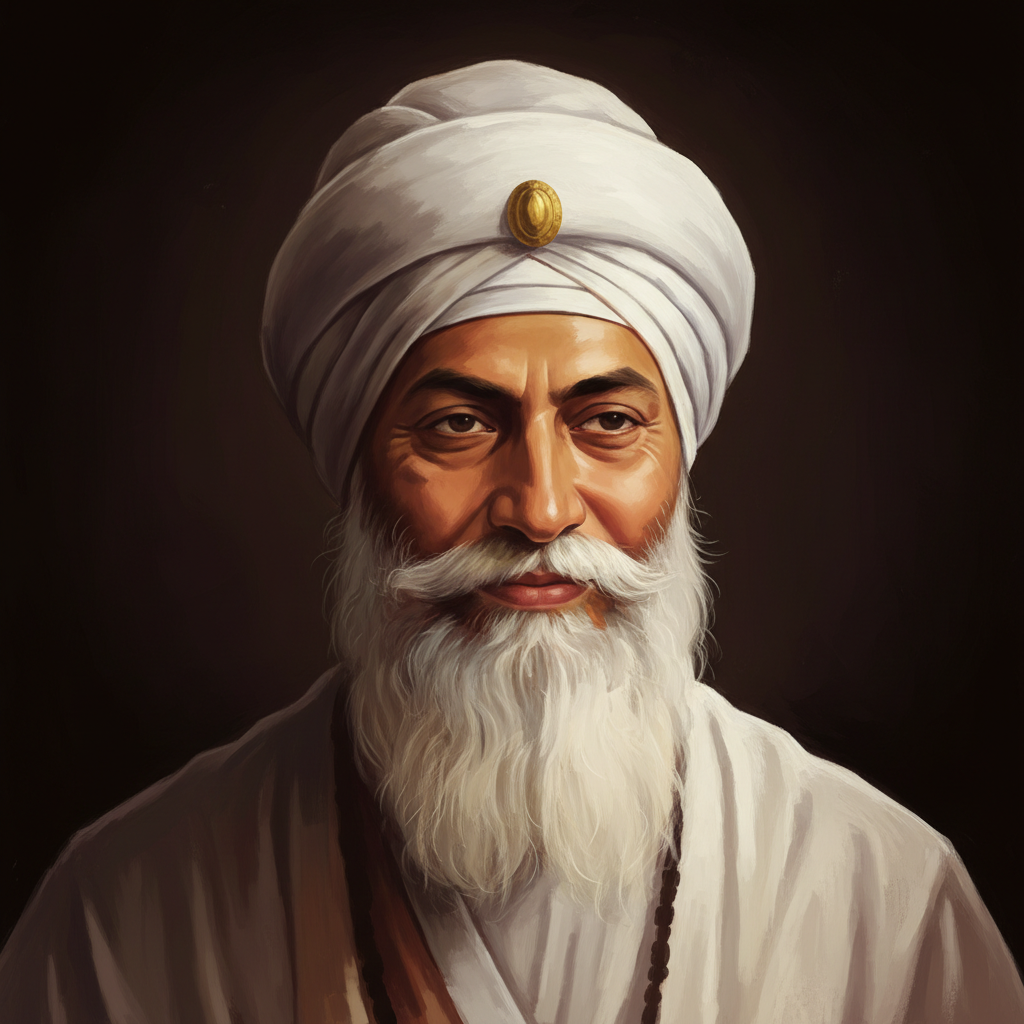
Guru Nanak — "Injustice has no place in God's order because He is absolute just."
Injustice has no place in God's order because He is absolute just.
Injustice has no place in God's order because He is absolute just.
Click any product to generate a realistic preview. Up to 3 at a time.
* Initial load can take up to 90 seconds — revising the preview in another color is nearly instant.
"Before becoming a Muslim, a Hindu, a Christian, a Jew, let us become a Human."
"What is the use of bathing at sacred shrines, if the mind is full of impurity?"
"There is no Hindu, there is no Muslim, there is only one human race."
"The world is suffering in falsehood, and only truth can save it."
"The Guru is the ladder, the boat, the raft, the ferryman, the ship, and the captain."
Founder of Sikhism and the first of the Ten Sikh Gurus, whose teachings of one universal God and rejection of caste shaped Punjab. Closely associated with Kabir (mystical poet whose verses appear in the Sikh Guru Granth Sahib). For an intellectual contrast, see Brahmanical orthodoxy, the Hindu caste-and-ritual establishment of his era — Sikhism was founded as a deliberate alternative to both Hindu ritual hierarchy and Islamic exclusivism — Nanak's universalism was a structural rejection of caste and priestly mediation.
Context: General teaching, often attributed as a core principle
Date: c. 15th-16th century
GeneralFound in 1 providers: gemini
1 source checked
The statement says that unfairness cannot exist as a legitimate part of reality because the divine is perfectly just by nature. Whatever appears unjust is not sanctioned by God but is a human distortion. Since the ultimate source of existence embodies flawless fairness, any system, ruler, or action built on oppression stands outside the true moral order and will ultimately be overturned or corrected, because the universe itself is structured around justice.
Guru Nanak (1469-1539) founded Sikhism on the pillars of one formless God, equality, and honest living. He openly condemned the caste system, empty ritualism, and the cruelty of rulers, even rebuking Emperor Babur for the slaughter at Saidpur. His insistence that God is absolutely just underpinned his teachings that Brahmins, Muslims, untouchables, and women all stood equal before the divine, making justice inseparable from genuine devotion.
Nanak lived during the Delhi Sultanate's decline and the Mughal invasions under Babur in Punjab. Society was fractured by rigid Hindu caste hierarchies, Islamic jizya taxation on non-Muslims, forced conversions, and brutal warfare that devastated ordinary villagers. Religious elites on both sides exploited commoners through ritual fees and political favor. Declaring God absolutely just directly challenged this entrenched inequality, offering a radical theological basis for dignity during a period of widespread violence and spiritual corruption.
AI-generated insights based on extensive research and information for context. Factual errors? Email [email protected].
Your cart is empty