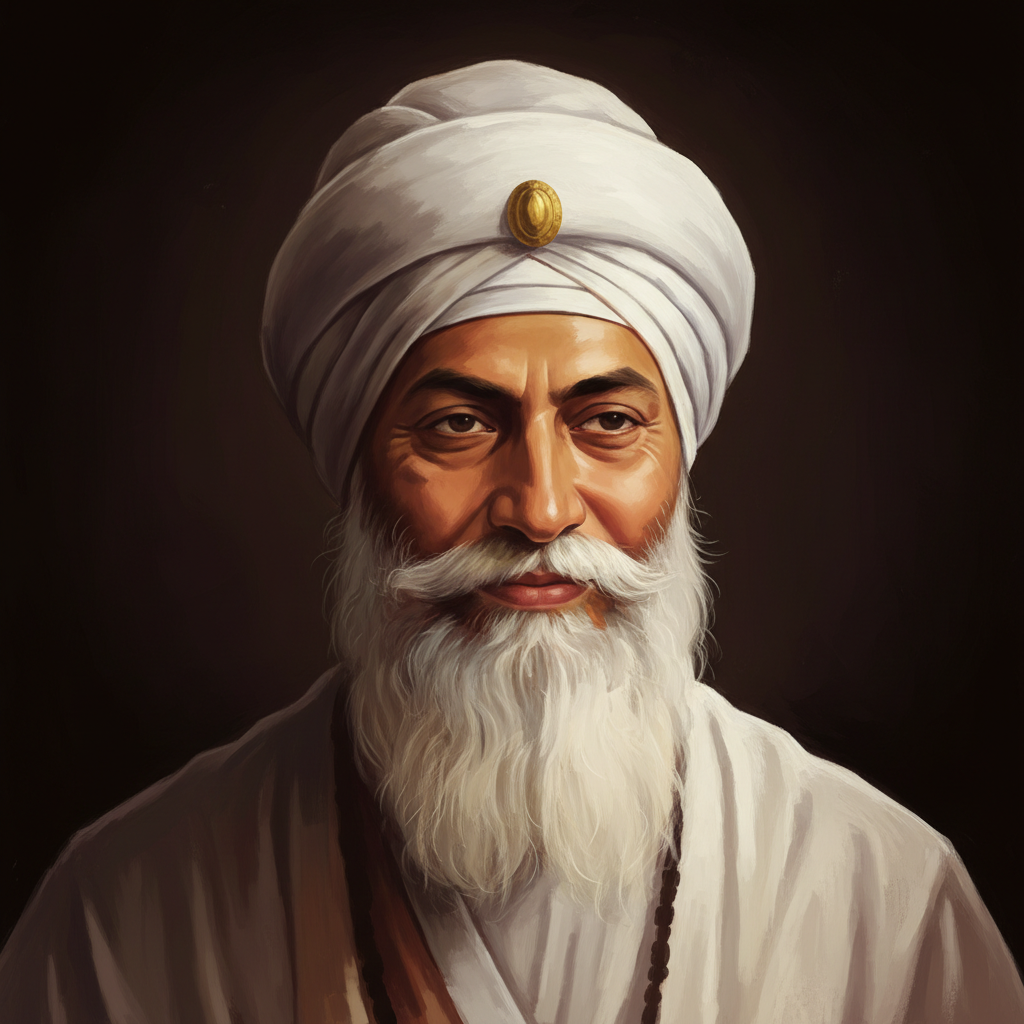
Guru Nanak — "The Guru is the ladder, the boat, the raft, the ferryman, the ship, and the capt…"
The Guru is the ladder, the boat, the raft, the ferryman, the ship, and the captain.
The Guru is the ladder, the boat, the raft, the ferryman, the ship, and the captain.
Click any product to generate a realistic preview. Up to 3 at a time.
* Initial load can take up to 90 seconds — revising the preview in another color is nearly instant.
"The world is burning in the fire of desire, hatred, and ego. Save it, O Lord, by Your Grace."
"Alone let him constantly meditate in solitude on that which is salutary for his soul, for he who meditates in solitude attains supreme bliss."
"He who is born, is bound to die. The only thing certain is death. All else is illusion."
"Without the Guru, no one has found God."
"Your Mercy is my social status."
Founder of Sikhism and the first of the Ten Sikh Gurus, whose teachings of one universal God and rejection of caste shaped Punjab. Closely associated with Kabir (mystical poet whose verses appear in the Sikh Guru Granth Sahib). For an intellectual contrast, see Brahmanical orthodoxy, the Hindu caste-and-ritual establishment of his era — Sikhism was founded as a deliberate alternative to both Hindu ritual hierarchy and Islamic exclusivism — Nanak's universalism was a structural rejection of caste and priestly mediation.
Found in 1 providers: gemini
1 source checked
A true teacher is every tool you need to cross from confusion to understanding. They are the climb upward, the vessel that carries you over rough water, and the skilled guide steering the way. Without such a guide, you cannot make the crossing on your own. The saying stacks multiple images to make one point: genuine spiritual progress depends on a trusted mentor who provides both the means and the direction.
Guru Nanak founded Sikhism and the very title 'Guru' became central to the tradition he started, with nine successors and finally the scripture itself serving as eternal Guru. A lifelong traveler who journeyed across South Asia and the Middle East on his udasis, he naturally reached for boat, ferry, and captain imagery. He taught that liberation came through a living teacher's guidance, not ritual or caste.
In early sixteenth-century Punjab under the early Mughals, Hindu and Muslim communities were sharply divided by ritual, caste, and clergy who gatekept salvation through fees, pilgrimages, and Sanskrit or Arabic scripture ordinary people could not read. Rivers like the Ravi and Beas were the real highways, and ferrymen were familiar figures. Nanak's Bhakti-Sufi-influenced message rejected priestly middlemen and offered a direct, vernacular path guided by a true teacher instead.
AI-generated insights based on extensive research and information for context. Factual errors? Email [email protected].
Your cart is empty