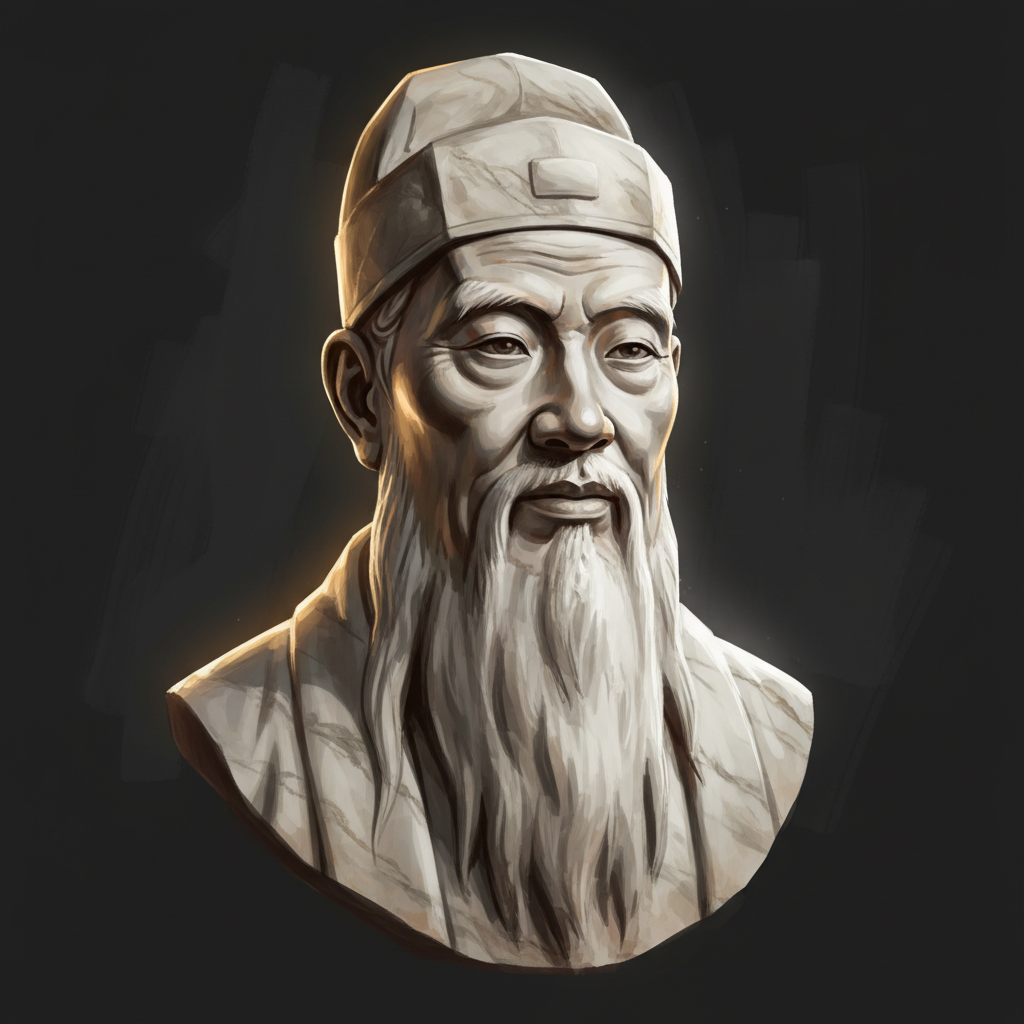
Confucius — "The noble-minded are calm and steady. Little people are forever fussing and fret…"
The noble-minded are calm and steady. Little people are forever fussing and fretting.
The noble-minded are calm and steady. Little people are forever fussing and fretting.
Click any product to generate a realistic preview. Up to 3 at a time.
* Initial load can take up to 90 seconds — revising the preview in another color is nearly instant.
"The superior man is catholic and not partisan. The mean man is partisan and not catholic."
"He who knows all the answers has not been asked all the questions."
"The Master said, 'Hold faithfulness and sincerity as first principles. Have no friends not equal to yourself. When you have faults, do not fear to abandon them.'"
"The Master said, 'The superior man, extensively studying all learning, and keeping himself under the restraint of the rules of propriety, may thus likewise not overstep what is right.'"
"A journey of a thousand miles begins with a single step."
Chinese philosopher and teacher whose teachings (compiled by his students in the Analects) became the foundational ethical framework of East Asian civilization for 2,500 years. Closely associated with Mencius (his most-influential follower a century later). For an intellectual contrast, see Laozi, near-contemporary Chinese sage and Tao Te Ching author — Confucius systematized social order through ritual and family hierarchy; Laozi's Taoist effortless-action philosophy argued such systems were the disease, not the cure. The two founding poles of Chinese moral philosophy — every East Asian moral tradition since has positioned itself between them.
The standard scholarly entry points to Confucius's work: Philip J. Ivanhoe (Georgetown, Chinese philosophy) — Confucian Moral Self Cultivation (2000); Edward Slingerland (UBC, Asian Studies) — Effortless Action: Wu-wei as Conceptual Metaphor (2003); Tu Weiming (Harvard, Confucian scholar) — Confucian Thought: Selfhood as Creative Transformation (1985). These are the works graduate seminars cite when teaching Confucius.
Found in 2 providers: grok,gemini
2 sources checked
People with strong character and inner security move through life with composure. They don't get rattled by every setback or chase every passing worry. Small-minded people, by contrast, are constantly anxious, complaining, comparing themselves to others, and reacting to trivial irritations. The difference isn't wealth or status, it's self-mastery. A settled mind produces steady behavior, while a restless mind produces endless agitation over things that ultimately don't matter.
Confucius built his entire teaching around the junzi, the noble or exemplary person, contrasted with the xiaoren, the petty person. He spent decades traveling between warring states trying to advise rulers, often rejected and impoverished, yet remained composed. His own calm under repeated failure embodied this saying. For him, moral cultivation, ritual discipline, and self-examination were what produced steadiness, while those lacking inner cultivation were slaves to appetite, status anxiety, and resentment.
Confucius lived during the late Spring and Autumn period around 551 to 479 BCE, when the Zhou dynasty's authority was collapsing and rival states waged constant war. Social hierarchies were fracturing, rulers were assassinated, and opportunistic officials schemed for advancement. In that climate of instability, the contrast between the composed gentleman and the anxious schemer wasn't abstract philosophy, it described the actual court figures around him and offered a moral anchor amid political chaos.
AI-generated insights based on extensive research and information for context. Factual errors? Email [email protected].
Your cart is empty