What it means
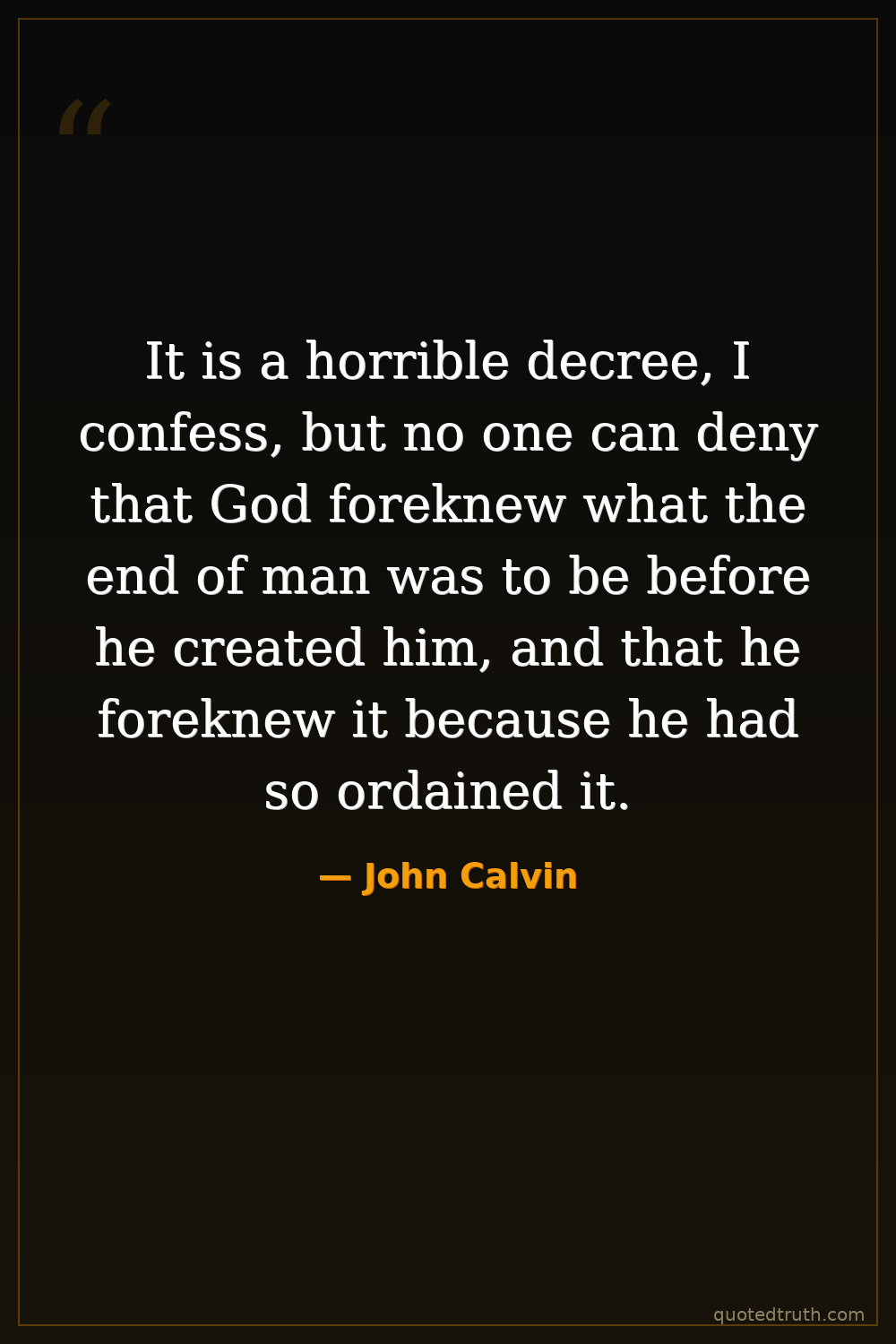
Calvin admits his conclusion is morally unsettling: God determined before creating humanity exactly who would be saved and who damned. He argues this follows necessarily from divine foreknowledge — if God knew the outcome before creation, that knowledge wasn't passive observation but an act of will. Foreknowledge and ordination are inseparable in his framework. He refuses to soften the logic to make it palatable, treating intellectual honesty as the greater theological virtue.
Relevance to John Calvin
Calvin built his Reformed theology on God's absolute sovereignty, with predestination as its most controversial cornerstone. This quote, from the Institutes of the Christian Religion, reflects his characteristic refusal to flinch from hard conclusions. As Geneva's chief pastor and theologian, he governed church and civic life under strict doctrine. His willingness to call the decree 'horrible' yet defend it anyway shows the intellectual rigor that made him Protestantism's most systematic theological architect.
The era
Calvin wrote during the Protestant Reformation's peak in the 16th century, when Europe's religious framework was fracturing. Medieval Catholicism offered salvation through sacraments and penance — human effort mattered. Calvin's predestination doctrine was a radical counter: salvation was entirely God's prerogative, decided before creation. This struck at Catholic soteriology and divided Protestants. The printing press spread these debates rapidly, and Calvin's Geneva became a laboratory for Reformed governance reshaping European religious and political identity.
AI-generated insights based on extensive research and information for context. Factual errors? Email [email protected].